
Lawn Care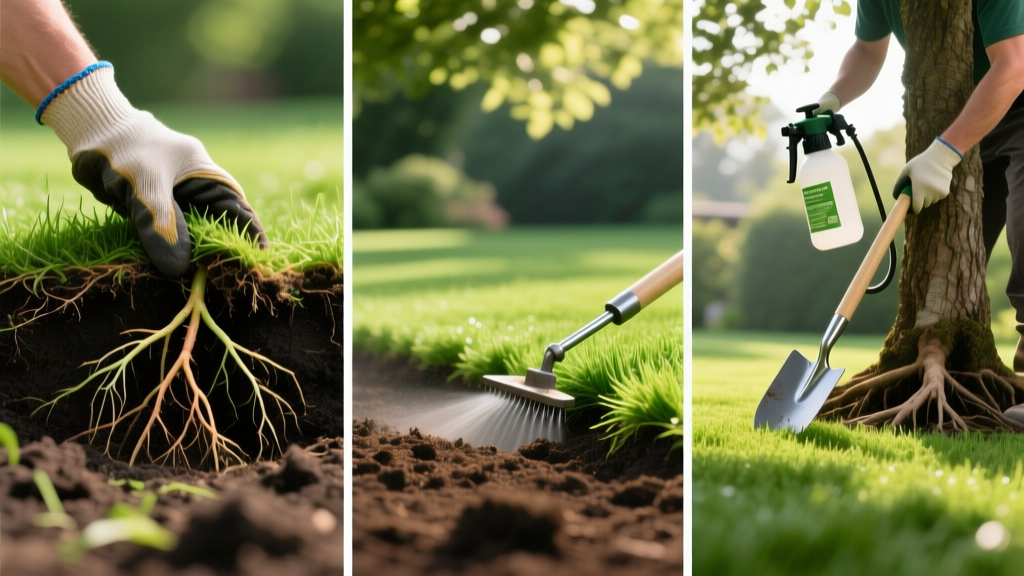
How The Grass Roots Sooner Or Later: Step-by-Step Procedures
The Biological Reality of Turfgrass Establishment
Homeowners often stare at bare dirt after overseeding, wondering if their investment will pay off. The biological reality is that the grass roots sooner or later, but the difference between 'sooner' and 'later' is entirely dictated by your step-by-step maintenance procedures. Germination is merely the seed cracking open; true establishment occurs when the radicle (embryonic root) anchors into the soil profile and begins drawing capillary moisture. If you mismanage soil temperatures, moisture matrices, or nutrient availability during this critical window, you force the turf into a prolonged, vulnerable state where it is highly susceptible to damping-off diseases and drought stress.
This guide details the exact agronomic procedures, product specifications, and environmental thresholds required to accelerate root development for both cool-season and warm-season turfgrasses.
Data Highlight: Root Depth at 30 Days
Tall Fescue (Cool-Season): Reaches 4 to 6 inches of root depth by day 30, provided soil temps remain between 50°F and 65°F.
Kentucky Bluegrass (Cool-Season): Slower initial development; typically achieves only 2 to 3 inches of root depth at day 30 due to its rhizomatous energy allocation.
Bermudagrass (Warm-Season): Aggressive stoloniferous growth allows roots to penetrate 6 to 8 inches by day 30 when soil temps exceed 70°F.
Phase 1: Pre-Planting Soil Architecture (Days -14 to 0)
Roots cannot penetrate compacted soil horizons. Before a single seed touches the dirt, you must physically alter the soil structure to reduce bulk density below 1.4 g/cm³, the threshold where turfgrass root elongation stalls.
- Deep Core Aeration: Use a mechanical drum aerator (rental cost: $85-$110 per day) to pull 3-inch plugs at a density of 20 to 30 holes per square foot. This is non-negotiable for clay-heavy soils.
- Compost Topdressing: Apply a 1/4-inch layer of screened, aged compost. At $45 to $60 per cubic yard, one cubic yard covers approximately 1,000 square feet at this depth. The organic matter acts as a moisture buffer and introduces beneficial mycorrhizal fungi.
- Starter Fertilizer Application: Apply a high-phosphorus starter fertilizer (e.g., 18-24-12 or 24-25-4) at a rate of 1.0 lb of nitrogen per 1,000 square feet. Phosphorus is the primary driver of early root cell division. According to the University of Minnesota Extension, phosphorus deficiency in the first 14 days permanently stunts the root-to-shoot ratio.
Phase 2: The Moisture Matrix (Days 1 to 21)
Once the seed is sown and lightly raked into the top 1/8 inch of soil, the moisture protocol shifts from deep, infrequent watering to shallow, high-frequency misting. The goal is to keep the top 1/2 inch of soil continuously moist without creating anaerobic, waterlogged conditions that invite Pythium blight.
| Establishment Phase | Watering Frequency | Duration per Zone | Target Soil Moisture Depth |
|---|---|---|---|
| Days 1–7 (Germination) | 3 to 4 times daily | 3 to 5 minutes | Top 1/4 inch |
| Days 8–14 (Root Emergence) | 2 times daily | 5 to 8 minutes | Top 1/2 inch |
| Days 15–21 (Radicle Anchor) | 1 time daily | 10 to 15 minutes | Top 1 inch |
| Days 22+ (Establishment) | Every 2nd or 3rd day | 20 to 30 minutes | 2 to 4 inches |
Phase 3: Troubleshooting Stalled Root Growth
Even with perfect seeding, environmental variables can halt root elongation. When the grass roots sooner or later depends heavily on how you manage these specific failure modes during the transition phase.
Failure Mode A: Hydrophobic Soil Repellency
In sandy soils or areas with heavy thatch, water may bead and run off rather than infiltrate. This leaves seeds dry despite active irrigation. The Fix: Apply a liquid soil surfactant or wetting agent (such as Lesco Wetting Agent or Aqueduct) at a rate of 3 to 4 oz per 1,000 square feet. Surfactants reduce the surface tension of water, allowing it to penetrate hydrophobic organic layers. Expect to pay around $35 to $45 per gallon for professional-grade wetting agents.
Failure Mode B: Damping-Off Disease (Pythium/Rhizoctonia)
If seedlings emerge but suddenly turn brown, collapse, and die at the soil line, you are dealing with damping-off. This is exacerbated by excessive moisture and poor air circulation. The Fix: Apply a preventative fungicide containing Azoxystrobin (e.g., Heritage TL or Scotts DiseaseEx). The application rate for Heritage TL is 0.2 to 0.4 oz per 1,000 square feet. While the upfront cost is high (approx. $180 for a 2.5-gallon jug), it covers over 10,000 square feet and saves the entire seeding investment.
'Root establishment is not a passive waiting game. It is an active management of the soil-food web. If you do not feed the roots via targeted phosphorus and manage the oxygen-to-water ratio in the soil pores, the turf will remain in a vegetative holding pattern indefinitely.' — NC State TurfFiles
Product & Cost Matrix for Root Acceleration
Selecting the correct amendments during the first 45 days is critical. Below is a comparison of the most effective root-stimulating products on the market for 2026 lawn maintenance programs.
| Product Name | Active N-P-K / Ingredient | Application Rate | Est. Cost (per 1k sq ft) |
|---|---|---|---|
| Scotts Turf Builder Starter Food | 24-25-4 (High Phosphorus) | 3.3 lbs / 1,000 sq ft | $0.12 |
| Pennington UltraGreen Starter | 22-23-4 + Iron | 3.6 lbs / 1,000 sq ft | $0.14 |
| Tenacity Herbicide | Mesotrione (40%) | 1/3 tsp / 1,000 sq ft | $0.08 |
| Kelp4Less Root Lifter | Kelp Extract / Humic Acid | 1 oz / 1,000 sq ft | $0.25 |
Frequently Asked Questions
Can I mow the lawn before the roots are fully established?
Yes, but you must follow the 'one-third rule' strictly. Wait until the new grass reaches 4.5 inches tall, then set your mower deck to cut it down to exactly 3.0 inches. Mowing actually stimulates lateral root branching by redirecting auxin hormones from vertical shoot growth to the root zone. Use a sharp rotary blade to avoid tearing the fragile, unanchored seedlings out of the soil.
Does tenacity herbicide hurt new grass roots?
No. Mesotrione (the active ingredient in Tenacity) is one of the few pre-emergent and post-emergent herbicides safe for use at the time of seeding for cool-season grasses like Tall Fescue and Kentucky Bluegrass. It inhibits photosynthesis in competing weeds (turning them white) without disrupting the root cell division of your newly planted turf. Apply it at 0.33 oz per acre (roughly 1/3 teaspoon per 1,000 sq ft) mixed with a non-ionic surfactant.
How do I know if the grass has rooted enough for heavy foot traffic?
Perform the 'tug test.' Grab a small tuft of the new grass between your thumb and forefinger and pull upward with moderate force. If the grass breaks or pulls out effortlessly with only a tiny white nub attached, the roots are not established. If you feel firm resistance and the soil slightly lifts before the grass yields, the radicle has successfully anchored into the subsoil, typically occurring around day 45 for cool-season varieties.

