
Lawn Care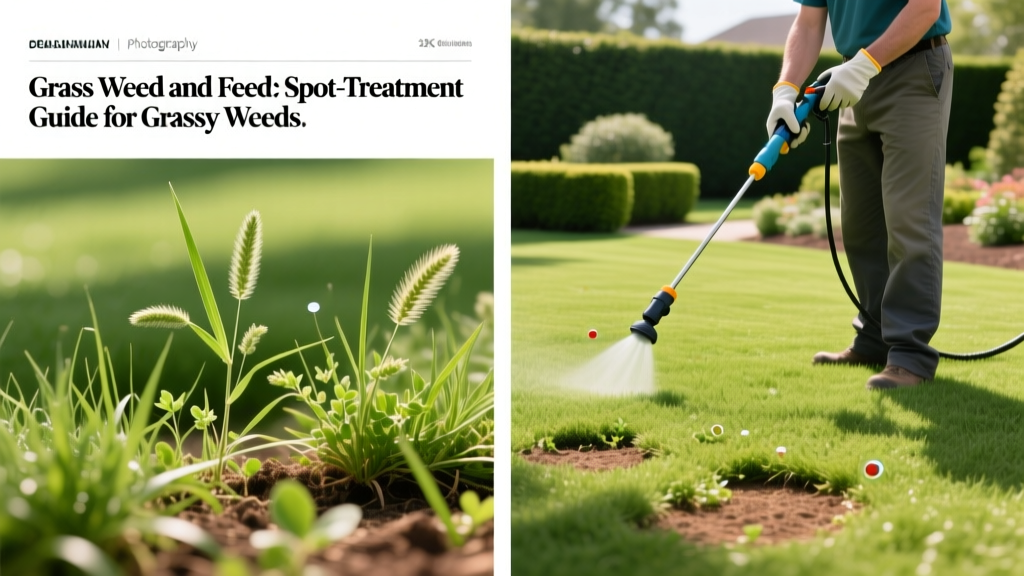
Grass Weed and Feed: Spot-Treatment Guide for Grassy Weeds
The Challenge of Grassy Weeds in Turf Management
Grassy weeds are the ultimate imposters in lawn care. Unlike broadleaf weeds (dicots) which respond predictably to synthetic auxin herbicides like 2,4-D, grassy weeds (monocots) share the same fundamental biology as your desirable turf. This biological similarity means that a standard broadcast 'weed and feed' designed for dandelions and clover will do absolutely nothing to stop crabgrass, dallisgrass, or goosegrass. Worse, using non-selective herbicides to spot-treat these invaders will kill your desirable grass in the process.
To successfully execute a grass weed and feed spot-treatment strategy, you must abandon generic big-box granular combinations and pivot to targeted liquid post-emergent herbicides paired with specific nutritional supplements. As of 2026, the professional turf industry relies on highly specific active ingredients—such as Quinclorac, Fenoxaprop-p-ethyl, and Fluazifop—to selectively eradicate grassy weeds without harming the surrounding lawn. According to the NC State TurfFiles Weed Identification database, accurate species identification is the mandatory first step, as applying the wrong chemistry can result in severe turf phytotoxicity or complete treatment failure.
Biology and Behavior: Why Spot-Treatment Works
Grassy weeds typically germinate in distinct flushes and spread via localized stolons, rhizomes, or aggressive seed drops. Broadcast applying a liquid grassy weed herbicide across an entire 5,000-square-foot lawn is not only economically inefficient (costing upwards of $150 in chemical costs alone), but it also unnecessarily stresses the desirable turf. Spot-treating confines the chemical load strictly to the affected zones, allowing you to use higher-precision surfactants and strictly calibrated mix rates.
Critical Turf Safety Warning
Not all desirable grasses tolerate grassy weed herbicides. While Tall Fescue, Kentucky Bluegrass, and Bermudagrass are highly tolerant to Quinclorac, St. Augustinegrass and Centipedegrass are highly sensitive. Applying Quinclorac or standard 2,4-D based weed and feeds to these warm-season grasses will cause severe stunting, chlorosis (yellowing), and potentially fatal necrosis. Always cross-reference your turf species with the herbicide label before mixing.
Top 3 Grassy Weed Species & Spot-Treatment Protocols
1. Crabgrass (Digitaria sanguinalis)
Crabgrass is an annual invader that thrives in compacted, hot soil. For post-emergent spot-treatments, Quinclorac is the undisputed industry standard. However, efficacy is strictly tied to the weed's growth stage. Quinclorac performs exceptionally well on crabgrass in the 1- to 3-leaf stage. Once the plant reaches the tillering stage (4+ leaves), a single application will only stunt it.
- Active Ingredient: Quinclorac (e.g., Drive XLR8 or generic equivalents).
- Mix Rate: 0.75 fluid ounces per 1,000 square feet.
- Surfactant Requirement: Methylated Seed Oil (MSO) at 0.5% v/v (approx. 1.5 tablespoons per gallon of water). Do not use standard non-ionic surfactants (NIS); they reduce Quinclorac efficacy by up to 60%.
- Protocol: Apply to the point of runoff. If the crabgrass is mature, apply a second spot-treatment exactly 14 days later.
2. Dallisgrass (Paspalum dilatatum)
Dallisgrass is a deep-rooted perennial that forms dense, unsightly clumps. It is notoriously resistant to Quinclorac. Historically, MSMA was the go-to treatment, but the EPA has heavily restricted its use on residential lawns. For modern spot-treatments, Fluazifop (sold as Ornamec Over-The-Top) is the most effective selective option for Fescue and Zoysia lawns.
- Active Ingredient: Fluazifop-p-butyl.
- Mix Rate: 0.5 to 0.75 fluid ounces per 1,000 square feet.
- Surfactant Requirement: Non-ionic surfactant (NIS) at 0.25% v/v.
- Protocol: Dallisgrass requires patience. Apply the first treatment, wait 10-14 days for the initial yellowing, and apply a second treatment to catch any regrowth from the deep rhizome network.
3. Goosegrass (Eleusine indica)
Often confused with crabgrass, goosegrass features a distinct silvery seedhead and a white, flattened stem base. It germinates later in the summer and tolerates heavy foot traffic. Fenoxaprop-p-ethyl (Acclaim Extra) is the premier spot-treatment chemistry for goosegrass in cool-season lawns and Zoysia.
- Active Ingredient: Fenoxaprop-p-ethyl.
- Mix Rate: 0.3 to 0.4 fluid ounces per 1,000 square feet.
- Surfactant Requirement: Generally formulated with an emulsifier, but adding a crop oil concentrate (COC) at 1% v/v improves penetration on mature plants.
- Protocol: Apply when goosegrass is young and actively growing. Avoid applying if daytime temperatures exceed 85°F, as Fenoxaprop can cause temporary phytotoxicity to desirable turf under heat stress.
Liquid Spot-Treatment vs. Granular Broadcast: Data Comparison
Many homeowners default to granular 'weed and feed' bags because they are easy to apply with a rotary spreader. However, granular formulations are fundamentally flawed for grassy weed eradication. The herbicide granules must stick to the wet leaves of the weed to be absorbed; if they bounce off and hit the soil, the post-emergent chemical is wasted. The University of Minnesota Extension consistently recommends liquid applications for targeted weed control due to superior foliar absorption.
| Metric | Liquid Spot-Treatment | Granular Broadcast (Weed & Feed) |
|---|---|---|
| Herbicide Efficacy on Grassy Weeds | High (Direct foliar contact) | Very Low (Poor leaf adhesion) |
| Cost per 1,000 sq. ft. | $1.20 - $3.10 (Chemical only) | $6.00 - $9.00 (Fertilizer + Chem) |
| Turf Stress Factor | Low (Targeted application) | Moderate (Systemic chemical load) |
| Surfactant Integration | Customizable (MSO, NIS, COC) | None (Relies on morning dew) |
| Nutritional Benefit | Requires separate liquid fert | Included (Typically 20-0-5 NPK) |
Step-by-Step Spot-Treatment Application Framework
To achieve professional-grade results, follow this exact calibration and application sequence. This framework assumes you are using a standard 1-gallon or 2-gallon pump sprayer for localized patches.
- Map and Mark: Flag the perimeters of the grassy weed patches. Grassy weeds often grow in localized rings or along driveway edges where soil compaction is highest.
- Calibrate the Sprayer: Spray plain water over a 100-square-foot concrete area to determine how many fluid ounces your sprayer outputs to cover that space. This prevents over-application, which is the leading cause of turf burn.
- Mix the Solution: Fill the sprayer halfway with water. Add the precise volume of herbicide (e.g., 0.75 oz of Quinclorac). Add the required surfactant (MSO). Fill the rest with water and agitate vigorously. Never mix herbicides directly into a dry tank.
- Apply to Point of Runoff: Spray the weed patches until the leaves are glistening and just about to drip. Do not soak the soil; post-emergent grassy weed herbicides are absorbed through the foliage, not the roots.
- Implement the 48-Hour Rule: Do not mow, water, or apply liquid fertilizers for 48 hours post-application. The herbicide needs this window to translocate down into the weed's root and stolon network.
Common Spot-Treatment Failure Modes & Edge Cases
Even with the correct chemistry, environmental and mechanical variables can derail a grass weed and feed spot-treatment. Recognizing these edge cases will save you time and money.
- Heat Stress Phytotoxicity: Applying Quinclorac or Fenoxaprop when ambient temperatures exceed 85°F (29°C) causes the desirable turf's stomata to close, trapping the herbicide on the leaf surface and causing severe yellowing or necrosis. Fix: Only spray in the early morning or late evening when temperatures are below 80°F.
- Surfactant Omission: Grassy weeds have thick, waxy cuticles designed to repel water. Spraying Quinclorac without an MSO surfactant results in the liquid beading up and rolling off the leaf. Fix: Always use MSO for Quinclorac; NIS is insufficient for waxy grassy weeds.
- Mowing Too Soon: Mowing 12 hours after application physically removes the treated leaf tissue before the chemical has translocated to the crown. Fix: Mow 2 days before application, and wait 2 days after.
- The 'Pre-Emergent Gap': Spot-treating post-emergent crabgrass in July does nothing to stop the seeds it already dropped. Fix: You must follow up late-summer spot treatments with a fall application of a pre-emergent like Prodiamine to break the reproductive cycle.
Frequently Asked Questions
Can I mix a liquid grassy weed herbicide with a liquid fertilizer?
Technically, yes, but it is highly discouraged for spot-treatments. Liquid fertilizers (especially those high in nitrogen or containing iron) alter the pH of the tank mix and can bind with the active ingredients in herbicides like Quinclorac, rendering them ineffective. Apply your grass weed herbicide first, wait 48 hours, and then apply your liquid or granular feed.
Why did my Tall Fescue turn yellow after spot-treating for crabgrass?
Temporary chlorosis (yellowing) in Tall Fescue and Bermudagrass is a known, documented side effect of Quinclorac application, especially if the mix rate exceeded 0.75 oz per 1,000 sq ft or if applied during high heat. According to EPA Lawn Care Pesticides Guidelines, this phytotoxicity is usually cosmetic. The turf will typically recover and green up within 10 to 14 days as the plant metabolizes the chemical.
Is there a single 'grass weed and feed' product that kills all grassy weeds?
No. The biological differences between annual crabgrass and perennial dallisgrass require entirely different modes of action. Quinclorac excels at crabgrass but fails on dallisgrass. Fluazifop targets dallisgrass but can severely injure Bermudagrass. Professional lawn care requires a targeted, multi-chemical approach based on exact species identification rather than relying on a single 'catch-all' product.

