
Lawn Care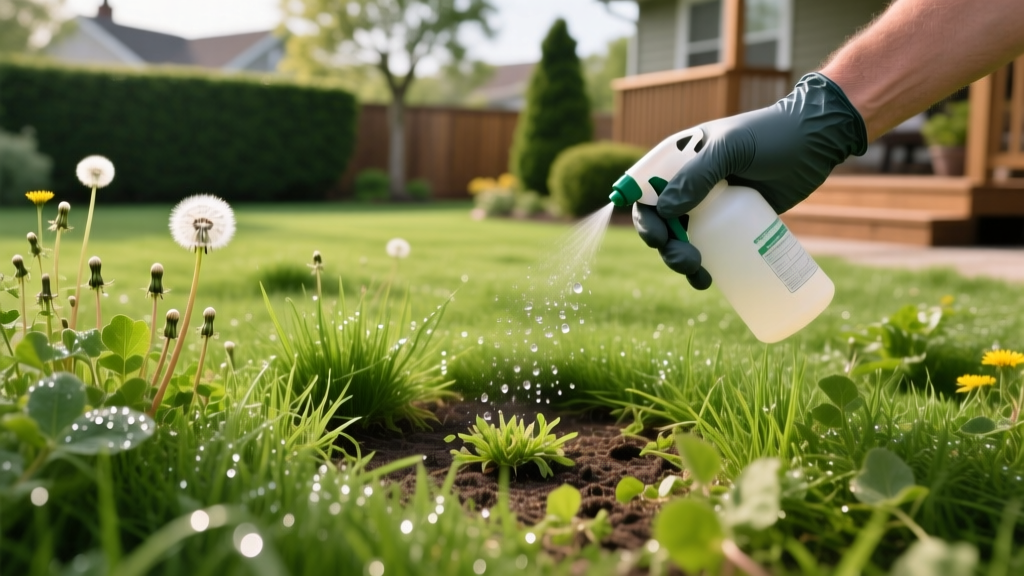
Spot-Treatment Guide for Grass Weeds in Lawn Turf
The Biological Challenge of Grass Weeds in Lawn Turf
Treating broadleaf weeds like dandelions or clover is relatively straightforward because their physiological makeup (dicots) differs vastly from your desirable turfgrass (monocots). However, when you are battling grass weeds in lawn environments, you are fighting a biological mirror image. Species like crabgrass, dallisgrass, and annual bluegrass share the same monocot cellular structures, photosynthetic pathways, and root systems as your fescue, bermuda, or zoysia turf. This biological similarity means that many standard selective herbicides will either fail to kill the weed or will severely injure your desirable lawn in the process.
Successful eradication requires precise identification, strict adherence to soil-temperature timing, and the use of highly specific active ingredients. According to the Penn State Extension, misidentifying grassy weeds and applying the wrong post-emergent chemical is the leading cause of turf burn and wasted herbicide among residential lawn care programs. This guide provides exact, field-tested spot-treatment protocols for the three most destructive grass weeds in lawn turf for the 2026 season.
Visual Identification Matrix: The Three Most Destructive Species
Before mixing any chemicals, you must accurately identify the invader. Applying a crabgrass-specific herbicide to dallisgrass will yield zero results. Use the morphological matrix below to confirm your weed species.
| Weed Species | Leaf Blade & Color | Ligule & Collar | Growth Habit & Seedhead |
|---|---|---|---|
| Crabgrass (Digitaria) | Wide (1/4"+), pale green, slightly hairy on both surfaces. | Tall, membranous, jagged ligule; wide, pale collar. | Prostrate, star-like clumps. Seedheads resemble 3-5 fingers. |
| Dallisgrass (Paspalum dilatatum) | Coarse, dark green, folded in the bud, prominent midrib. | Fringe of hairs (membranous ligule with hairy margin). | Upright clumps, deep root system. Seedheads have 3-5 alternating spikes with black smut fungus. |
| Annual Bluegrass (Poa annua) | Narrow, light green, boat-shaped tip, folded in bud. | Long, membranous, whitish ligule; no auricles. | Bunch-type, shallow roots. Produces white, feathery panicles year-round. |
For further visual confirmation and regional lifecycle data, the UC Statewide IPM Program maintains an excellent photographic database of turfgrass weeds that can help you confirm your diagnosis before treatment.
Targeted Chemical Protocols: Active Ingredients and Exact Mix Rates
Once identified, select the correct active ingredient. The retail pricing below reflects average 2026 market rates for professional-grade concentrates, which are vastly more cost-effective and potent than big-box store ready-to-spray alternatives.
1. Crabgrass Post-Emergent Protocol
Active Ingredient: Quinclorac (Brand equivalent: Drive XLR8)
Target: Smooth and Large Crabgrass
Mix Rate: 0.75 fluid ounces per 1,000 square feet.
Surfactant Requirement: Quinclorac requires a Methylated Seed Oil (MSO) to penetrate the waxy cuticle of mature crabgrass. Add 1 teaspoon of MSO per gallon of mixed solution.
Cost: Approximately $65 for a 12 oz bottle (treats up to 16,000 sq ft).
Restriction: Do not apply to St. Augustinegrass or Centipedegrass, as severe chlorosis (yellowing) and stunting will occur.
2. Dallisgrass Post-Emergent Protocol
Active Ingredient: Fluazifop-p-butyl (Brand equivalent: Fusilade II)
Target: Dallisgrass and other perennial grassy weeds.
Mix Rate: 0.5 fluid ounces per 1,000 square feet.
Surfactant Requirement: Non-ionic surfactant (NIS) at 0.25% v/v (approx. 1/2 tsp per gallon).
Cost: Approximately $110 for an 8 oz bottle.
Restriction: CRITICAL: Fluazifop is strictly for use in Tall Fescue and Zoysiagrass lawns. It will completely kill Bermudagrass and Centipedegrass. If you have a warm-season lawn (other than Zoysia), spot-treating dallisgrass requires careful, manual glyphosate wicking or physical removal, as selective residential options like MSMA are no longer EPA-approved for home use.
3. Annual Bluegrass (Poa Annua) Protocol
Active Ingredient: Ethofumesate (Brand equivalent: Prograss)
Target: Poa annua (Best applied as a late-fall pre-emergent or early post-emergent when the weed is in the 1-2 leaf stage).
Mix Rate: 1.5 to 2.0 fluid ounces per 1,000 square feet.
Cost: Approximately $180 per gallon.
Note: Mature Poa annua is highly resistant to post-emergent chemicals. If the plant has already developed seedheads, chemical control is largely ineffective. Focus on pre-emergent defense instead.
⚠️ Critical Warning: The Non-Selective Trap
Many homeowners, frustrated by the survival of grass weeds in lawn turf, resort to non-selective herbicides like Glyphosate (Roundup). Glyphosate does not differentiate between monocots; it will systematically kill your desirable turf alongside the weed, leaving dead, brown patches that require costly sod replacement or reseeding. Reserve non-selective herbicides exclusively for painted-wick applications on isolated dallisgrass clumps in warm-season lawns.
Many homeowners, frustrated by the survival of grass weeds in lawn turf, resort to non-selective herbicides like Glyphosate (Roundup). Glyphosate does not differentiate between monocots; it will systematically kill your desirable turf alongside the weed, leaving dead, brown patches that require costly sod replacement or reseeding. Reserve non-selective herbicides exclusively for painted-wick applications on isolated dallisgrass clumps in warm-season lawns.
Step-by-Step Spot-Spraying Execution
Proper application technique is just as critical as the chemical selection. Broadcast spraying grassy weed herbicides over the entire lawn is a waste of product and increases the risk of turf stress. Follow this precision spot-treatment framework:
- Equipment Calibration: Use a 1-gallon or 2-gallon pump sprayer equipped with a flat-fan nozzle (such as the TeeJet XR11002VS). This nozzle provides a uniform spray pattern that minimizes drift compared to cone nozzles.
- Pressure Control: Pump the sprayer to 20-30 PSI. Higher pressures atomize the droplets too finely, causing them to drift onto desirable turf and volatilize into the air.
- Mixing Order: Fill the tank halfway with water, add the surfactant, then add the herbicide concentrate. Agitate gently, then fill the remaining water. This prevents the chemical from foaming or binding to the tank walls.
- Application Technique: Hold the wand 12 to 18 inches above the target weed. Apply a single, even pass until the leaves are lightly glistening. Do not spray to the point of runoff. Dripping herbicide into the soil reduces foliar absorption and wastes the product.
- Mowing Restrictions: Do not mow the lawn for 48 hours before application (to ensure maximum leaf surface area) and wait at least 48 hours after application to allow the chemical to translocate down to the root system.
Post-Treatment Recovery and Pre-Emergent Defense
Killing existing grass weeds in lawn turf is only half the battle. The bare soil left behind after a crabgrass or dallisgrass plant dies is an immediate invitation for new weed seeds to germinate. Within 7 days of the weed turning brown, rake out the dead debris and overseed the bare spot with a turf-type tall fescue or matching warm-season cultivar. Apply a starter fertilizer (e.g., 18-24-12) at a rate of 4 lbs per 1,000 sq ft to accelerate canopy closure.
To prevent future invasions, establish a strict pre-emergent barrier. Prodiamine 65 WDG (Brand equivalent: Barricade) is the industry standard for preventing crabgrass and Poa annua germination. Apply at a rate of 0.115 oz per 1,000 sq ft (costing roughly $40 for a 5 oz bottle) when soil temperatures at a 2-inch depth consistently reach 55°F for three consecutive days in the spring. As noted by Purdue University's Turfgrass Science program, splitting your pre-emergent application into two half-doses—one in early spring and one in late summer—provides a much more resilient chemical barrier against late-germinating grassy weeds than a single heavy application.
By combining precise morphological identification, targeted active ingredients, and strict pre-emergent timing, you can systematically eliminate grass weeds in lawn turf without sacrificing the health and density of your desirable grass.

