
Lawn Care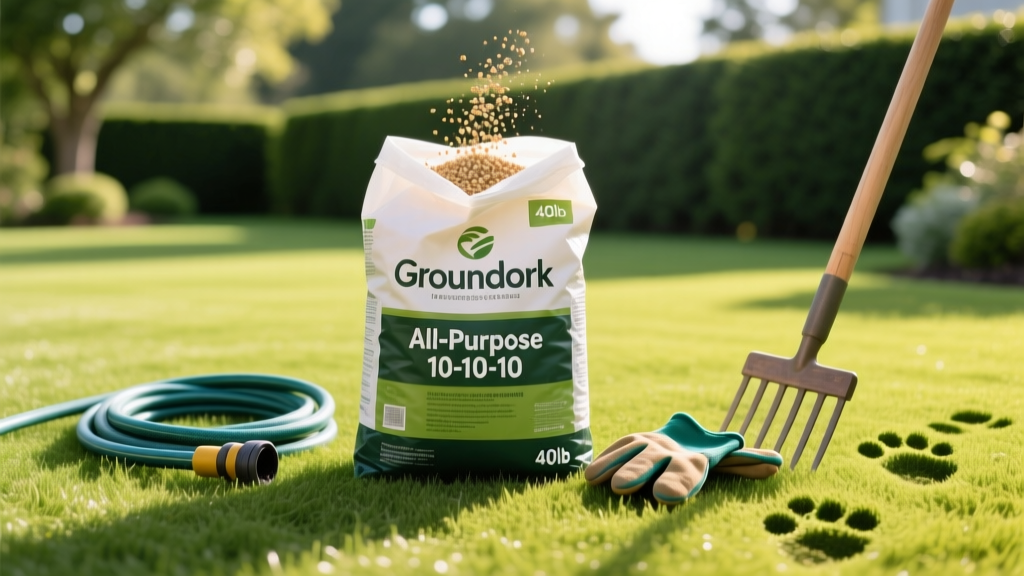
Groundwork All-Purpose 10-10-10 Fertilizer 40lb Bag: Coverage & Cost
The Reality of Groundwork 10-10-10: Coverage vs. Weight
When homeowners pick up a 40lb bag of Groundwork All-Purpose 10-10-10 fertilizer from a farm or rural supply store, the most common mistake is assuming the heavy bag will cover a massive area. Unlike premium, high-nitrogen lawn fertilizers (such as 32-0-4 formulations) where a 15lb bag can cover 5,000 square feet, a balanced 10-10-10 granular product relies heavily on inert filler materials like sand, limestone, or clay to carry the nutrients.
The Golden Rule of Fertilizer Math: Turfgrass generally requires 1 pound of actual Nitrogen (N) per 1,000 square feet per application. A 40lb bag of 10-10-10 contains exactly 10% Nitrogen by weight. Therefore, 40 lbs × 0.10 = 4 lbs of actual Nitrogen. This means one 40lb bag covers exactly 4,000 square feet at the standard turf application rate.
Because Groundwork is an economy-tier, all-purpose agricultural and garden fertilizer, it does not feature the advanced polymer coatings or slow-release nitrogen technology found in specialized turf products. The nutrients are highly water-soluble, meaning they will green up your lawn rapidly within 5 to 7 days, but the feeding window is short (typically 3 to 4 weeks).
True Cost Analysis: Groundwork vs. Premium Turf Brands (2026 Pricing)
Is Groundwork actually a budget option? While the upfront sticker price of a 40lb bag is attractive, the cost-per-square-foot tells a different story for established lawns. Below is a breakdown comparing the Groundwork 40lb bag against standard specialty lawn fertilizers based on early 2026 retail averages.
| Product | Bag Size | Coverage | Avg. Price | Cost per 1,000 sq ft |
|---|---|---|---|---|
| Groundwork 10-10-10 | 40 lbs | 4,000 sq ft | $28.99 | $7.25 |
| Scotts Turf Builder (32-0-4) | 14 lbs | 5,000 sq ft | $34.99 | $7.00 |
| Milorganite (6-4-0) | 36 lbs | 2,500 sq ft | $22.99 | $9.20 |
The Verdict: Groundwork 10-10-10 is not inherently cheaper per square foot than premium synthetic turf builders. Its primary financial advantage is the low barrier to entry (a ~$29 checkout price) and its dual-utility for homeowners who need to fertilize a vegetable garden, flower beds, and a small lawn with a single product.
Spreader Calibration: The Missing Groundwork Manual
Economy agricultural brands like Groundwork rarely print specific spreader settings for modern residential drop or rotary spreaders (like the Scotts EdgeGuard or Lesco models) on their packaging. Applying 10-10-10 by 'guessing' the dial setting is the leading cause of fertilizer burn, as the high salt index of basic granular synthetics will scorch turf if overlapped.
Step-by-Step Calibration Method
Instead of relying on generic charts, use this 10-minute calibration process to guarantee you are applying exactly 10 lbs of product per 1,000 square feet (which delivers the required 1 lb of Nitrogen):
- Measure a Test Area: Mark off a 200-square-foot section of your driveway or a sparse area of the lawn (e.g., 10 feet by 20 feet).
- Weigh the Product: Place a bucket on a digital scale and weigh out exactly 2.0 lbs of Groundwork 10-10-10.
- Set the Spreader: Open your rotary spreader to a medium setting (usually around 5 or 6 on a 1-10 dial).
- Run the Test: Walk at your normal, steady mowing pace (approx. 3 mph) and spread the 2 lbs over the 200 sq ft area.
- Evaluate: If you run out of product before finishing the area, open the dial one notch. If you have product left over, close the dial one notch. Repeat until the 2 lbs perfectly covers the 200 sq ft.
Warning on Overlap: Because Groundwork 10-10-10 uses a standard prill size (typically 2.0 to 2.5 mm), it throws slightly shorter than premium coated urea. When using a rotary spreader, maintain a strict 30% overlap pattern on your return passes to avoid visible striping.
The Phosphorus Problem: When to Avoid 10-10-10
The most critical factor in deciding whether to use Groundwork 10-10-10 on your lawn is your soil's existing Phosphorus (P) level. The middle number in 10-10-10 indicates 10% Phosphorus (as P2O5). Applying this to an established lawn that already has adequate phosphorus is not just a waste of money; it is an environmental hazard.
According to the EPA guidelines on lawn and garden care, excess phosphorus does not leach deeply into the soil. Instead, it binds to soil particles and is eventually carried away via surface runoff into storm drains, rivers, and lakes. Once in waterways, phosphorus acts as a catalyst for toxic algae blooms, which deplete oxygen and kill aquatic life. Many municipalities and states (such as New York, Minnesota, and parts of Florida) have strictly banned or limited the sale of phosphorus-containing lawn fertilizers unless a certified soil test proves a deficiency.
Ideal Use Cases for Groundwork 10-10-10
- New Lawn Establishment: When seeding or laying sod, the root zone requires immediate phosphorus to stimulate root growth. 10-10-10 is excellent for tilling into the top 2 inches of soil before planting.
- Vegetable Gardens & Annual Beds: Heavy-feeding crops like tomatoes, corn, and peppers thrive on the balanced NPK profile of Groundwork.
- Severely Depleted Soils: If a professional soil test from the Penn State Extension Turfgrass Program or your local university extension confirms low P and low K levels.
When to Choose a Different Product
- Established Lawns (Years 2+): Mature turfgrasses require high nitrogen and almost zero phosphorus. Switch to a 24-0-6 or 32-0-4 formulation.
- Properties Near Waterways: If your lawn borders a pond, stream, or storm drain, avoid 10-10-10 entirely to prevent contributing to eutrophication.
- Late Fall Winterization: The high soluble nitrogen in Groundwork will push tender top growth right before frost, increasing the risk of snow mold. Use a specialized winterizer instead.
Storage, Shelf Life, and Clumping Prevention
A 40lb bag of Groundwork is often more than a small urban lawn needs for a single application, meaning you will likely store the remainder. Basic 10-10-10 granular fertilizers are highly hygroscopic—meaning they aggressively pull moisture from the air. If left in an unsealed paper bag in a humid garage, the prills will fuse into a solid, concrete-like block within 60 days.
Pro-Storage Protocol: Immediately after opening, transfer the remaining Groundwork fertilizer into a 5-gallon food-grade plastic bucket with a gamma-seal screw-top lid. Place a 4-ounce silica gel desiccant packet inside the bucket before sealing. Stored this way in a climate-controlled shed or garage, the granular integrity of the 10-10-10 will remain perfectly intact for up to 5 years, with no loss of NPK potency.
Frequently Asked Questions
Can I use Groundwork 10-10-10 on my vegetable garden?
Yes. In fact, this is the optimal use case for the product. Apply 2 to 3 pounds per 100 square feet of garden bed space, tilling it into the top 4 inches of soil two weeks before planting your spring crops.
Will this fertilizer burn my grass if it doesn't rain?
Yes. Because Groundwork utilizes fast-release synthetic salts (ammonium sulfate and diammonium phosphate typically), it requires immediate watering. Apply 0.25 inches of irrigation immediately after spreading to wash the granules off the grass blades and into the soil profile. Leaving it on dry foliage for more than 24 hours will result in severe tip-burn.
Is Groundwork safe for pets after application?
Keep dogs and cats off the treated lawn until the fertilizer has been watered in and the grass blades are completely dry. While 10-10-10 is not highly toxic once diluted in the soil, ingestion of the raw, concentrated granules directly from the spreader hopper or lawn surface can cause severe gastrointestinal distress and oral burns in pets.

