
Lawn Care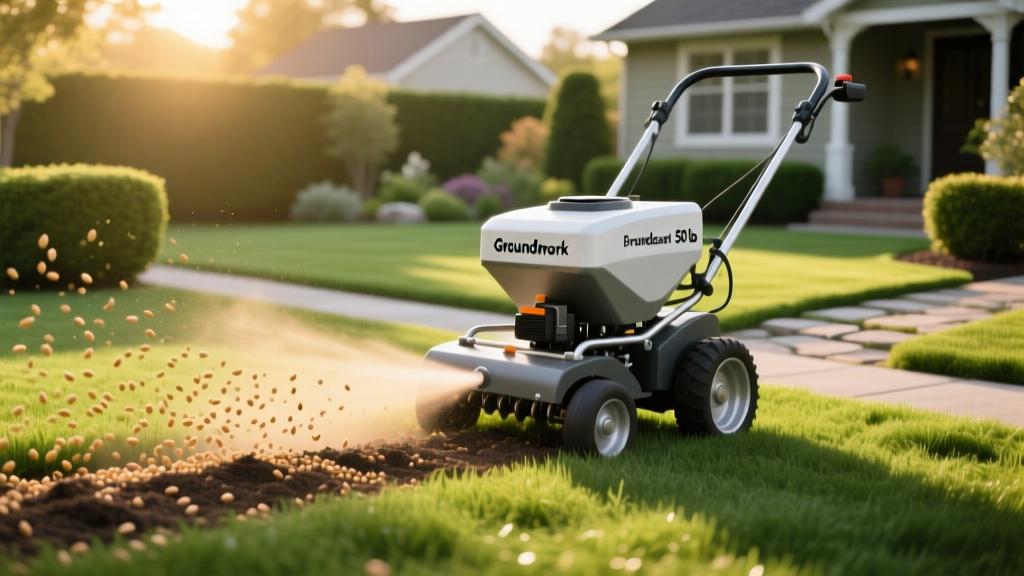
Groundwork 50 lb. Push Broadcast Spreader: Coverage, Dosage & Costs
The Groundwork 50 lb. Push Broadcast Spreader at a Glance
For homeowners managing mid-sized lawns between 5,000 and 15,000 square feet, the Groundwork 50 lb. push broadcast spreader occupies a highly specific niche in the 2026 lawn care market. Unlike entry-level plastic drop spreaders that struggle with wind drift and narrow swaths, or commercial-grade stainless steel units that exceed $400, this Groundwork model offers a powder-coated steel hopper, a tubular steel frame, and 10-inch pneumatic tires. These pneumatic tires are a critical upgrade over hard plastic wheels, providing the traction necessary to turn the internal rotary agitator consistently without slipping on damp morning grass or sloped terrain.
Expert Insight: The primary advantage of a broadcast spreader over a drop spreader is the lateral throw. The Groundwork 50 lb. model casts material up to 12 feet laterally, meaning a standard pass covers a 10-to-12-foot swath. This reduces overlap errors and cuts application time by roughly 40% compared to a standard 22-inch drop spreader.
Quick Specs & Limitations
- Hopper Capacity: 50 lbs (holds roughly one standard bag of fertilizer or half a bulk bag of seed).
- Frame: Powder-coated tubular steel (prone to surface rust if stored wet).
- Tires: 10-inch pneumatic (requires occasional air top-offs to maintain consistent gear ratios).
- Agitator: Wire rotor (effective for prills, but struggles with powdery lime).
True Cost of Ownership: 2026 Pricing & Value Breakdown
Evaluating the Groundwork 50 lb. push broadcast spreader requires looking past the initial retail price. In 2026, this unit typically retails between $119.99 and $129.99 at major agricultural and home improvement retailers. To determine its true value, we must compare the cost-per-application against professional lawn care services and cheaper plastic alternatives.
| Metric | Groundwork 50 lb. Spreader | Entry-Level Plastic Spreader | Professional Service (Per App) |
|---|---|---|---|
| Upfront Equipment Cost | $125.00 | $75.00 | $0.00 |
| Annual Maintenance | $12.00 (Lubricant/Paint) | $0.00 | N/A |
| Cost Per 10,000 sq ft App. | $35.00 (Material only) | $35.00 (Material only) | $85.00 (Labor + Material) |
| Estimated Lifespan | 7-10 Years | 2-4 Years | N/A |
According to University of Minnesota Extension, a well-maintained lawn requires 3 to 4 fertilizer applications annually. By utilizing the Groundwork spreader for DIY applications, a homeowner with a 10,000 square foot lawn will achieve break-even against a professional service ($85 per application) in just under two seasons, factoring in the $125 upfront equipment cost.
Coverage Mathematics: What 50 lbs. Actually Covers
The '50 lb.' designation refers strictly to weight capacity, not volume or area. Coverage depends entirely on the bulk density of the material and the application rate dictated by the product label. Below is the exact coverage math for the three most common lawn care materials loaded into this specific hopper.
Granular Fertilizer (e.g., 32-0-4)
Standard Rate: 3.5 lbs per 1,000 sq ft.
Total Coverage: 14,285 sq ft per 50 lb bag.
Refills Needed for 1 Acre: 3 bags.
Tall Fescue Seed
Standard Rate: 6.0 lbs per 1,000 sq ft.
Total Coverage: 8,333 sq ft per 50 lb bag.
Refills Needed for 1 Acre: 5.5 bags.
Pelletized Lime
Standard Rate: 40.0 lbs per 1,000 sq ft.
Total Coverage: 1,250 sq ft per 50 lb bag.
Refills Needed for 1 Acre: 35 bags.
Calibration & Dial Settings for Major Brands
The most common point of failure for DIY lawn care is incorrect dial settings, leading to fertilizer burn or ineffective weed control. The Groundwork 50 lb. push broadcast spreader utilizes a 1-through-10 rotary dial connected to a metal baffle plate. Because manufacturer settings are rarely printed for generic or store-brand spreaders, you must map the product's recommended 'standard broadcast' setting to the Groundwork dial.
| Product Type | Application Rate | Groundwork Dial Setting | Walking Speed |
|---|---|---|---|
| Milorganite (Organic Nitrogen) | 36 lbs / 2,500 sq ft | 7.0 | Normal (3 mph) |
| Scotts Turf Builder (Synthetic) | 3.5 lbs / 1,000 sq ft | 5.5 | Normal (3 mph) |
| Lesco Pre-Emergent (Prodiamine) | 2.8 lbs / 1,000 sq ft | 4.5 | Normal (3 mph) |
| Tall Fescue Grass Seed | 6.0 lbs / 1,000 sq ft | 8.0 | Fast (4 mph) |
| Pelletized Lime | 40.0 lbs / 1,000 sq ft | 10.0 (Max) | Slow (2 mph) |
Step-by-Step Calibration Protocol (The 100 Sq. Ft. Test)
Relying solely on printed dial settings is a risk, as tire pressure and walking speed drastically alter output. UMass Amherst Extension strongly recommends the 100 square foot calibration test before applying any chemical to your turf. Follow this exact protocol for the Groundwork model:
- Measure the Test Zone: Mark off a 10 ft x 10 ft area (100 sq ft) on your driveway or a tarp. Never calibrate directly on grass where you cannot recover the material.
- Calculate the Test Weight: Divide the product's 1,000 sq ft application rate by 10. For example, if applying 3.5 lbs per 1,000 sq ft, you need exactly 0.35 lbs (5.6 ounces) for the 100 sq ft test area.
- Weigh and Load: Use a digital kitchen scale to weigh out 5.6 ounces of the product. Pour it into the Groundwork hopper.
- Set the Dial: Adjust the baffle lever to the estimated setting (e.g., 5.5).
- Execute the Pass: Push the spreader over the 10x10 area at your normal walking pace. Engage the lever exactly as you would on the lawn.
- Capture and Weigh: Sweep up all the material that fell onto the tarp and weigh it. If you have 5.6 ounces remaining, the setting is perfect. If you have less, your setting is too high (close the dial by 0.5). If you have more, open the dial by 0.5 and repeat.
Warning: The Pneumatic Tire Variable
The Groundwork spreader relies on tire friction to turn the internal gear. If your 10-inch pneumatic tires are under-inflated (below 20 PSI), the effective tire diameter shrinks. This causes the wheels to turn more times per linear foot, over-spinning the agitator and dumping up to 25% more material than the dial indicates. Always check tire pressure with a gauge before calibrating.
The Groundwork spreader relies on tire friction to turn the internal gear. If your 10-inch pneumatic tires are under-inflated (below 20 PSI), the effective tire diameter shrinks. This causes the wheels to turn more times per linear foot, over-spinning the agitator and dumping up to 25% more material than the dial indicates. Always check tire pressure with a gauge before calibrating.
Common Failure Modes & Edge Cases
While the Groundwork 50 lb. push broadcast spreader is a robust tool, its steel construction and mechanical linkages introduce specific failure modes that plastic spreaders do not face. Anticipating these edge cases will extend the life of your equipment and prevent ruined lawns.
1. Hopper Rust and Baffle Seizing
The powder-coated steel hopper is highly susceptible to micro-abrasions from sharp synthetic fertilizer prills. Over time, bare steel is exposed to the hygroscopic salts in the fertilizer, leading to rapid oxidation. If rust forms along the baffle track at the bottom of the hopper, the metal slide plate will seize, making it impossible to open or close the flow gate mid-walk. The Fix: After every use, blow out the hopper with a leaf blower. Once a season, apply a light coat of fluid film or silicone spray to the interior baffle track to displace moisture.
2. Agitator Clogging with Powdery Materials
The internal wire rotor is designed to break up small clumps of granular fertilizer. However, if you attempt to spread powdery agricultural lime or wet sand, the material will pack into the rotor housing, jamming the gear mechanism and snapping the plastic drive pin. The Fix: Never use this spreader for powdered lime; use pelletized lime exclusively. If the drive pin snaps, it can be replaced with a standard 3/16-inch steel cotter pin from any hardware store.
3. Edge Guard Limitations
Unlike premium models that feature a mechanical side-shield to prevent material from throwing into flower beds, the Groundwork 50 lb. model relies on an asymmetrical deflector shield built into the hopper throat. This deflector is only partially effective. The Fix: When navigating perimeter beds, walk with the right side of the spreader (the deflector side) facing the garden bed, and drop your walking speed by 20% to reduce the kinetic energy of the spinning rotor, shortening the lateral throw distance.

