
Lawn Care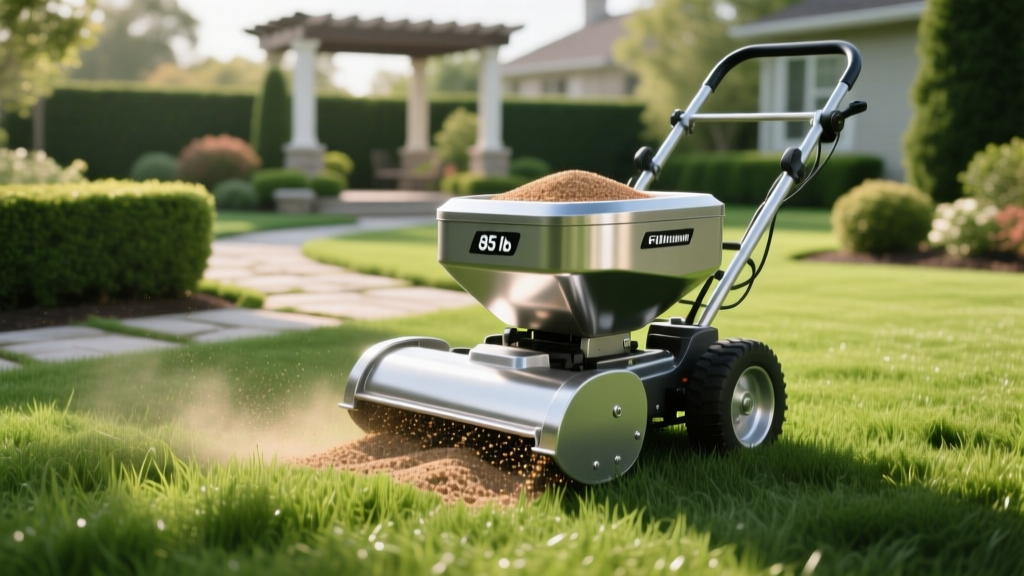
Groundwork 85 lb Broadcast Push Spreader: Coverage & Cost Guide 2026
Search Intent Clarification: Many homeowners search for the groundwork 85 lb broadcast tow lawn push spreader sku:1600537. It is critical to note that SKU:1600537 is strictly a manual push spreader, not a tractor tow-behind model. This guide exclusively covers the push configuration, its dosage metrics, and real-world cost analysis for the 2026 season.
When managing large residential lawns or small commercial properties, the transition from a standard 50-pound drop spreader to an 85-pound broadcast model drastically reduces application time and improves lateral distribution. The Groundwork 85 lb Broadcast Push Spreader (SKU:1600537), widely distributed through rural and agricultural retail channels, occupies a unique middle ground between consumer-grade plastic models and heavy-duty commercial stainless-steel units. This guide breaks down the exact coverage mathematics, 2026 calibration settings, and long-term cost efficiency of this specific unit.
Technical Specifications & Coverage Capacity
Understanding the physical limitations and capabilities of the Groundwork 85 lb model is the first step in calculating accurate dosage rates. Unlike models with exposed plastic gears, this unit utilizes an enclosed gearbox to protect internal mechanisms from corrosive fertilizer dust and moisture.
| Specification | Groundwork 85 lb (SKU:1600537) | Impact on Application |
|---|---|---|
| Hopper Capacity | 85 lbs (Volume: ~1.4 cubic feet) | Holds enough standard fertilizer for 25,000+ sq ft |
| Spread Width | 10 to 12 feet (adjustable via speed) | Requires 5-6 ft overlap for uniform distribution |
| Tire Type | 10-inch Pneumatic (Air-filled) | Prevents rutting on soft, wet turf compared to solid plastic |
| Gearbox | Enclosed Metal/Composite | Reduces gear stripping from heavy granular loads |
Calibration & Dosage Settings for 2026 Fertilizers
Spreader settings printed on fertilizer bags are often based on legacy Scotts EdgeGuard models. Because the Groundwork 85 lb features a wider aperture and a different agitator design, blindly following bag settings will result in under-application. According to turf management protocols outlined by Penn State Extension, you must adjust for the specific spreader's throw pattern and walking speed (aim for a consistent 3.0 mph).
Below are the baseline dial settings for the Groundwork 85 lb spreader for common 2026 turf products. Always perform a catch-test on a driveway before applying to turf.
Baseline Dial Settings (Scale 1-10)
- Scotts Turf Builder (32-0-4): Setting 5.5 (Yields ~3.2 lbs per 1,000 sq ft)
- Lesco Professional 19-0-6: Setting 6.0 (Yields ~4.0 lbs per 1,000 sq ft)
- Andersons 15-0-15 with 15% Pre-Emergent: Setting 6.5 (Yields ~5.5 lbs per 1,000 sq ft)
- Tall Fescue Grass Seed (Standard): Setting 7.0 (Yields ~8.0 lbs per 1,000 sq ft)
Cost Breakdown: Unit Price vs. Long-Term Value
When evaluating the Groundwork 85 lb spreader against market alternatives, the initial purchase price is only one metric. We must analyze the cost-per-acre and expected lifespan to determine true value.
| Model | 2026 Avg. Retail Price | Hopper Material | Expected Lifespan |
|---|---|---|---|
| Groundwork 85 lb (SKU:1600537) | $139 - $149 | Polypropylene / Steel Frame | 5-7 Years (with washing) |
| Scotts EdgeGuard Max | $129 - $139 | All Plastic | 3-4 Years |
| Lesco High Wheel Commercial | $299 - $349 | Stainless Steel | 10-15 Years |
The Verdict: The Groundwork model offers an 85 lb capacity for roughly the same price as the 75 lb plastic Scotts model. The pneumatic tires alone justify the $10 premium, as they prevent the 'scalping' effect that hard plastic wheels cause on uneven terrain. However, if you are managing over 2 acres of turf, the polypropylene hopper of the Groundwork will eventually warp under heavy granular loads and UV exposure, making the Lesco stainless model a better long-term investment.
Step-by-Step Calibration Framework
To guarantee you are applying the exact dosage required by your soil test, follow this 100-square-foot catch test recommended by Michigan State University Extension.
- Measure the Test Zone: Mark off a 10 ft x 10 ft (100 sq ft) area on your driveway using chalk.
- Load the Spreader: Add exactly 5 lbs of the specific granular product you intend to use.
- Set the Dial: Adjust the Groundwork dial to the baseline setting identified in the chart above.
- Catch the Output: Place a lightweight tarp or wide bucket over the spreader's discharge chute. Walk the 10 ft distance at your normal pace while engaging the handle.
- Weigh the Catch: Weigh the captured granules. Multiply this weight by 10 to determine your application rate per 1,000 sq ft.
- Adjust: If the calculated rate is too high, lower the dial by 0.5 increments. If too low, increase by 0.5.
Pro Tip: Humidity drastically affects granular flow. If you calibrated your spreader on a dry morning but are applying in the late afternoon when humidity spikes, the granules will clump and flow slower. Always store fertilizer in a climate-controlled garage until the exact moment of application.
Common Edge Cases & Troubleshooting
Even with proper maintenance, the Groundwork 85 lb push spreader experiences specific failure modes that users must anticipate.
- Agitator Jamming: The internal wire agitator frequently bends if you attempt to spread wet or heavily clumped pre-emergent. Fix: Remove the agitator, bend it back to a 45-degree angle, and apply a silicone-based lubricant to the hopper shaft.
- Uneven Tire Wear: Because the gearbox is driven by the left wheel only, dragging the spreader while turning (instead of lifting it) will strip the left pneumatic tire's tread and damage the axle pin. Fix: Always disengage the hopper lever and physically lift the front of the spreader during tight turns.
- Hopper Rust at the Seams: While the hopper is poly, the steel frame mounting brackets are prone to rust where fertilizer dust accumulates. Fix: After every wash, spray the metal mounting brackets with a light coat of WD-40 or fluid film to displace moisture.
By understanding the exact coverage metrics, adhering to calibrated dosage settings, and performing targeted maintenance on the gearbox and tires, the Groundwork 85 lb broadcast push spreader (SKU:1600537) remains one of the most cost-effective mid-tier application tools available to homeowners in 2026.

