
Lawn Care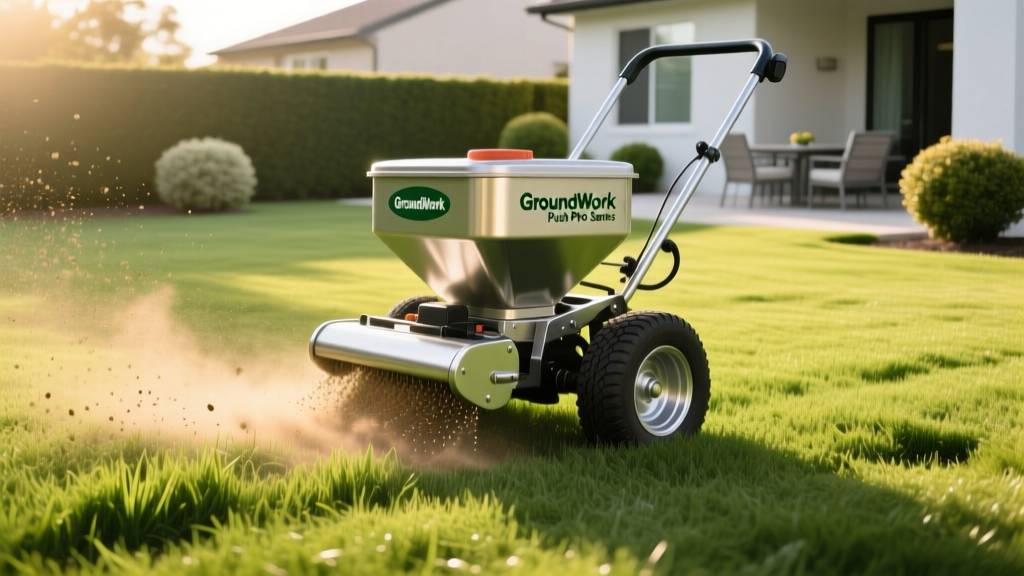
GroundWork Push Pro Series Broadcast Spreader: Setup and Calibration
Core Specifications and Build Architecture
The GroundWork Push Pro Series broadcast spreader (typically the 85 lb and 100 lb capacity models sold through Tractor Supply Co.) occupies a specific tier in the lawn equipment market: it bridges the gap between cheap, all-plastic residential spreaders and $400+ commercial Lesco models. For the 2026 lawn care season, the Pro Series remains a dominant choice for homeowners managing between 5,000 and 15,000 square feet of turf.
Understanding the mechanical architecture of this specific unit is critical before attempting calibration. Unlike gravity-fed drop spreaders, the Pro Series utilizes a gear-driven rotary spinner enclosed in a protective housing. The rotation of the pneumatic tires turns a nylon drive gear, which engages a metal pinion to spin the impeller at roughly 450 RPM at a standard 3 MPH walking pace.
| Component | Specification | Operational Impact |
|---|---|---|
| Hopper Capacity | 100 lbs (Volume: ~2.8 cu ft) | Handles standard 40-50 lb fertilizer bags without mid-job refills. |
| Spread Width | 10 to 12 feet (edge-to-edge) | Requires 50% overlap pattern for uniform distribution. |
| Tires | 13-inch Pneumatic (Air-filled) | Absorbs terrain bumps; tire pressure directly alters calibration. |
| Transmission | Enclosed Gearbox | Prevents fertilizer dust from degrading the drive mechanism. |
| Flow Control | Handle-mounted cable actuator | Allows on-the-fly shutoff to prevent burning turf near driveways. |
The 1,000-Square-Foot Calibration Method
Relying solely on the manufacturer's printed dial settings is a primary cause of fertilizer burn and wasted product. Granule size, humidity, and walking speed drastically alter the actual application rate. According to turfgrass management protocols outlined by the University of Georgia Extension, physical calibration is mandatory for every new material you load into the hopper.
Pro Tip: Never calibrate over your actual lawn. A miscalibration can deposit three times the intended nitrogen load, resulting in severe osmotic shock and turf death within 48 hours. Always calibrate on a driveway or use a catch-pan attachment.
Step-by-Step Calibration Protocol
- Calculate the Target Weight: Read the fertilizer bag. If a 40 lb bag covers 10,000 sq ft, your target application rate is 4.0 lbs per 1,000 sq ft.
- Measure the Test Zone: Mark off a 10 ft by 100 ft area on your driveway (exactly 1,000 sq ft). Alternatively, measure a 20 ft by 50 ft area.
- Weigh the Spreader: Load the hopper with roughly 20 lbs of product. Weigh the entire spreader on a digital bathroom scale. Record this starting weight.
- Execute the Pass: Set the flow lever to the manufacturer's suggested baseline (e.g., Setting 5). Walk at a brisk, consistent 3 MPH pace across the 100 ft test zone, engaging the flow lever only while in motion.
- Weigh and Compare: Weigh the spreader again. If the starting weight was 65.0 lbs and the ending weight is 61.2 lbs, you applied 3.8 lbs over 1,000 sq ft.
- Adjust and Repeat: Since 3.8 lbs is slightly under the 4.0 lb target, open the flow dial by half a setting and repeat the test until the weight dropped matches your target exactly.
Material Flow Settings Matrix
Different materials possess vastly different bulk densities and friction coefficients. Milorganite, an organic biosolid, is dense and dusty, requiring a wider gate opening. Conversely, lightweight grass seed requires a nearly closed gate to prevent over-seeding. The University of Minnesota Turfgrass Science program emphasizes that particle shape dictates how material flows through the agitator.
| Material Type | Specific Product Example | Approx. Dial Setting | Walk Speed Adjustment |
|---|---|---|---|
| Standard Synthetic Fertilizer | Scotts Turf Builder (32-0-4) | 5.5 | Standard (3 MPH) |
| Organic / Biosolids | Milorganite (6-4-0) | 11.0 | Standard (3 MPH) |
| Tall Fescue Grass Seed | Jonathan Green Black Beauty | 4.0 | Slightly Faster (3.5 MPH) |
| Pelletized Lime | Encapsulated Calcium Carbonate | 8.5 | Standard (3 MPH) |
| Ice Melt (Winter Use) | Calcium Chloride Pellets | 6.0 | Standard (3 MPH) |
Advanced Maintenance: Preventing Galvanic Corrosion
The most common failure point for the GroundWork Pro Series is not the gearbox, but the corrosion of the steel chassis and spinner assembly caused by fertilizer salts. Muriate of potash (potassium chloride), a common potassium source in cheap fertilizers, is highly hygroscopic and corrosive. If left in the hopper or on the frame, it will rust through the steel mounting brackets within a single season.
Critical Warning: Never use standard WD-40 to lubricate the spinner shaft or flow gate. WD-40 is a solvent and light penetrant that leaves a sticky residue. This residue attracts fertilizer dust, creating an abrasive paste that will seize the flow control cable by mid-summer.
The Post-Application Wash Protocol
- Dry Brush First: Before introducing water, use a stiff-bristled nylon brush to sweep out 95% of the residual granules from the poly hopper and the agitator bar.
- Low-Pressure Rinse: Use a garden hose without a high-pressure nozzle. High pressure can force water and dissolved salts past the seals and into the enclosed gearbox, destroying the lithium grease inside.
- Silicone Lubrication: Once the spreader is completely dry, spray the metal spinner plate, the agitator bar, and the flow gate hinge with a 100% silicone spray. Silicone repels moisture and does not attract dust.
- Cable Maintenance: Apply a few drops of dry graphite lubricant into the flow control cable housing to ensure the handle lever snaps back to the 'closed' position instantly.
The Tire Pressure Calibration Variable
Most homeowners overlook the pneumatic tires when maintaining their spreader, yet tire pressure is a hidden variable that directly alters your application rate. The GroundWork Pro Series relies on the physical rotation of the tire to turn the gearbox. The manufacturer calibrates the gear ratio assuming a specific tire diameter, which requires roughly 25 to 30 PSI of air pressure.
If your tires deflate to 15 PSI over the winter, the effective diameter of the wheel shrinks by nearly 8%. A smaller wheel must rotate more times to cover the same linear distance. More wheel rotations equal more gearbox turns, which spins the impeller faster. The result? An 8% over-application of fertilizer, which can easily push a safe nitrogen load into turf-burning territory. Check and adjust your tire pressure with a digital gauge before every spring and fall application cycle.
Annual Gearbox Servicing
While the gearbox is 'enclosed,' the seals degrade over time. Once a year, typically in late autumn after the final winterizer application, locate the single fill plug on the side of the gearbox housing. Remove the plug and inject a high-quality white lithium grease or synthetic gear grease until it purges slightly from the seam. This displaces any moisture that may have infiltrated the housing during summer washings and ensures the nylon drive gear does not strip the metal pinion under heavy loads.

