
Lawn Care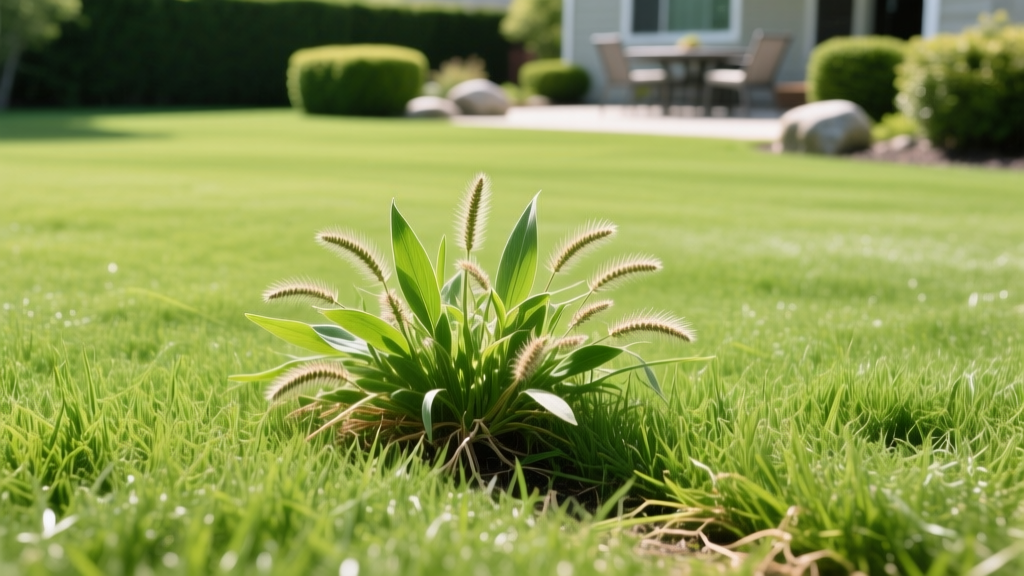
How to Identify and Spot-Treat Hairy Crabgrass in Your Lawn
The Botanical Profile: Identifying Hairy Crabgrass
Hairy crabgrass (Digitaria sanguinalis) is a prolific, warm-season annual weed that aggressively colonizes thinning turf. Unlike perennial weeds that spread via deep rhizomes, hairy crabgrass relies entirely on seed production, with a single mature plant capable of yielding up to 150,000 seeds in one growing season. Accurate identification is the prerequisite for effective spot-treatment, as confusing it with smooth crabgrass (Digitaria ischaemum) or desirable turfgrasses can lead to misapplied herbicides and wasted capital.
According to the NC State Extension Turffiles, the defining morphological features of hairy crabgrass are found at the collar region and the leaf sheath. Below is a diagnostic matrix to differentiate the two most common crabgrass species invading residential lawns.
| Diagnostic Feature | Hairy Crabgrass (D. sanguinalis) | Smooth Crabgrass (D. ischaemum) |
|---|---|---|
| Leaf Sheath | Covered in dense, long, white hairs | Smooth (glabrous), occasionally sparse hairs |
| Ligule | Tall (2-4mm), membranous, pointed, prominent | Short (1-2mm), membranous, truncate (flat top) |
| Leaf Blade | Light green, 1/4 to 2/5 inch wide, hairy on both surfaces | Dark green, 1/5 to 1/3 inch wide, mostly hairless |
| Stem Base | Green to pale white, branching outward | Distinctly purplish or reddish at the base |
| Seed Head | 3 to 10 finger-like spikes, arranged alternately | 2 to 6 finger-like spikes, arranged in a whorl |
The Germination Window: Timing Your Pre-Emergent
Pre-emergent herbicides do not kill seeds; they create a chemical barrier in the top 1 to 2 inches of soil that inhibits cell division during germination. If you apply the barrier after the radicle (embryonic root) has breached the seed coat, the treatment fails. Hairy crabgrass germinates when the soil temperature at a 1-inch depth consistently reaches 55°F to 60°F for three consecutive days. Relying on ambient air temperature or calendar dates (e.g., 'apply on April 15th') is a primary cause of pre-emergent failure.
Calibrating the Pre-Emergent Spot-Treatment
For targeted spot-treatment of known crabgrass zones (e.g., sunny parkways, thin areas near driveways), Prodiamine 65 WDG (active ingredient: prodiamine) offers a long residual window of 4 to 6 months. For areas where you missed the early window and suspect crabgrass is just sprouting, Dithiopyr 2EC (active ingredient: dithiopyr) provides 'early post-emergent' control, killing crabgrass up to the 1-tiller stage.
- Prodiamine 65 WDG Rate: 0.4 oz per 1,000 square feet for a standard barrier. Mix in 1 to 2 gallons of water for even coverage.
- Dithiopyr 2EC Rate: 0.5 fl oz per 1,000 square feet. Ideal for late-spring applications when soil temps hit 65°F.
- Watering Requirement: Both products require 0.25 to 0.5 inches of irrigation or rainfall within 7 days to activate the chemical barrier into the soil profile.
Post-Emergent Spot-Treatment Protocol
When hairy crabgrass has surpassed the 1-tiller stage and established a deep, fibrous root system, pre-emergents are useless. You must transition to a selective post-emergent herbicide. The industry standard for selective crabgrass control in cool-season lawns (Tall Fescue, Kentucky Bluegrass, Perennial Ryegrass) and Bermuda grass is Quinclorac (commercially available as Drive XLR8 or Quinclorac 75 DF).
The Quinclorac Mixing Matrix
Quinclorac is notoriously difficult to absorb through the waxy cuticle of mature crabgrass leaves. It strictly requires a high-quality surfactant to penetrate the tissue. Methylated Seed Oil (MSO) is the mandatory adjuvant for this chemistry.
- Herbicide Dose: Add 0.367 fl oz of Quinclorac 75 DF per 1,000 square feet of target area.
- Surfactant Dose: Add 1.3 fl oz of MSO per gallon of spray solution (a 1% v/v ratio).
- Carrier Volume: Use 1.5 to 2 gallons of water per 1,000 square feet to ensure thorough, dripping-wet coverage of the weed foliage.
Pro Tip: Quinclorac works systemically. Visible yellowing and necrosis of the crabgrass will take 7 to 14 days. Do not reapply within 21 days, and do not mow the target area for 48 hours before or after application to maximize leaf surface area for absorption.
⚠️ Critical Warning for Warm-Season Lawns
Quinclorac will cause severe phytotoxicity (stunting, chlorosis, and necrosis) to St. Augustine grass and Centipede grass. If you are managing hairy crabgrass in these turf types, do not use Quinclorac. Instead, spot-treat with a selective Atrazine formulation (if local regulations permit) during the cooler shoulder seasons, or use a non-selective Glyphosate (Roundup) gel applicator to carefully paint the weed leaves without dripping onto the desirable turf.
Application Mechanics: Avoiding the 'Burn Ring'
A common failure mode in spot-treating is overlapping spray patterns, which delivers a 2x or 3x dose of herbicide to the perimeter of the target zone. This causes chemical burn to the desirable turf, leaving a dead ring that ironically creates the perfect bare-soil seedbed for next year's crabgrass generation.
To prevent this, use a backpack sprayer equipped with a flat-fan nozzle (e.g., TeeJet 8002VS) and add a visible turf dye (like Blue Indicator Dye) to your tank mix. The dye allows you to track exactly where the Quinclorac or Prodiamine has been deposited, ensuring edge-to-edge coverage without overlapping.
Cultural Defense Mechanisms
Chemical spot-treatments are a reactive measure. The University of California Statewide IPM Program emphasizes that crabgrass is an opportunistic invader that requires high light intensity at the soil surface to germinate. If your turf canopy is dense, crabgrass seeds will remain dormant or die off.
- Mowing Height: Maintain Tall Fescue and Kentucky Bluegrass at a minimum of 3.0 to 3.5 inches. This shades the soil surface, dropping soil temperatures below the 55°F germination threshold in early spring.
- Nitrogen Timing: Avoid heavy nitrogen applications in late spring and summer. High nitrogen in June and July fuels rapid crabgrass expansion. Shift 75% of your annual nitrogen budget to the fall months (September and November) to thicken the cool-season turf canopy before the summer weed flush.
- Irrigation Strategy: Crabgrass thrives on frequent, shallow watering. Transition to deep, infrequent irrigation (0.5 to 0.75 inches twice a week) to encourage deep turf roots while stressing the shallow-rooted crabgrass seedlings.
Frequently Asked Questions
Can I pull hairy crabgrass by hand?
Yes, but only if the plant is young (pre-tiller stage). Once hairy crabgrass develops its fibrous, sprawling root system and begins producing seed heads, hand-pulling often snaps the stem, leaving the crown intact to regenerate. If pulling mature plants, use a weeding tool to extract the entire crown, and immediately bag the plant to prevent seed shatter.
Will vinegar or organic herbicides kill hairy crabgrass?
Horticultural vinegar (20% acetic acid) is a non-selective contact desiccant. It will burn the top growth of hairy crabgrass within hours, but it will not translocate to the roots. The weed will simply push new growth from the crown within a week. Furthermore, 20% acetic acid will severely burn your desirable turfgrass and temporarily lower soil pH. It is not a viable long-term solution for established crabgrass.
How long does Prodiamine last in the soil?
When applied at the maximum label rate of 0.8 oz per 1,000 square feet, Prodiamine 65 WDG can provide a residual pre-emergent barrier for up to 6 months. However, for residential spot-treatments, the standard 0.4 oz rate provides roughly 3 to 4 months of control, which is sufficient to carry most northern lawns through the primary spring germination flush.

