
Lawn Care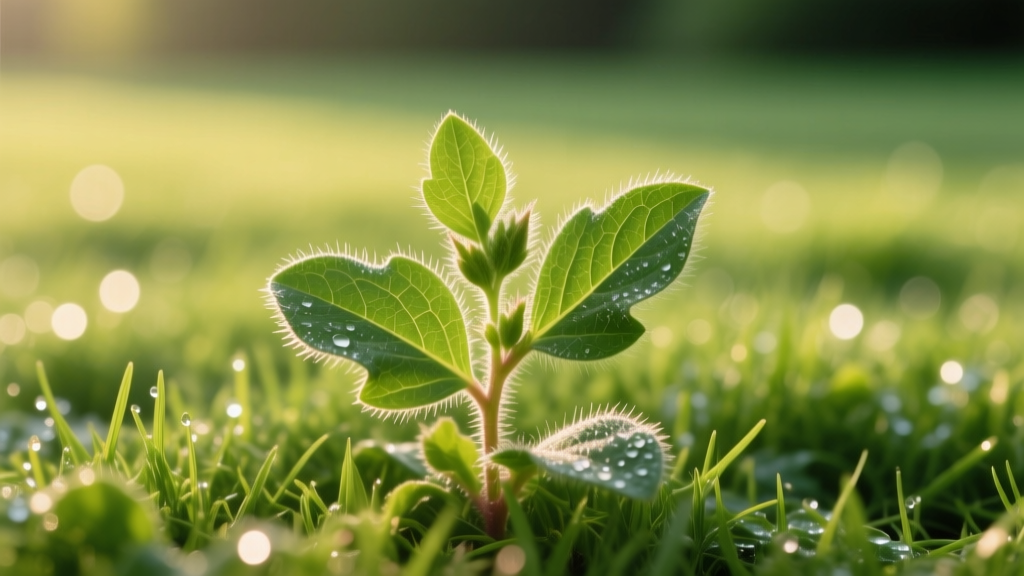
Hairy Leaf Weed Identification and Spot-Treatment Guide
The Botany of Trichomes: Why Hairy Leaf Weeds Resist Herbicides
When homeowners search for a "hairy leaf weed" invading their turf, they are usually encountering one of three specific botanical culprits: Galinsoga quadriradiata (hairy galinsoga), Cardamine hirsuta (hairy bittercress), or Digitaria sanguinalis (hairy crabgrass). The defining feature of these weeds—the dense fuzz or "hairs" on their foliage—is not just a visual identifier. Botanically known as trichomes, these microscopic leaf hairs serve as a highly effective physical defense mechanism against contact herbicides.
Trichomes hold spray droplets suspended above the actual leaf cuticle. If you apply a standard post-emergent herbicide without the correct adjuvant, the chemical beads up on the hairs and evaporates before penetrating the plant's vascular system. Understanding this botanical shield is the first step in formulating a successful spot-treatment protocol. According to the USDA Plants Database, hairy galinsoga can produce multiple generations in a single season, making rapid, effective chemical penetration critical to prevent seed set.
⚠️ Critical Warning: The Explosive Dehiscence Trap
Hairy bittercress (Cardamine hirsuta) possesses a defense mechanism called explosive dehiscence. Its seed pods (siliques) build immense turgor pressure. If you spray a mature plant with a fast-acting contact herbicide (like diquat or pelargonic acid) or physically yank it from the soil, the sudden shock triggers the pods to rupture, launching seeds up to 12 feet across your lawn. Always use slow-acting systemic herbicides on mature bittercress, or carefully enclose the plant in a plastic bag before mechanical removal.
Identification Matrix: The Big Three Hairy Lawn Invaders
Accurate identification dictates your chemical selection. Use this matrix to confirm which hairy leaf weed is colonizing your turfgrass.
| Weed Species | Leaf Hair Density & Texture | Growth Habit & Lifecycle | Primary Vulnerability |
|---|---|---|---|
| Hairy Galinsoga (Galinsoga quadriradiata) |
Dense, coarse white hairs on stems and leaf margins; leaves are opposite and toothed. | Summer annual; rapid vertical growth up to 24 inches; thrives in thin, moist turf. | Highly susceptible to systemic broadleaf herbicides (2,4-D + Dicamba) when paired with MSO. |
| Hairy Bittercress (Cardamine hirsuta) |
Fine, sparse hairs on basal rosette leaves; upper stem leaves are mostly hairless. | Winter annual; low-growing rosette; explosive seed pods in early spring. | Vulnerable to pre-emergents in fall; post-emergents must be systemic to avoid pod rupture. |
| Hairy Crabgrass (Digitaria sanguinalis) |
Long, stiff hairs on the leaf sheath and upper leaf surface; distinct membranous ligule. | Summer annual grassy weed; prostrate, spreading growth habit; roots at nodes. | Pre-emergent barrier in spring; post-emergent control requires Quinclorac or Fenoxaprop. |
For detailed morphological profiles and regional distribution maps, the NC State Extension Plant Toolbox provides excellent botanical reference imagery for Cardamine hirsuta and similar winter annuals.
Precision Spot-Treatment Protocols
Broadcast spraying is inefficient and damages surrounding desirable turf. For isolated patches of hairy leaf weeds, utilize a dedicated 1-gallon or 2-gallon pump sprayer calibrated to deliver 1.5 gallons per 1,000 square feet. This ensures the leaf surface is thoroughly wetted without excessive runoff.
Protocol A: Selective Broadleaf Control (Cool-Season Turf)
Target: Hairy Galinsoga and Hairy Bittercress in Fescue, Kentucky Bluegrass, or Ryegrass.
Active Ingredients: A three-way herbicide containing 2,4-D, MCPP, and Dicamba (e.g., Trimec Classic or SpeedZone).
Mixing Rate: 1.5 fl oz of herbicide per 1 gallon of water.
The Surfactant Multiplier: You must add a Methylated Seed Oil (MSO) at a rate of 0.5% v/v (0.66 fl oz per gallon). MSO outperforms standard Non-Ionic Surfactants (NIS) on hairy leaves because the oil fraction actively dissolves the waxy cuticle beneath the trichome barrier, pulling the active ingredient into the phloem.
- Step 1: Fill sprayer halfway with water, add MSO, and agitate.
- Step 2: Add the three-way herbicide and fill the rest with water.
- Step 3: Spray until the hairy leaves are uniformly wet, but not dripping.
- Step 4: Wait 48 hours before mowing to allow maximum translocation to the root system.
Protocol B: Grassy Hairy Weed Eradication (Warm-Season Turf)
Target: Hairy Crabgrass in Bermudagrass or Zoysiagrass.
Active Ingredients: Quinclorac (e.g., Drive XLR8) or Fenoxaprop-p-ethyl (e.g., Acclaim Extra).
Mixing Rate: Quinclorac at 0.367 fl oz per 1,000 sq ft.
Adjuvant Requirement: Quinclorac requires a high-quality crop oil concentrate (COC) at 1% v/v (1.3 fl oz per gallon) to penetrate the hairy leaf sheaths of mature crabgrass. Apply when daytime temperatures are below 85°F to prevent phytotoxicity to the desirable warm-season turf.
💡 Pro Tip: The Dormant Window
If you are managing a warm-season lawn (Bermuda, Zoysia, Centipede) that is fully dormant and brown in late winter, you can bypass selective herbicides entirely. Spot-treat any green, hairy-leafed winter annuals (like bittercress or henbit) with a 2% solution of non-selective Glyphosate (2.5 fl oz per gallon). Because the desirable turf is dormant, the glyphosate will only kill the active weeds without harming the grass roots.
Pre-Emergent Defense and Cultural Overrides
Spot-treating hairy leaf weeds is a reactive measure. Because hairy galinsoga and hairy crabgrass produce thousands of seeds that persist in the soil seed bank for years, a proactive pre-emergent strategy is non-negotiable for long-term eradication.
Spring and Fall Pre-Emergent Applications
Use Prodiamine 65 WDG (Water Dispersible Granule) to create a chemical barrier in the top inch of soil, inhibiting root development in germinating weed seeds.
- Spring Application (Crabgrass & Galinsoga): Apply when soil temperatures at a 2-inch depth reach 55°F for three consecutive days (typically late February to early April, depending on your hardiness zone). Rate: 0.4 oz per 1,000 sq ft.
- Fall Application (Bittercress): Apply in late August to early September before soil temperatures drop below 70°F. Rate: 0.4 oz per 1,000 sq ft.
- Activation: Pre-emergents require 0.25 to 0.5 inches of irrigation or rainfall within 48 hours of application to be washed into the soil profile where the weed seeds germinate.
Cultural Overrides: Mowing and Nitrogen
Hairy leaf weeds are opportunistic; they exploit thin, under-fertilized turf canopies. Hairy galinsoga requires high light levels at the soil surface to germinate. By maintaining your cool-season turf at a mowing height of 3.5 to 4.0 inches during the summer stress months, you shade the soil profile, dropping soil temperatures and blocking the photosynthetically active radiation (PAR) that galinsoga seeds need to trigger germination. Pair this with a balanced, slow-release nitrogen program (e.g., 3.0 to 4.0 lbs of actual nitrogen per 1,000 sq ft annually) to ensure your desirable turf outcompetes the weeds for space and nutrients.
"The presence of trichomes on weed foliage is an evolutionary adaptation to reduce water loss and deter herbivory, but in turf management, it serves as a physical barrier to foliar-applied chemicals. Adjusting your spray solution's surface tension and utilizing oil-based adjuvants is the only reliable method to bypass this defense." — Principles of Weed Science and Turfgrass Management
By combining precise botanical identification, oil-based surfactant chemistry, and strict pre-emergent timing, you can permanently eliminate hairy leaf weeds from your lawn without resorting to costly, full-scale lawn renovations.

