
Lawn Care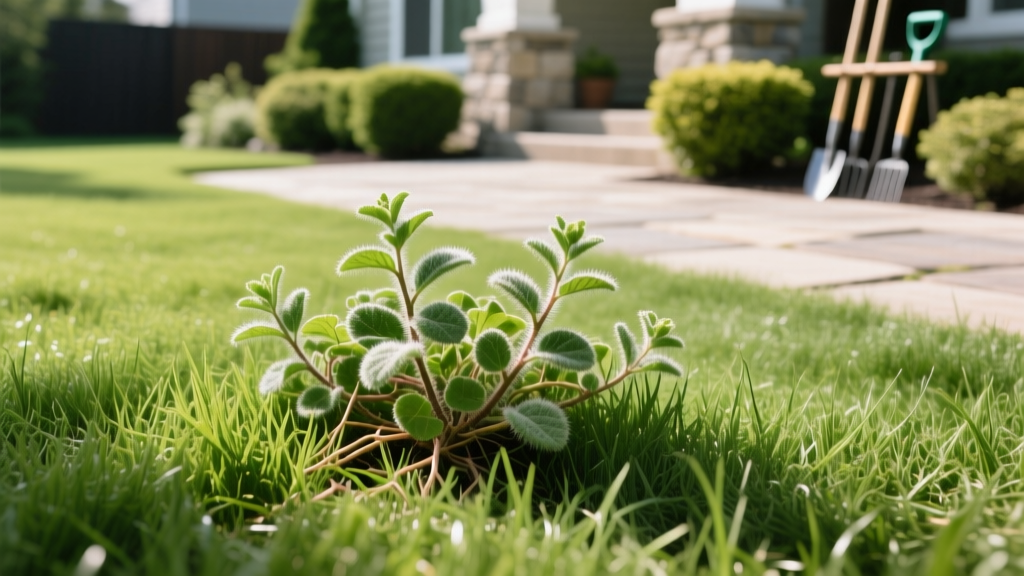
Spot-Treatment Guide for Hairy Leaved Weeds in Lawns
Standard broadleaf herbicides often fail against hairy leaved weeds. The physical presence of trichomes (leaf hairs) creates a biological shield that repels water-based chemical sprays, causing herbicide droplets to bead up and roll off onto the soil before they can penetrate the leaf cuticle. To successfully eradicate species like hairy bittercress, hairy galinsoga, and common mallow, homeowners must combine precise species identification with targeted surfactant chemistry and specific active ingredients.
The Trichome Barrier: Why Standard Sprays Fail
Hairy leaved weeds utilize trichomes for multiple survival functions: deterring insect herbivores, reducing water loss, and reflecting excess UV radiation. However, in the context of lawn care, these hairs create a microclimate of still air and physically elevate liquid droplets above the leaf surface. Pure water has a high surface tension (approximately 72 mN/m). When sprayed onto a hairy leaf, the surface tension causes the droplet to maintain a spherical shape, resting on the tips of the trichomes rather than collapsing and spreading across the epidermis.
⚠️ Critical Formulation Warning: Never apply standard 2,4-D or Dicamba concentrates to hairy leaved weeds without a non-ionic surfactant (NIS). Without an NIS to drop the surface tension to ~30 mN/m, you are effectively wasting 80% of your active ingredient and increasing the risk of soil contamination.
Species Profile 1: Hairy Bittercress (Cardamine hirsuta)
Identification and Lifecycle
Hairy bittercress is a winter annual that germinates in late fall, overwinters as a low-growing rosette, and aggressively bolts in early spring (typically March and April). The leaves are compound, with a larger terminal leaflet, and are covered in fine, sparse hairs. Its most defining trait is its explosive seed pods (silicles) that can eject seeds up to three feet away when disturbed.
Spot-Treatment Protocol
Because bittercress bolts rapidly, timing is the primary variable for success. Spot-treatment must occur during the rosette stage (November or late February) before the flower stalks emerge.
- Active Ingredients: A three-way mixture of 2,4-D, MCPP, and Dicamba.
- Recommended Product: Ortho WeedClear Lawn Weed Killer (Approx. $22/gallon ready-to-use, or $35 for a 32oz concentrate).
- Application Rate: Mix 2 oz of concentrate per gallon of water. Add 0.25% v/v non-ionic surfactant (approx. 0.5 oz per gallon).
- Technique: Use a 1-gallon pump sprayer with an 8002 flat-fan nozzle. Spray until the leaves are uniformly wet, but avoid runoff. The surfactant will cause the liquid to collapse through the hairs and coat the leaf surface.
According to Penn State Extension, treating bittercress after it has flowered is largely ineffective, as the plant's energy shifts to seed production and the vascular system stops pulling nutrients (and herbicides) down into the roots.
Species Profile 2: Hairy Galinsoga (Galinsoga quadriradiata)
Identification and Lifecycle
Hairy galinsoga is a summer annual that thrives in thin, poorly maintained turf or garden borders that encroach on lawn edges. It features opposite, coarsely toothed leaves covered in dense, stiff hairs and small, daisy-like flowers with white rays and yellow centers. It has a shallow, fibrous root system but can produce multiple generations in a single summer.
Spot-Treatment Protocol
Galinsoga is highly susceptible to hormonal herbicides, but its dense hair coverage requires aggressive wetting agents. Hand-pulling is often counterproductive; the stems break easily at the soil line, and the plant regenerates from the crown within 10 days.
- Active Ingredients: Triclopyr combined with Quinclorac or 2,4-D.
- Recommended Product: BioAdvanced Lawn Weed and Crabgrass Killer (Approx. $28/gallon).
- Application Rate: Follow label rates (typically 2.5 oz per gallon for spot treatment).
- Surfactant Requirement: Use a silicone-based spreader rather than a standard NIS. Silicone surfactants (like Dyna-Gro Pro-Silwet) reduce surface tension even further (~21 mN/m), forcing the chemical through the dense, stiff hairs of the galinsoga leaf.
The UC Statewide IPM Program notes that hairy galinsoga can develop resistance to single-mode-of-action herbicides if treated repeatedly. Rotating your active ingredients between Triclopyr and Fluroxypyr across different seasons is highly recommended.
Species Profile 3: Common Mallow (Malva neglecta)
Often called cheeseweed due to its wheel-shaped seed pods, common mallow is a broadleaf weed with deeply lobed, crinkled leaves that are distinctly fuzzy or hairy on both surfaces. It operates as a winter annual or short-lived perennial, developing a deep, woody taproot that makes it incredibly drought-tolerant and difficult to eradicate.
Spot-Treatment Protocol
Because of its deep taproot, contact herbicides will only burn the top growth, resulting in rapid regrowth. You must use a systemic herbicide applied during the plant's active growth phases (early spring or early fall).
| Weed Species | Lifecycle | Root Structure | Primary Active Ingredients | Optimal Surfactant Type |
|---|---|---|---|---|
| Hairy Bittercress | Winter Annual | Shallow Fibrous | 2,4-D + MCPP + Dicamba | Standard NIS |
| Hairy Galinsoga | Summer Annual | Shallow Fibrous | Triclopyr + Quinclorac | Silicone Spreader |
| Common Mallow | Perennial/Biennial | Deep Taproot | Triclopyr + 2,4-D | Crop Oil Concentrate |
For Common Mallow, a Crop Oil Concentrate (COC) is superior to an NIS. The oil penetrates the waxy cuticle beneath the hairy layer, acting as a solvent to pull the systemic Triclopyr into the plant's phloem. Apply COC at a rate of 1% v/v (1.25 oz per gallon of water). Expect to spend around $18 to $25 for a pint of high-quality COC, which will last an average homeowner several seasons.
Equipment Calibration for Spot Treatment
The biggest mistake homeowners make when spot-treating hairy leaved weeds is using the wrong nozzle, leading to excessive drift and inadequate coverage.
- Ditch the Cone Nozzle: Most consumer sprayers come with an adjustable cone nozzle. This produces large, heavy droplets that easily roll off hairy leaves, even with a surfactant.
- Install a Flat-Fan Nozzle: Purchase a TeeJet 8002 or 11002 flat-fan nozzle (approx. $8). This produces a fine, uniform spray pattern that creates smaller droplets, maximizing the surface area of the herbicide and allowing the surfactant to work effectively.
- Pressure Control: Pump your 1-gallon sprayer to exactly 30 to 40 PSI. Pumping to maximum pressure (often 60+ PSI) atomizes the spray too finely, causing it to drift onto your desirable turfgrass and cause phytotoxicity.
"When dealing with trichome-dense weeds, coverage is more important than concentration. A lower dose of herbicide spread evenly across the leaf surface via a flat-fan nozzle and surfactant will outperform a high dose applied in large, rolling droplets every single time."
Post-Treatment Lawn Recovery
Hairy leaved weeds often colonize areas where the turfgrass canopy is thin or soil compaction is high. Once the weeds have curled and died (typically 10 to 14 days post-application for systemic herbicides, or 3 to 5 days for contact burn), rake out the dead debris.
Immediately overseed the bare spots with a turfgrass species suited to your region. For cool-season lawns, use a mix of Kentucky Bluegrass and Tall Fescue at a rate of 4 to 6 lbs per 1,000 sq ft. For warm-season lawns, plug the area with Bermudagrass or Zoysia. The goal is to establish a dense canopy that shades the soil, preventing the next generation of hairy weed seeds from receiving the sunlight required for germination. Consult the NC State TurfFiles database for region-specific turf density recommendations to naturally suppress future weed invasions.
Frequently Asked Questions
Can I use vinegar to kill hairy leaved weeds?
Horticultural vinegar (20% acetic acid) is a contact burn herbicide. While it will desiccate the top growth of hairy bittercress or galinsoga, the acetic acid is rapidly neutralized by the soil and will not translocate to the roots. Furthermore, the high surface tension of vinegar causes it to bead up on hairy leaves just like water. You will end up with a burned leaf surface and a weed that regrows within two weeks.
Is it safe to mix my own surfactant using dish soap?
While a few drops of Dawn dish soap can act as a temporary wetting agent, it is not a true non-ionic surfactant. Dish soaps are often anionic and contain degreasers, fragrances, and dyes that can cause phytotoxicity (leaf burn) on your desirable lawn grass when exposed to direct sunlight and temperatures above 80°F. Always use a dedicated agricultural NIS like Hi-Yield Spreader Sticker ($14/pint) for predictable, safe results.

