
Lawn Care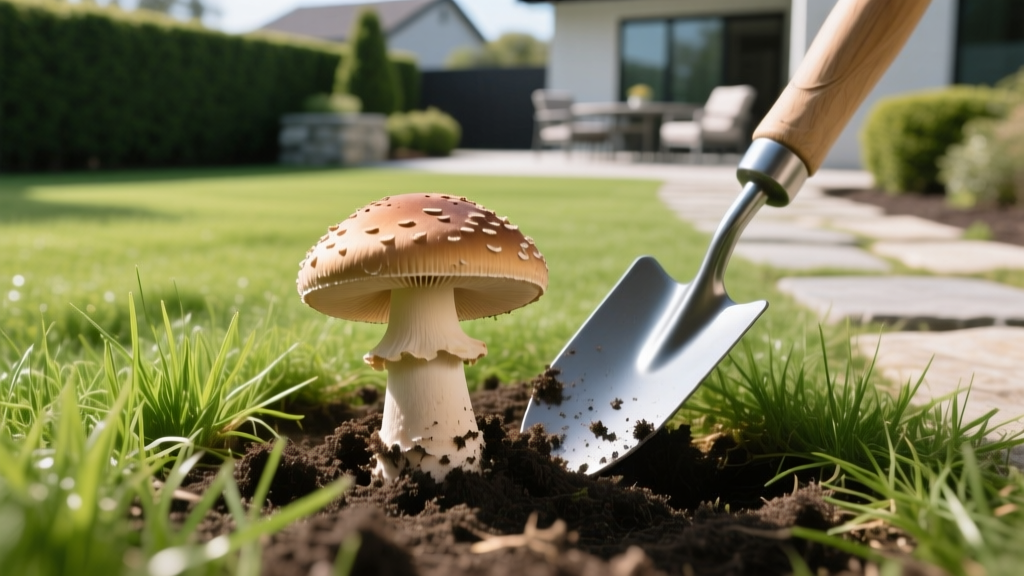
Step-by-Step Removal Guide for a Hard Mushroom in Lawn
Identifying the Hard Mushroom in Lawn Grass
When homeowners encounter a hard mushroom in lawn grass, it is rarely a standard gilled mushroom. Soft, fleshy mushrooms decompose quickly, but hard, leathery, or woody fruiting bodies indicate a mature, deeply established mycelial network feeding on subterranean organic matter. In turfgrass environments, these tough fungi generally fall into three categories: earthballs (Scleroderma species), mature puffballs (Calvatia or Lycoperdon), or the leathery caps associated with fairy ring fungi (Marasmius oreades).
Unlike surface-level weeds, these fungi are symptoms of underlying soil conditions—specifically, heavy thatch accumulation, buried construction debris (lignin), or hydrophobic soil layers. Eradicating them requires a targeted lawn maintenance protocol that addresses both the fruiting body and the subterranean food source.
Diagnostic Matrix: What Type of Hard Mushroom Do You Have?
| Fungi Type | Exterior Texture | Interior Cross-Section | Primary Turf Cause |
|---|---|---|---|
| Earthball (Scleroderma) | Thick, hard, scaly rind; yellowish-brown | Solid, purplish-black or dark brown | Buried wood, heavy thatch, acidic soil |
| Mature Puffball | Leathery, tough outer skin; white to brown | Powdery, olive-brown spore mass | Decaying tree roots, high organic matter |
| Fairy Ring Mushroom | Tough, leathery cap; tan to pale brown | White gills, tough fibrous stem | Hydrophobic soil, deep thatch, low nitrogen |
⚠️ Pet Safety Warning: If the hard mushroom in your lawn is an earthball (Scleroderma citrinum), exercise extreme caution. According to University of Minnesota Extension, earthballs are highly toxic to dogs and can cause severe gastrointestinal distress, vomiting, and lethargy if ingested. Always wear gloves when extracting them and dispose of them in sealed municipal waste bins, not compost piles.
Step-by-Step Extraction and Soil Remediation
Simply kicking or mowing over hard mushrooms only disperses spores and leaves the mycelial mat intact. Follow this four-step turf maintenance procedure to permanently remove the fungus and restore soil health.
Step 1: Deep Physical Extraction
Do not pull the mushroom by the stem; it will snap, leaving the base and sclerotia (hardened fungal masses) in the soil to regenerate.
- Tool Selection: Use a stainless steel Hori-hori knife or a narrow soil knife with a serrated edge.
- Excavation: Insert the blade 4 to 6 inches into the soil at a 45-degree angle, circling the mushroom to a depth of at least 3 inches below the visible base.
- Extraction: Lever the soil upward to remove the entire fruiting body along with the dense, white, web-like mycelial mat attached to it.
- Backfill: Fill the void with a 70/30 mix of topsoil and coarse sand to promote drainage and discourage fungal recolonization.
Step 2: Address the Subterranean Food Source
Hard mushrooms require complex carbohydrates (lignin and cellulose) to survive. If you are repeatedly finding them in the same zone, there is likely buried construction debris, an old decaying tree stump, or a thatch layer exceeding 0.5 inches.
- Thatch Management: Measure your thatch layer using a soil probe. If it exceeds 0.5 inches, perform mechanical dethatching (power raking) in the early fall for cool-season grasses, or late spring for warm-season varieties.
- Debris Removal: If the mushroom is fruiting directly over buried wood or stump grindings, you must excavate the wood. Fungi will continue to fruit until the lignin is entirely consumed, which can take 5 to 10 years.
Step 3: Break Hydrophobic Soil Layers
Fairy ring fungi create dense, waxy mycelial mats that repel water, leading to localized dry spot (LDS) and turf death. To combat this, you must alter the soil's surface tension.
- Apply a Soil Surfactant: Use a professional-grade wetting agent like Aqua-Aid or Penterra. Apply at a rate of 3 to 4 ounces per 1,000 square feet, diluted in 2 gallons of water. This penetrates the waxy fungal barrier and rehydrates the root zone.
- Core Aeration: Follow up with hollow-tine core aeration, pulling 3-inch to 4-inch plugs spaced no more than 3 inches apart. This physically fractures the mycelial mat and introduces oxygen, which inhibits anaerobic fungal pathogens.
Step 4: Masking and Suppression via Nitrogen
While NC State Extension notes that fungicides are rarely cost-effective for simple fruiting bodies, you can mask the visual damage caused by the underlying mycelium. The fungi consume soil nitrogen, starving your grass.
- Fertilization: Apply a slow-release, methylene-urea based nitrogen fertilizer at a rate of 0.5 to 1.0 lbs of actual N per 1,000 sq ft. This stimulates rapid turfgrass growth, allowing the grass to outcompete the fungi visually and recover from localized nitrogen depletion.
- Fungicide (Severe Cases Only): If the hard mushrooms are part of a massive, expanding fairy ring killing large swaths of turf, apply a systemic fungicide containing Azoxystrobin (e.g., Heritage SC) at 0.4 fl oz per 1,000 sq ft. Water it in immediately with 0.25 inches of irrigation to push the active ingredient into the root zone where the mycelium resides.
Seasonal Prevention Schedule
Preventing the return of a hard mushroom in lawn grass requires consistent cultural practices that reduce organic buildup and improve soil drainage.
| Season | Maintenance Action | Target Metric |
|---|---|---|
| Early Spring | Apply soil wetting agents to prevent hydrophobic mycelial mats from forming as temperatures rise. | 1 application every 45 days |
| Late Summer | Perform hollow-tine core aeration to physically disrupt fungal networks and relieve soil compaction. | 15-20 cores per sq. ft. |
| Early Fall | Dethatch and apply potassium-heavy winterizer fertilizer to strengthen turf cell walls against fungal intrusion. | Thatch layer < 0.5 inches |
| Winter | Avoid heavy foot traffic on frozen or saturated turf to prevent deep soil compaction that favors fungal growth. | N/A |
Troubleshooting Edge Cases
Why do hard mushrooms keep returning after extraction?
If you remove the fruiting body but the mushroom returns within weeks, the subterranean food source (usually a decaying root system from a previously removed tree) is still active. The fungus is simply doing its ecological job of breaking down wood. In these cases, continuous physical removal of the fruiting bodies combined with heavy nitrogen fertilization to mask turf yellowing is the most practical approach until the wood fully decomposes.
Can I use vinegar or bleach to kill lawn mushrooms?
No. Pouring household bleach, vinegar, or boiling water on a hard mushroom will only kill the surface fruiting body and severely damage your turfgrass roots. It will not penetrate deep enough to affect the mycelial network, and the resulting soil pH alteration can cause localized heavy metal toxicity or grass burn. Rely on physical extraction and cultural soil management instead.
For more comprehensive data on turfgrass diseases and fungal identification, consult the University of California Integrated Pest Management (UC IPM) guidelines on lawn mushrooms and soil ecology.

