
Lawn Care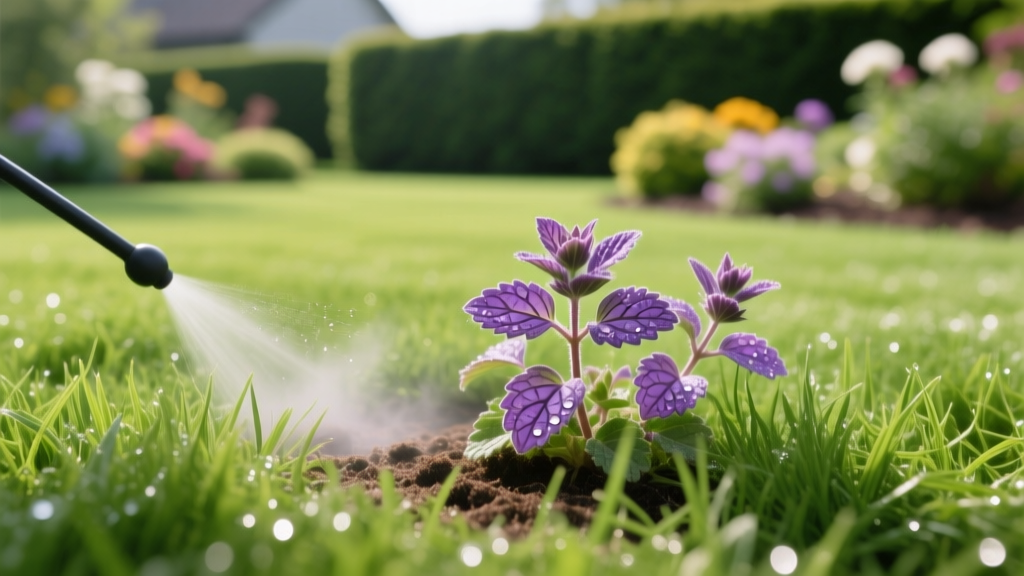
Weed Control for Henbit: Spot-Treatment & Eradication Guide
The Biology of Henbit: Why Timing Dictates Success
Henbit (Lamium amplexicaule) is a winter annual broadleaf weed that exploits the dormant periods of warm-season grasses and the slow-growth phases of cool-season turf. Understanding its life cycle is the single most critical factor in effective weed control for henbit. Seeds germinate in early autumn when soil temperatures drop below 70°F. The plant forms a low-growing rosette, overwinters in a semi-dormant state, and then aggressively bolts, flowers, and sets seed in early spring (typically March and April).
CRITICAL TIMING WARNING: Most homeowners attempt weed control for henbit in April when the lawn is covered in purple flowers. At this stage, the plant is already senescing (dying back naturally) and has likely dropped thousands of seeds into the soil bank. Spraying mature, flowering henbit in spring is largely cosmetic. True eradication requires targeting the vulnerable seedling stage in late fall or applying a pre-emergent barrier in late summer.
Henbit vs. Purple Deadnettle: Identification Matrix
Before mixing herbicides, confirm your target. Henbit is frequently confused with purple deadnettle (Lamium purpureum). While both are winter annuals in the mint family and respond to similar chemical controls, accurate identification helps you understand your soil conditions, as deadnettle prefers more compacted, moist soils.
| Feature | Henbit (L. amplexicaule) | Purple Deadnettle (L. purpureum) |
|---|---|---|
| Upper Leaf Attachment | Clasps the stem directly (sessile) | Attached via short petioles (stems) |
| Leaf Shape & Color | Rounded, deeply scalloped edges, green | Triangular, pointed tips, purplish-red tint |
| Growth Habit | Upright, branching from the base | Upright, single central stem with whorls |
| Soil Preference | Thin turf, varied moisture, partial shade | Heavy clay, compacted, consistently moist |
For deeper botanical identification profiles and regional emergence maps, consult the NC State TurfFiles database, which provides excellent high-resolution imagery of the cotyledon and mature leaf stages.
Chemical Spot-Treatment Protocols
When executing weed control for henbit via post-emergent spot treatments, your herbicide selection must match the ambient temperature and the weed's growth stage. Henbit's waxy leaf cuticle makes it somewhat resistant to single-active-ingredient herbicides, necessitating multi-mode-of-action mixtures.
Cool-Weather Post-Emergent (Fall & Early Spring)
When daytime highs are between 45°F and 65°F, standard 2,4-D formulations struggle to translocate through the plant's vascular system. Instead, utilize herbicides containing carfentrazone-ethyl or sulfentrazone. These PPO-inhibitors cause rapid cell membrane disruption and work effectively in cool weather.
- Product Recommendation: SpeedZone Broadleaf Herbicide for Turf (contains carfentrazone, 2,4-D, MCPP, and dicamba).
- Mixing Rate: 1.5 to 2.0 fluid ounces per 1,000 square feet, diluted in 1.5 gallons of water.
- Surfactant Requirement: Add a non-ionic surfactant (NIS) at 0.25% v/v (roughly 1 teaspoon per gallon) to break the leaf surface tension.
- Expected Cost: ~$130 per gallon of concentrate, yielding a cost of roughly $0.05 per 1,000 sq ft per application.
Warm-Weather Systemic Control (Late Spring)
If you miss the fall window and must treat henbit in late April when temperatures exceed 65°F, a standard three-way herbicide will translocate effectively down to the root system.
- Product Recommendation: Trimec Southern Broadleaf Herbicide or Ortho WeedClear Lawn Weed Killer (Ready-to-Use).
- Mixing Rate (Concentrate): 1.5 fl oz per gallon of water per 1,000 sq ft.
- Temperature Restriction: Do not apply when temperatures exceed 85°F. The esters in 2,4-D and dicamba will vaporize and drift, potentially damaging nearby ornamental shrubs and garden vegetables.
Organic and Cultural Eradication Tactics
For homeowners managing organic lawns or those with pets and children who frequently play on the turf, synthetic auxin herbicides may not be desirable. Organic weed control for henbit relies on desiccation and cultural shading.
The Iron HEDTA Advantage
Chelated iron (FeHEDTA) is the most effective organic post-emergent option. Broadleaf weeds like henbit absorb iron in toxic amounts, leading to severe oxidative stress and rapid tissue necrosis, while monocot grasses safely regulate iron uptake.
- Brand Equivalent: Fiesta Turf Weed Killer or Natria Lawn Weed Control.
- Application Protocol: Apply a 33% solution directly to the foliage until wet. You must apply a second treatment exactly 14 to 21 days after the first to kill the recovering root system.
- Visual Result: Henbit leaves will turn black and desiccate within 48 hours.
Cultural Prevention: The University of Minnesota Extension emphasizes that winter annuals only thrive where turf is thin. Raising your mowing height to 3.5 inches for cool-season fescues or 2.5 inches for warm-season zoysia creates a dense canopy that shades the soil, preventing henbit seeds from receiving the light required for autumn germination.
Troubleshooting: Why Your Henbit Came Back
If you executed a spot-treatment but faced a massive henbit resurgence the following year, you likely fell victim to one of these common failure modes:
- Treating the Flower, Not the Root: Spraying in late April only kills the dying mother plant. The seeds were already deposited. You must follow up with a pre-emergent like prodiamine (Barricade) in late August to stop the next generation.
- Ignoring the Soil Seed Bank: Henbit seeds can remain viable in the top two inches of soil for up to five years. A single year of weed control for henbit is insufficient; you must commit to a two-year fall post-emergent and late-summer pre-emergent rotation.
- Poor Spray Coverage: Henbit's deeply veined, hairy leaves repel water droplets. If you omitted a methylated seed oil (MSO) or non-ionic surfactant, the herbicide likely beaded up and rolled off the leaf onto the soil, where it was rapidly degraded by microbes.
Frequently Asked Questions
Will pulling henbit by hand spread the seeds?
Yes, if the plant has already formed its characteristic whorled seed capsules (usually by mid-March). If you hand-pull flowering henbit, immediately bag the debris. Do not compost it, as standard residential compost piles do not reach the 140°F required to destroy henbit seeds.
Is henbit toxic to dogs or livestock?
According to the National Pesticide Information Center, the weed itself is not highly toxic, but it can cause mild gastrointestinal upset in dogs if ingested in large quantities. However, the primary danger to pets comes from the synthetic herbicides used to treat it. Always keep pets off treated turf until the liquid application has completely dried (typically 2 to 4 hours).
Can I use a pre-emergent for henbit in the spring?
No. Spring pre-emergents (applied in March/April) target summer annuals like crabgrass. Henbit germinates in the fall. Applying a pre-emergent in spring will have zero effect on the henbit seed bank waiting for autumn temperatures.

