
Lawn Care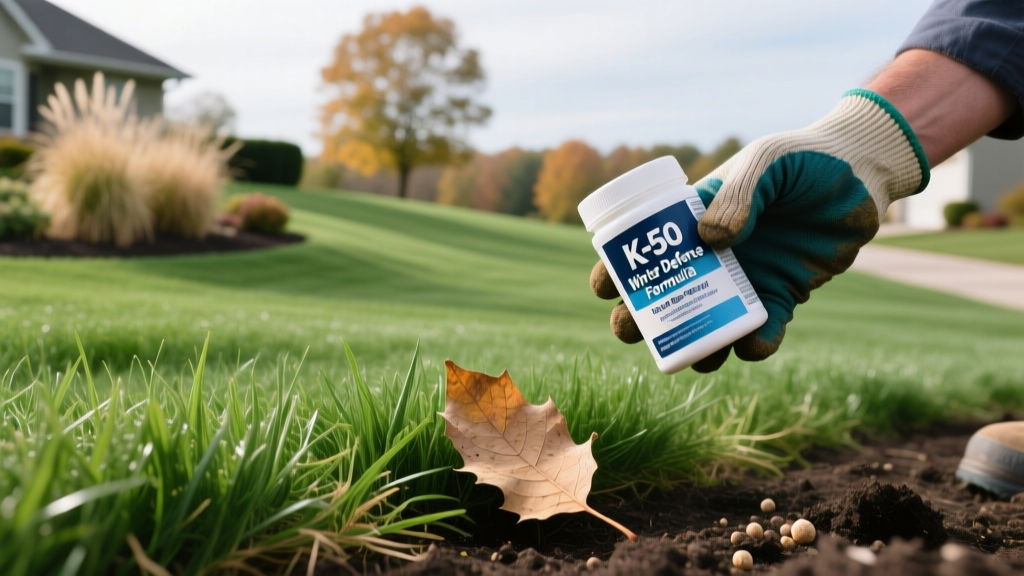
When to Apply High Potassium Fertilizer for Lawn Stress & Winter
The Physiology of Potassium in Turfgrass
While nitrogen drives the visible green blade growth that homeowners obsess over, potassium (K) operates as the unseen metabolic engine of your lawn. In the N-P-K ratio found on every fertilizer bag, potassium is the third number. It does not stimulate rapid shoot growth; instead, it regulates the internal cellular processes that allow turfgrass to survive extreme environmental stress.
Potassium acts as an osmoregulator. It controls the opening and closing of stomata (the microscopic pores on grass leaves), which directly dictates how efficiently your lawn retains water during summer droughts. Furthermore, K is required for the activation of over 60 essential plant enzymes and the synthesis of complex carbohydrates that fortify cell walls against fungal pathogens like brown patch and dollar spot.
According to turfgrass researchers at the University of Minnesota Extension, lawns with adequate potassium levels exhibit significantly deeper root systems and enhanced freeze tolerance, making it a non-negotiable element for both summer survival and winter prep.
Diagnosing Potassium Deficiency: Look Beyond the Color
Nitrogen deficiency presents as a uniform, pale yellowing across the entire lawn. Potassium deficiency is far more insidious and localized. Because potassium is a mobile nutrient within the plant, the turf will cannibalize older leaves to support new growth.
- Marginal Chlorosis: The edges of older grass blades turn yellow, eventually progressing to a scorched, brown necrosis at the leaf tips.
- Weak Stalks: The grass feels limp and fails to spring back when stepped on, due to a loss of cellular turgor pressure.
- Increased Weed Invasion: Thin, stressed turf canopy allows opportunistic weeds like spurge and crabgrass to establish.
⚠ Warning: Do Not Guess Your Soil Chemistry
Visual symptoms of potassium deficiency perfectly mimic drought stress, chinch bug damage, and certain fungal diseases. Before purchasing a high potassium fertilizer, you must conduct a professional soil test. Target a Mehlich-3 extractable potassium level between 120 and 150 ppm. If your test reads below 80 ppm, your soil is critically deficient. The NC State TurfFiles program strongly advises against blind applications, as excess potassium can competitively inhibit the uptake of magnesium and calcium.
Muriate vs. Sulfate: Choosing the Right Potassium Source
Not all high potassium fertilizers are created equal. The source of the potassium dictates how safely it can be applied to specific turf types, particularly in high-heat environments.
Muriate of Potash (Potassium Chloride / KCl)
This is the most common and least expensive source, typically analyzing at 0-0-60. However, it contains roughly 47% chloride. While cool-season grasses (Kentucky Bluegrass, Tall Fescue) tolerate chloride well, warm-season grasses like St. Augustinegrass and Centipedegrass are highly sensitive to chloride toxicity. Applying MOP to these grasses during summer heat can cause severe root burn and leaf scorch.
Sulfate of Potash (Potassium Sulfate / K2SO4)
Analyzing at 0-0-50, this source replaces the chloride with sulfur, an essential secondary macronutrient. It is significantly more expensive per pound but is the mandatory choice for salt-sensitive warm-season lawns, coastal properties, and soils that already test high in chloride.
Top High Potassium Fertilizer Formulations Compared
Selecting the right product depends on your application method (liquid vs. granular) and your specific seasonal goals. Below is a comparison of professional-grade formulations currently on the market.
| Product / Formulation | N-P-K Ratio | Type & Coverage | Est. Price (2026) | Best Use Case |
|---|---|---|---|---|
| Lesco 0-0-24 | 0-0-24 | Granular (50 lbs / 12,000 sq ft) | $58.00 | Late fall winterizer; pure K without nitrogen surge. |
| Simple Lawn Solutions Liquid Potash | 0-0-14 | Liquid (32 oz / 10,000 sq ft) | $34.95 | Mid-summer drought stress relief; fast foliar uptake. |
| ProScape 10-0-20 Winterizer | 10-0-20 | Granular (50 lbs / 10,000 sq ft) | $49.50 | Early fall transition; provides minor N for root storage. |
Calculating Exact Application Rates
The most common mistake homeowners make is applying fertilizer by the 'handful' rather than calculating the exact pounds of actual potassium (K2O) per 1,000 square feet. The standard agronomic recommendation for correcting a deficiency or prepping for winter is 1.0 lb of K2O per 1,000 sq ft.
💡 The Application Math Framework
To find out how much physical product you need, divide your target rate (1.0) by the percentage of potassium in the bag (expressed as a decimal).
Example using Lesco 0-0-24:
1.0 lb target ÷ 0.24 (the K percentage) = 4.16 lbs of product per 1,000 sq ft.
If your lawn is 5,000 sq ft, you will need exactly 20.8 lbs of that specific bag.
Strategic Application Timelines
Timing dictates whether the potassium goes to waste or actually builds cellular resilience. Follow these seasonal windows based on your grass type:
1. The Late-Fall Winterizer (Cool-Season Grasses)
For Tall Fescue, Kentucky Bluegrass, and Perennial Ryegrass, apply a high potassium, zero-or-low nitrogen granular fertilizer (like 0-0-24) when soil temperatures consistently drop to 55°F at a 2-inch depth (usually late October to mid-November). At this stage, top growth has ceased, and the plant routes the potassium directly into the crown and roots to synthesize cryoprotectants (natural antifreeze).
2. The Summer Stress Reliever (Warm-Season Grasses)
For Bermudagrass, Zoysia, and St. Augustine, apply a liquid potassium blend (like 0-0-14 mixed with kelp extract) in late June or early July. Liquid formulations bypass the soil and are absorbed directly through the leaf cuticle within 24 hours, instantly improving stomatal regulation before the peak August heat waves hit. Never apply granular potassium chloride during high heat, as the salt index will burn the roots.
Frequently Asked Questions
Can I just use wood ash as a high potassium fertilizer?
While hardwood ash contains roughly 3% to 7% potassium, it is highly alkaline (pH 10+). Applying enough ash to meet your lawn's potassium requirements will drastically spike your soil pH, locking out iron and manganese, leading to severe iron chlorosis. Stick to formulated, pH-balanced turf fertilizers.
Does high potassium fertilizer kill weeds?
No. Potassium is a nutrient, not an herbicide. However, by thickening the cell walls of your turfgrass and promoting deep root growth, a dense, potassium-rich lawn will naturally outcompete and shade out broadleaf weeds and crabgrass over a 2-to-3-year period.
How long does it take to see results from a potassium application?
Unlike nitrogen, which turns grass dark green in 5 to 7 days, potassium works internally. You will not see a visual color change. You will 'see' the results when your lawn remains green and turgid during a 95°F August drought while your neighbor's nitrogen-heavy lawn turns brown and goes dormant.

