
Lawn Care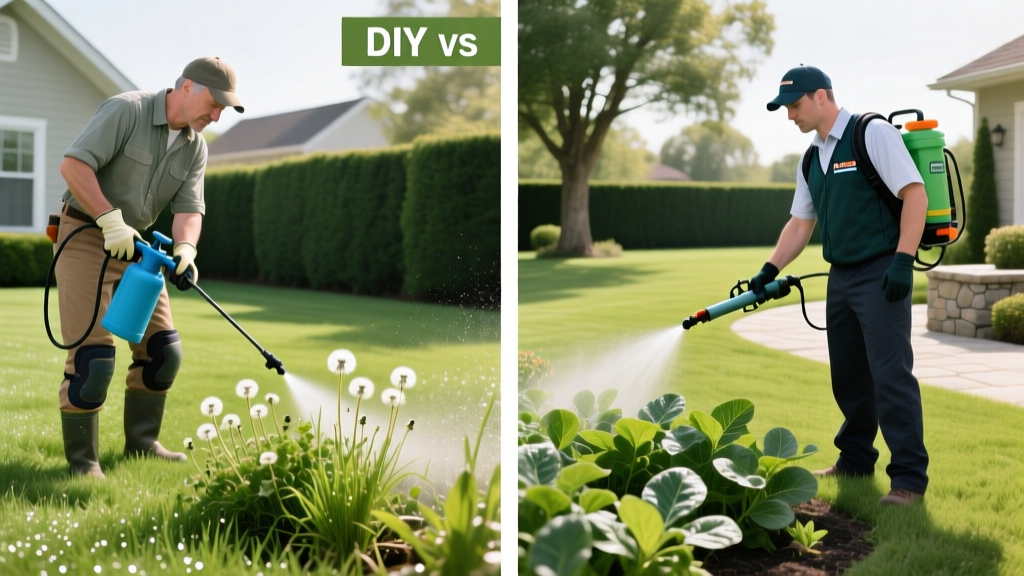
DIY vs Weed Control Company: Spot-Treating Stubborn Weeds
The Economics and Efficacy of Targeted Weed Eradication
Homeowners facing recurring patches of yellow nutsedge, wild violet, or dallisgrass quickly learn that broadcast spraying standard herbicides rarely solves the problem. These perennial and sedge species require precise spot-treatments using specific active ingredients and commercial-grade adjuvants. The core dilemma is whether to invest time and money into DIY retail chemicals or hire a professional weed control company to execute targeted applications. While DIY spot-treatment seems cheaper upfront, the failure rate on mature, established weeds often leads to repeated chemical purchases and eventual professional intervention. Understanding the chemical gap between retail shelves and commercial supplier inventories is critical for making the right decision for your lawn.
Cost and Success Matrix: DIY vs. Professional Spot-Treatment
The financial calculation for spot-treating stubborn weeds extends beyond the sticker price of a bottle. You must factor in the cost of specialized surfactants, application equipment, and the value of your time. Below is a comparative breakdown of tackling a 1,000-square-foot infestation of a stubborn weed like wild violet or nutsedge.
| Variable | DIY Retail Spot-Treatment | Professional Weed Control Company |
|---|---|---|
| Upfront Chemical Cost | $25 - $45 (Retail concentrate + basic surfactant) | $0 (Included in service call or annual program) |
| Service / Trip Fee | $0 | $75 - $125 minimum call-out fee (or bundled) |
| Equipment Required | $40 - $150 (Pump sprayer, shielded nozzle) | $0 (Pros use calibrated backpack or skid sprayers) |
| Active Ingredient Access | Limited to consumer-grade formulations (e.g., SedgeHammer) | Access to restricted or high-cost commercial chemicals (e.g., Revolver, Prosedge) |
| Success Rate on Mature Weeds | 40% - 60% (Often requires 3+ applications) | 85% - 95% (Often achieved in 1-2 targeted visits) |
Three Stubborn Species That Defeat Standard DIY Methods
Not all weeds are created equal. While broadleaf weeds like dandelions succumb easily to retail 2,4-D products, the following three species possess biological defenses that routinely defeat homeowner spot-treatments.
1. Yellow Nutsedge (Cyperus esculentus)
Nutsedge is technically a sedge, not a grass or a broadleaf weed, meaning standard lawn herbicides will not kill it. It reproduces via underground tubers (nutlets) that can remain dormant in the soil for years. According to Penn State Extension, pulling nutsedge by hand actually stimulates the remaining nutlets to sprout, worsening the infestation.
The DIY Limitation: Homeowners typically buy retail Halosulfuron-methyl (sold as SedgeHammer). While effective, retail packets are highly concentrated and difficult to mix accurately for small spot-treatments, leading to turf burn or under-dosing.
The Professional Edge: A weed control company uses commercial formulations like Prosedge, often tank-mixed with a non-ionic surfactant to ensure the herbicide penetrates the sedge's waxy leaf blade. Professionals also understand the critical timing: applications must be made when the nutsedge is actively growing but before it reaches the 5-leaf stage, preventing new nutlet formation.
2. Wild Violet (Viola papilionacea)
Wild violets are notorious for invading thin turf and shady areas. They spread via fleshy rhizomes and produce a thick, waxy cuticle on their leaves that acts as a biological shield against herbicides.
The DIY Limitation: Most ready-to-use (RTU) retail broadleaf sprays lack the necessary penetrating adjuvants. The herbicide beads up and rolls off the waxy violet leaf, resulting in superficial leaf burn while the root system remains entirely unaffected. The University of Minnesota Extension notes that controlling wild violets requires specific three-way herbicides combined with methylated seed oil (MSO) to dissolve the leaf cuticle.
The Professional Edge: Professionals tank-mix Trimec (2,4-D, MCPP, and Dicamba) with commercial-grade MSO. They also adjust their sprayer pressure to under 40 PSI, utilizing a flat-fan nozzle to deliver larger droplets that coat the violet leaves thoroughly without drifting onto nearby ornamental beds.
3. Dallisgrass (Paspalum dilatatum)
Dallisgrass is a perennial, warm-season grassy weed that forms unsightly, rapid-growing clumps in cool-season lawns. Because it is a grass, broadleaf herbicides are useless, and selective grassy-weed herbicides that are safe for turfgrass are incredibly rare.
The DIY Limitation: Historically, homeowners used MSMA to kill dallisgrass, but the EPA has restricted MSMA for residential lawn use. Currently, there are virtually no effective, affordable retail options for selectively killing dallisgrass in a fescue or bluegrass lawn without killing the surrounding turf.
The Professional Edge: Licensed applicators have access to foramsulfuron (brand name Revolver) or topramezone (Pylex). These chemicals selectively target dallisgrass while sparing cool-season turf. However, a single bottle of Revolver costs upwards of $180 and requires a commercial pesticide license to purchase in many states, making it economically unviable for a DIYer treating a few isolated clumps.
Warning on Retail 'Weed and Feed' Products: Do not rely on broadcast granular 'weed and feed' fertilizers for spot-treating stubborn perennials. These products rely on the weed's leaves absorbing the granular herbicide, which requires dew or moisture to stick. For waxy weeds like wild violet or upright sedges like nutsedge, granular applications yield a near 0% success rate.
The Chemical Gap: Adjuvants and Calibration
The most significant advantage a professional weed control company holds over a DIYer is not just the active ingredient, but the adjuvants and calibration. Adjuvants are additives that modify the herbicide's behavior.
- Methylated Seed Oil (MSO): Essential for penetrating the waxy cuticles of wild violets and mature broadleaves.
- Crop Oil Concentrates (COC): Used to increase herbicide absorption in cooler temperatures when weed metabolism is slow.
- Drift Reduction Agents (DRAs): Polymers added to the tank that increase droplet size, preventing the herbicide from vaporizing and drifting into your neighbor's vegetable garden or your prized rose bushes.
Furthermore, professionals calibrate their equipment to deliver exact gallons per acre (GPA). A DIYer pumping a hand sprayer to 60 PSI creates a fine mist that drifts easily and fails to deliver the lethal dose to the weed's crown. Pros dial their pressure down to 25-30 PSI for spot-treatments, ensuring heavy, targeted coverage.
Decision Framework: When to Call the Professionals
Use this practical matrix to determine if your weed problem warrants a professional service call or a DIY afternoon.
Choose DIY Spot-Treatment If:
- The weed is an annual broadleaf (e.g., henbit, chickweed, standard dandelions).
- The infestation is less than 5% of your total lawn area.
- You already own a high-quality pump sprayer and understand how to calculate square footage and mix ratios.
- You are treating cool-season weeds in early spring when temperatures are between 60°F and 75°F.
Hire a Weed Control Company If:
- You are battling grassy weeds (dallisgrass, crabgrass in late summer) or sedges (nutsedge, kyllinga).
- The weeds have deep rhizomes or tubers (wild violet, ground ivy, bindweed).
- Previous DIY applications resulted in leaf burn but the weed returned within 3 weeks.
- The infestation is near sensitive ornamental beds, requiring shielded nozzles and drift-reduction technology.
Vetting a Weed Control Company for Spot-Treatment Expertise
Not all lawn care providers excel at targeted spot-treatments; many prefer to blanket-spray entire properties to save time. When interviewing a company, ask these specific technical questions to verify their expertise, aligning with EPA guidelines for hiring pest control professionals:
- 'Do you include a penetrant surfactant like MSO in your broadleaf tank mix?' If they say no, or if they only use basic non-ionic surfactants for waxy weeds, look elsewhere.
- 'What nozzle type and pressure do you use for spot-treatments near landscape beds?' The correct answer should involve a flat-fan or air-induction nozzle (like a Turbo TeeJet) operated at low pressure (under 40 PSI) to minimize drift.
- 'How do you handle perennial grassy weeds like dallisgrass?' If they suggest pulling it by hand or using standard pre-emergents, they lack the specialized post-emergent chemicals (like foramsulfuron) required for actual eradication.
Spot-treating stubborn weeds is a game of biological chess. By understanding the specific chemical and mechanical requirements of nutsedge, wild violet, and dallisgrass, you can accurately weigh the hidden costs of DIY trial-and-error against the targeted efficacy of a professional weed control company.

