
Lawn Care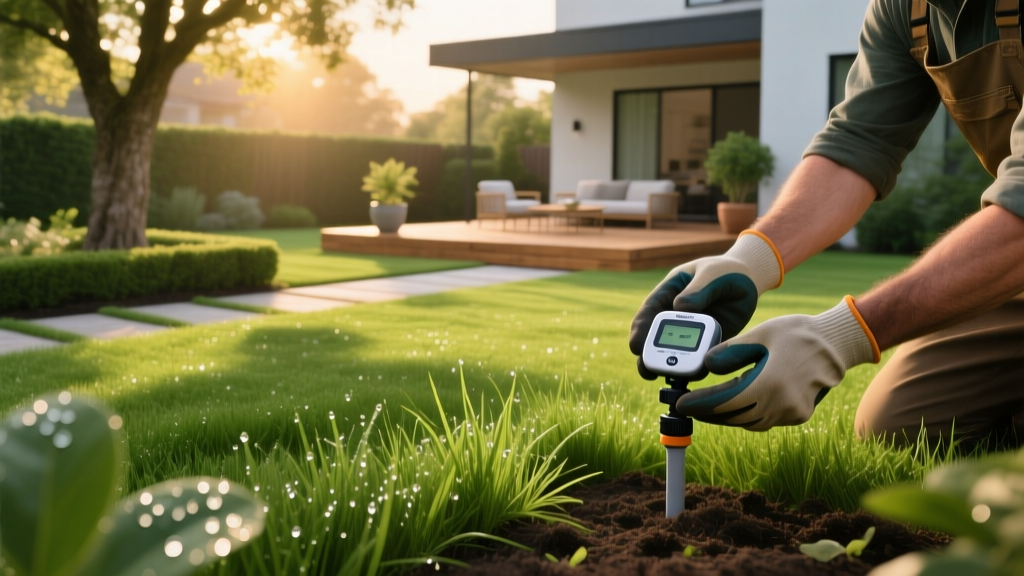
How Frequently to Water Lawn Grass: The Deep-Root Schedule
The Core Framework: Determining Your Baseline Frequency
The most pervasive myth in residential landscaping is that a lawn needs a light sprinkle every single day. In reality, daily shallow watering trains grass roots to stay near the surface, making them highly vulnerable to heat stress, drought, and fungal pathogens. The fundamental rule of turfgrass irrigation is deep, infrequent watering. But figuring out exactly how frequently to water lawn areas requires moving beyond generic advice and looking at your specific soil profile and local evapotranspiration (ET) rates.
According to the EPA WaterSense program, most established lawns require between 1 and 1.5 inches of water per week to thrive during the active growing season. This includes both rainfall and irrigation. However, how you divide that 1.5 inches across the week depends entirely on your soil's infiltration rate. Applying 1.5 inches all at once on heavy clay will result in massive runoff, while applying it to sandy soil will drain past the root zone before the grass can absorb it.
Soil Type and Watering Frequency Matrix
| Soil Type | Infiltration Rate | Optimal Weekly Frequency | Irrigation Strategy |
|---|---|---|---|
| Sandy Loam | 1.5 - 2.0+ in/hr | 2 to 3 times per week | Standard continuous run. Water drains quickly, requiring more frequent but shorter cycles to prevent deep percolation loss. |
| Loam | 0.5 - 1.0 in/hr | 1 to 2 times per week | Deep watering. Ideal soil structure holds moisture well in the top 6-8 inches of the root zone. |
| Heavy Clay | 0.2 - 0.5 in/hr | 1 to 2 times per week | Cycle-and-Soak method required. Run sprinklers for 10 minutes, wait 30 minutes for absorption, then run again to prevent surface runoff. |
Warning: The Daily Watering Trap
Watering for 10 minutes every morning might keep the top inch of soil green, but it encourages shallow root growth. When summer temperatures spike above 90°F, the topsoil dries out in hours, causing rapid wilting. Always aim to moisten the soil to a depth of 6 inches, which typically requires 0.5 to 0.75 inches of water per session.
Cool-Season vs. Warm-Season Grass Hydration Needs
The frequency of your watering schedule must also adapt to the biological needs of your specific turfgrass species. The University of Minnesota Extension notes that cool-season grasses have peak water demands during the hot summer months when they are fighting heat stress, while warm-season grasses are in their prime growth phase and utilize water more efficiently.
- Kentucky Bluegrass & Tall Fescue (Cool-Season): Require 1.2 to 1.5 inches per week in summer. Fescue has deeper roots and can stretch to 1 inch per week, but Bluegrass will go dormant and turn brown if it drops below 1.2 inches without supplemental irrigation.
- Perennial Ryegrass (Cool-Season): Highly susceptible to drought. Requires strict adherence to the 1.5-inch weekly rule, split into two sessions, as it lacks the deep rooting of fescue or the rhizome spread of bluegrass.
- Bermudagrass & Zoysia (Warm-Season): Highly drought-tolerant. Require only 0.5 to 1.0 inches per week. Bermudagrass can survive on as little as 0.25 inches, though it will lose its vibrant color and enter a state of semi-dormancy to protect its crown.
- St. Augustine (Warm-Season): The most water-demanding warm-season grass. Requires 1.0 to 1.25 inches per week and will show immediate leaf-folding (a sign of wilt) if the soil dries out past 4 inches deep.
Calibrating Your Irrigation System: The Catch-Can Test
You cannot manage what you do not measure. Knowing you need 1 inch of water is useless if you do not know how long your sprinklers need to run to deliver that exact amount. The Texas A&M AgriLife Extension recommends the 'Catch-Can Test' to determine your system's precipitation rate.
- Place Catch Cans: Set out 4 to 6 straight-sided containers (tuna cans or specialized rain gauges) evenly spaced across a single sprinkler zone.
- Run the Zone: Turn on that specific zone for exactly 15 minutes.
- Measure and Average: Use a ruler to measure the water depth in each can. Add the measurements together and divide by the number of cans to find the average depth.
- Calculate the Hourly Rate: Multiply the 15-minute average by 4 to get your inches-per-hour (IPH) rate.
- Determine Run Time: If your target is 0.75 inches per watering session, and your system outputs 1.5 inches per hour, you need to run that zone for exactly 30 minutes.
Note: Standard spray heads typically output 1.5 to 2.0 IPH, while rotary nozzles (like the Hunter MP Rotator) output only 0.4 to 0.6 IPH. Rotary nozzles require significantly longer run times but drastically reduce runoff and wind drift.
Upgrading to Smart Irrigation: Removing the Guesswork
If you are manually adjusting your controller every week based on the weather forecast, you are likely overwatering or underwatering. Modern smart irrigation controllers use local weather data and soil moisture sensors to automatically calculate exactly how frequently to water lawn zones based on real-time evapotranspiration (ET) deficits.
Two industry-leading options for residential retrofits include:
- Rachio 3 Smart Sprinkler Controller (8-Zone): Priced around $229, this Wi-Fi-enabled unit integrates with local weather stations to automatically skip watering before rain events and adjust run times based on seasonal ET shifts. It pays for itself in water savings within 12 to 18 months in most municipalities.
- Hunter Pro-C with Solar Sync Sensor: For homes without reliable Wi-Fi in the garage, the Hunter Pro-C base unit ($110) paired with the Solar Sync ET sensor ($85) measures local solar radiation and temperature to dynamically adjust the controller's seasonal percentage dial daily.
Seasonal Shifts: Adjusting Frequency from Spring to Fall
Your irrigation schedule is not static. As daylight hours and temperatures fluctuate, the atmospheric demand for water changes. Use this decision framework to adjust your frequency throughout the year:
- Early Spring (Soil temps below 65°F): Turn off automatic irrigation. Rely on spring rainfall. Overwatering cold soil promotes Pythium blight and shallow rooting before summer.
- Late Spring (Active growth, temps 70°F-80°F): Begin watering 1 time per week, delivering 0.75 to 1.0 inches. This encourages roots to chase the receding moisture deeper into the soil profile.
- Peak Summer (Temps 85°F+): Increase to 2 times per week, delivering 0.5 to 0.75 inches per session. Water strictly between 4:00 AM and 6:00 AM to minimize evaporation and prevent fungal diseases that thrive on wet nighttime foliage.
- Early Fall (Temps dropping below 75°F): Reduce back to 1 time per week. Cool-season grasses enter their peak root-building phase; deep, weekly watering supports carbohydrate storage for winter survival.
- Late Fall (Pre-Winterization): Stop watering entirely once the grass stops growing and soil temps drop below 50°F. Blow out irrigation lines with compressed air before the first hard freeze to prevent PVC pipe fractures.
Frequently Asked Questions
How frequently should I water new grass seed or sod?
Newly planted seed and unrooted sod are the exceptions to the deep-watering rule. Because their root systems are non-existent or only 1 inch deep, you must water lightly 2 to 4 times per day to keep the top 1 inch of soil constantly moist. Once the grass reaches 2 inches in height (seed) or cannot be easily lifted by the corners (sod), transition immediately to the standard deep, infrequent schedule to force roots downward.
Is it better to water at night or in the morning?
Always water in the early morning, ideally finishing by 6:00 AM. Watering at night leaves the grass blades wet for 12+ hours in cool temperatures, creating the perfect environment for dollar spot, brown patch, and Pythium blight. Mid-day watering is wasteful, as up to 30% of the water can be lost to evaporation and wind drift before it reaches the soil.
How do I know if my lawn needs water before my scheduled day?
Perform the 'footprint test.' Walk across your lawn and observe the grass blades. If your footprints remain visible and the grass blades do not spring back upright within 30 seconds, the turf is experiencing mild wilting and requires immediate irrigation, regardless of your scheduled frequency.

