
Lawn Care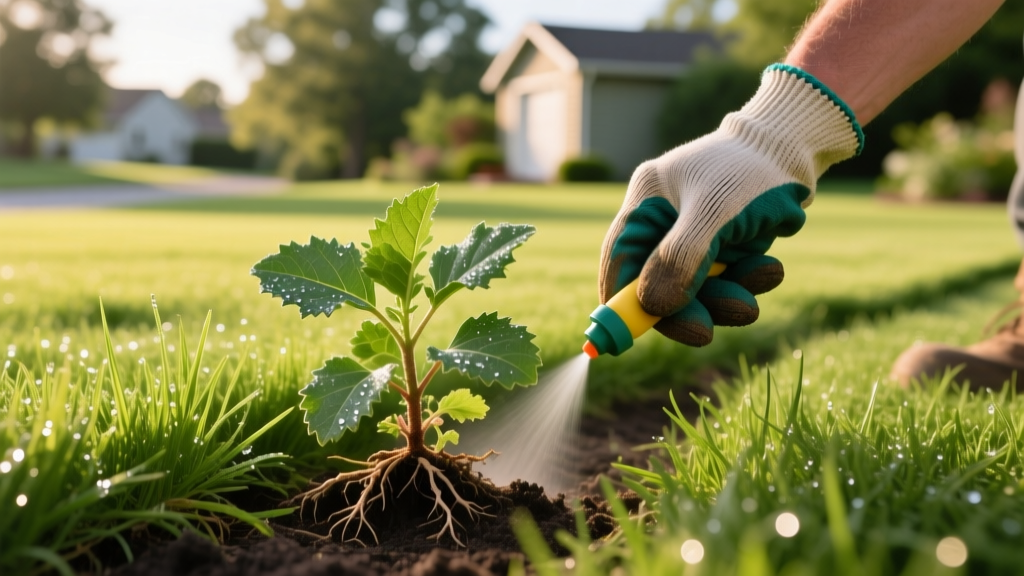
How to Destroy Weeds: Spot-Treatment Guide for Tough Lawn Invaders
The Biology of Weed Survival: Why Broadcast Spraying Fails
When homeowners ask how to destroy weeds effectively, the most common mistake is relying on broadcast applications of generic, big-box store herbicides. Broadcast spraying wastes chemical, damages desirable turf, and often fails to kill the root systems of mature perennial weeds. To truly eradicate invasive species, you must understand their biology and deploy targeted spot-treatment protocols.
Broadleaf perennials like dandelions (Taraxacum officinale) and plantain (Plantago major) survive via deep taproots that can extend 10 to 15 inches into compacted soil. If the top growth is burned off but the taproot remains intact, the weed will regenerate within 14 days. Conversely, grassy weeds like dallisgrass (Paspalum dilatatum) and crabgrass (Digitaria sanguinalis) spread through aggressive rhizomes and prolific seed heads. According to NC State Turfgrass Weed Science, understanding the specific growth habit of your target weed is the prerequisite for selecting the correct systemic or contact herbicide.
Spot-Treatment Arsenal: Active Ingredients & Product Matchups
Professional lawn care operators do not use "weed and feed" combinations for spot treatments. They use concentrated liquid active ingredients mixed in dedicated pump sprayers. Below is the 2026 professional matchup guide for the most stubborn lawn invaders.
| Target Weed Category | Primary Active Ingredient | Top Product (2026 Market) | Approx. Cost |
|---|---|---|---|
| Broadleaf Perennials | 2,4-D + Dicamba + Triclopyr | SpeedZone Southern | $45 / pint |
| Grassy Weeds (Crabgrass) | Quinclorac | Quinclorac 75 DF | $30 / lb |
| Tough Grassy (Dallisgrass) | Thiencarbazone + Topramezone | Celsius WG | $135 / 5 oz |
| Sedges (Nutsedge) | Halosulfuron-methyl | SedgeHammer+ | $25 / pack |
Protocol 1: Eradicating Broadleaf Perennials
For deep-rooted broadleaf weeds, you need a systemic herbicide that translocates from the leaf tissue down to the taproot. SpeedZone Southern is the industry standard because it contains carfentrazone, which provides a rapid "burndown" effect (visible wilting in 24 hours), while the 2,4-D and Triclopyr components work systemically over 14 days to destroy the root.
Pro-Tip: The Surfactant Multiplier
Never spray systemic herbicides with plain water. Broadleaf weeds have waxy cuticles that repel water. You must add a Non-Ionic Surfactant (NIS) like Southern Ag Surfactant ($15/quart). NIS reduces the surface tension of the spray droplet from 72 dynes/cm to roughly 30 dynes/cm, allowing the chemical to spread evenly across the leaf and penetrate the stomata. Mix at 0.25% v/v (approximately 0.66 fl oz of surfactant per gallon of water).
Never spray systemic herbicides with plain water. Broadleaf weeds have waxy cuticles that repel water. You must add a Non-Ionic Surfactant (NIS) like Southern Ag Surfactant ($15/quart). NIS reduces the surface tension of the spray droplet from 72 dynes/cm to roughly 30 dynes/cm, allowing the chemical to spread evenly across the leaf and penetrate the stomata. Mix at 0.25% v/v (approximately 0.66 fl oz of surfactant per gallon of water).
Protocol 2: Tackling Grassy Weeds and Sedges
Grassy weeds are notoriously difficult to destroy because they are biologically similar to your desirable turf. Using a non-selective herbicide like glyphosate will kill the weed, but it will also leave a dead, brown patch in your lawn.
For crabgrass, Quinclorac is highly effective. It acts as a synthetic auxin, causing abnormal cell division and epinasty (twisted growth) that eventually starves the plant. However, Quinclorac requires multiple applications spaced 21 days apart for mature, multi-tiller crabgrass. For dallisgrass, a notoriously tough perennial grassy weed, University of Minnesota Extension research highlights the efficacy of ALS and HPPD inhibitors found in Celsius WG. Celsius is uniquely safe for warm-season turfgrasses like Bermuda and Zoysia, selectively destroying dallisgrass without bleaching the surrounding lawn.
The Execution: Step-by-Step Spot Spraying Mechanics
Knowing how to destroy weeds chemically is only half the battle; mechanical application dictates success. Follow this exact protocol for spot-treating a 5,000 sq ft lawn with scattered weed pressure.
- Calibrate Your Sprayer: Use a dedicated 2-gallon poly pump sprayer. Never use a sprayer that has previously held glyphosate or soil sterilants, as cross-contamination will kill your turf. Pump to 40 PSI.
- Select the Right Nozzle: Swap the standard cone nozzle for a TeeJet 8002VS flat fan nozzle. Flat fan nozzles produce a uniform, directional spray pattern that minimizes wind drift onto desirable plants.
- Mix the Solution: Fill the sprayer halfway with clean water. Add your measured herbicide (e.g., 1.5 fl oz of SpeedZone per gallon). Add the NIS surfactant. Fill the rest of the tank with water and agitate gently to prevent foaming.
- Target the Rosette: When spraying dandelions or plantain, aim directly at the center "rosette" of the weed. Do not spray to the point of runoff. The leaves should be visibly wet, but the liquid should not be dripping off the edges onto the soil.
- Observe the Weather Window: Apply only when wind speeds are below 5 mph and temperatures are between 65°F and 85°F.
⚠️ CRITICAL WARNING: Temperature Volatility
Many professional broadleaf herbicides use "ester" formulations of 2,4-D for rapid absorption. However, esters are highly volatile. If you spot-treat when ambient temperatures exceed 85°F, the chemical will vaporize and drift through the air, causing severe curling and damage to nearby ornamental shrubs, tomatoes, and desirable turf. In peak summer heat, you must switch to "amine" formulations, which are less volatile but slightly slower to absorb.
Many professional broadleaf herbicides use "ester" formulations of 2,4-D for rapid absorption. However, esters are highly volatile. If you spot-treat when ambient temperatures exceed 85°F, the chemical will vaporize and drift through the air, causing severe curling and damage to nearby ornamental shrubs, tomatoes, and desirable turf. In peak summer heat, you must switch to "amine" formulations, which are less volatile but slightly slower to absorb.
Post-Destruction Soil Recovery and Prevention
Once you have successfully destroyed the weeds, you are left with bare soil patches. According to Purdue University Turfgrass Science, bare soil is an open invitation for the next wave of weed seeds to germinate. The final step in the spot-treatment protocol is immediate ecological recovery.
Overseeding and Pre-Emergent Timing
If you are treating cool-season lawns (Fescue, Kentucky Bluegrass) in the fall, wait 14 to 21 days after your final herbicide application before overseeding the bare patches. Herbicides like Triclopyr and Quinclorac have soil residual activity that can inhibit the germination of new grass seed. Use a hand spreader to drop high-quality, weed-free seed into the bare spots, and top-dress with a 1/4 inch layer of compost to retain moisture.
If you are treating warm-season lawns in the spring, the focus shifts to pre-emergent herbicides. Once the spot-treatment has killed the existing visible weeds, apply a pre-emergent like Prodiamine 65 WDG at a rate of 0.185 oz per 1,000 sq ft. This creates a chemical barrier in the top inch of the soil, preventing dormant crabgrass and Poa Annua seeds from sprouting in the newly opened spaces. By combining precise chemical spot-treatments with aggressive soil recovery, you transition from reactive weed killing to proactive lawn management.

