
Lawn Care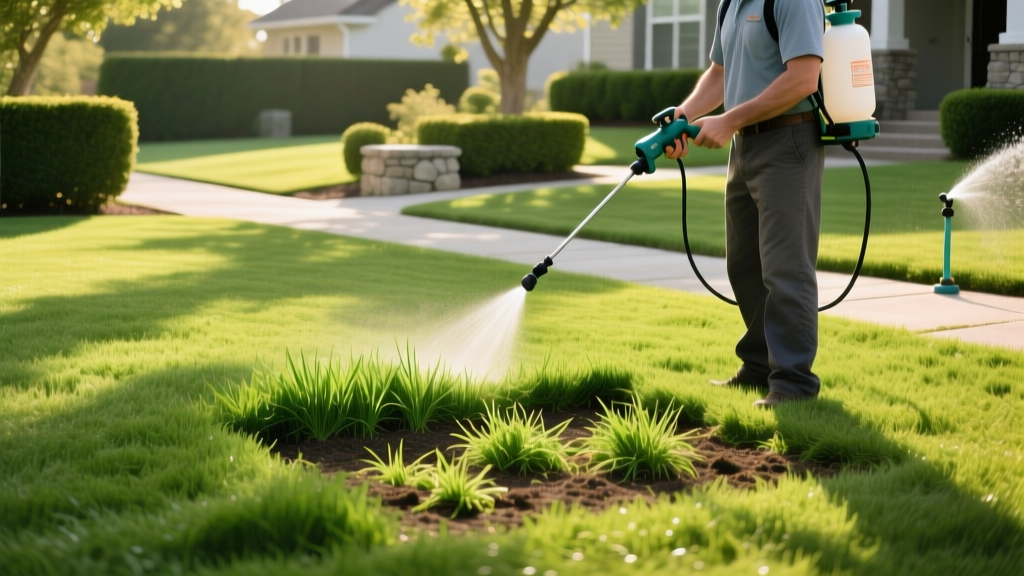
How to Eliminate Crabgrass: Spot-Treatment and Post-Emergent Guide
The Biology of Crabgrass Infestations
Crabgrass (Digitaria sanguinalis and Digitaria ischaemum) is a prolific summer annual weed that thrives in hot, compacted, and poorly nourished soil. Understanding how to eliminate crabgrass requires recognizing its life cycle. Germination triggers when soil temperatures consistently reach 55°F to 60°F at a two-inch depth for three consecutive days. Once the plant reaches the third-tiller stage—characterized by lateral branching at the base—it develops a robust root system and a waxy leaf cuticle that heavily resists standard contact herbicides.
Spot-treating crabgrass is fundamentally different from broadcasting pre-emergents. When you discover crabgrass in mid-to-late summer, the window for prevention has closed. Your objective shifts to post-emergent systemic eradication, which requires specific active ingredients, precise adjuvants, and strict temperature management to avoid damaging your desirable turf.
Active Ingredient Breakdown & Efficacy Matrix
Not all post-emergent herbicides are effective against mature crabgrass, and turfgrass safety varies drastically by active ingredient. Below is a comparison of the three most effective systemic herbicides for crabgrass spot-treatment.
| Active Ingredient | Common Trade Names | Safe For Grass Types | Application Rate (per 1,000 sq ft) | Avg. Cost per 1k sq ft |
|---|---|---|---|---|
| Quinclorac | Drive XLR8, Bayer Advanced Crabgrass Killer | Kentucky Bluegrass, Fescue, Zoysia, Bermuda | 0.75 fl oz + Surfactant | $0.12 - $0.18 |
| Fenoxaprop-p-ethyl | Acclaim Extra | Cool-season grasses ONLY (Fescue, Bluegrass, Ryegrass) | 0.41 fl oz | $0.25 - $0.30 |
| Mesotrione | Tenacity | Cool-season grasses, Centipedegrass, St. Augustine | 1/3 tsp + Surfactant | $0.35 - $0.45 |
⚠️ CRITICAL GRASS TYPE WARNING: Quinclorac will severely damage or kill St. Augustinegrass and Bahiagrass. Fenoxaprop-p-ethyl will cause severe phytotoxicity (browning and dieback) in all warm-season grasses. Always verify your turf species before purchasing an herbicide. If you have St. Augustine, Mesotrione (Tenacity) is your only viable post-emergent chemical option.
The Post-Emergent Spot-Treatment Protocol
To successfully eradicate visible crabgrass without harming surrounding turf, follow this exact mixing and application sequence. This protocol assumes the use of Quinclorac on a cool-season or safe warm-season lawn.
Step 1: Preparation and Mowing
Mow your lawn to a height of 2.5 inches 24 hours before application. This removes excess leaf canopy from the surrounding desirable grass, ensuring the herbicide directly contacts the crabgrass tillers. Do not water the lawn for 24 hours prior to spraying; slightly drought-stressed crabgrass absorbs systemic herbicides more aggressively as it pulls moisture (and the chemical) down into its root zone.
Step 2: Mixing the Solution
For a standard 1-gallon pump sprayer calibrated to cover 1,000 square feet:
- Add 0.75 fluid ounces of Quinclorac (e.g., Drive XLR8).
- Add 0.5 fluid ounces of Methylated Seed Oil (MSO) or a high-quality Non-Ionic Surfactant (NIS). Crabgrass leaves are covered in microscopic silica hairs and a waxy cuticle; the surfactant breaks this surface tension, preventing the spray from beading up and rolling off.
- Fill the remainder with water and shake vigorously for 30 seconds.
Step 3: Targeted Application
Adjust your sprayer nozzle to a tight, low-pressure stream rather than a wide mist. Spray the crabgrass until the leaves are visibly wet but not dripping. Focus heavily on the crown (the base where the stems meet the soil), as this is the primary growth point. Systemic herbicides like Quinclorac mimic plant growth hormones (auxins), causing the weed to grow itself to death from the inside out.
Troubleshooting Failure Modes and Edge Cases
Homeowners frequently report that spot-treatments "didn't work." In 90% of cases, the failure stems from one of three environmental or biological edge cases:
1. The Purple Stem Indicator (Mature Tillering)
If the base of your crabgrass stems has turned deep purple or red, the plant has reached advanced maturity and developed significant lignin (woody tissue). A single application of Quinclorac will only burn the leaves, leaving the root crown intact to push out new growth. The Fix: You must apply a second treatment exactly 14 to 21 days after the first application to kill the regenerating crown.
2. Heat Stress Phytotoxicity
Applying post-emergent herbicides when ambient air temperatures exceed 85°F causes rapid evaporation of the spray droplets and severe stress to your desirable turf. The herbicide can volatilize (turn into a gas) and drift, damaging nearby ornamental plants or desirable grass. The Fix: Only spray in the early morning (between 6:00 AM and 9:00 AM) when temperatures are below 80°F and dew has just dried.
3. Missing the Surfactant
Quinclorac applied with plain water will fail against mature crabgrass. According to turfgrass researchers at the University of Minnesota Extension, the inclusion of an oil-based adjuvant like MSO increases foliar absorption by up to 40%, which is mandatory for overcoming the plant's natural defenses in late summer.
Pre-Emergent Backup: Stopping the Next Generation
Eliminating current crabgrass is only half the battle. A single mature crabgrass plant can produce up to 150,000 seeds that remain viable in your soil seed bank for up to three years. To prevent a massive resurgence the following spring, you must apply a pre-emergent herbicide.
The industry standard for crabgrass pre-emergent control is Dithiopyr (Trade name: Dimension). Unlike older products like Prodiamine (Barricade), Dithiopyr possesses early post-emergent activity, meaning it can still kill crabgrass that has germinated but hasn't yet reached the two-leaf stage. Apply Dimension at a rate of 0.38 lbs of active ingredient per acre (roughly 0.15 oz per 1,000 sq ft for standard liquid formulations) when soil temperatures reach 50°F in early spring. For detailed regional timing and soil temperature tracking, consult the University of Maryland Extension turfgrass guidelines.
Frequently Asked Questions
Can I pull crabgrass by hand instead of spraying?
Hand-pulling is only effective if the plant is young (first or second-tiller stage) and the soil is heavily saturated. Once crabgrass matures, its deep, fibrous root system breaks off when pulled, leaving the crown in the soil to regenerate. Furthermore, pulling mature plants often scatters seeds directly into the freshly disturbed soil, guaranteeing future germination.
Will Tenacity (Mesotrione) kill crabgrass in one application?
No. Mesotrione is a HPPD-inhibitor that causes the crabgrass to bleach white and eventually die. Because it is a slower-acting systemic, it typically requires two applications spaced two to three weeks apart for complete control. However, it is the safest option for St. Augustine and Centipede lawns where Quinclorac is prohibited.
How long should I wait to overseed after spot-treating crabgrass?
Quinclorac leaves a residual in the soil that can inhibit the germination of desirable cool-season grass seeds. You must wait at least 28 days after your final Quinclorac application before overseeding with Tall Fescue or Kentucky Bluegrass. If you use Fenoxaprop-p-ethyl (Acclaim Extra), there is no reseeding waiting period, making it the preferred choice for late-summer renovation projects on cool-season lawns.

