
Lawn Care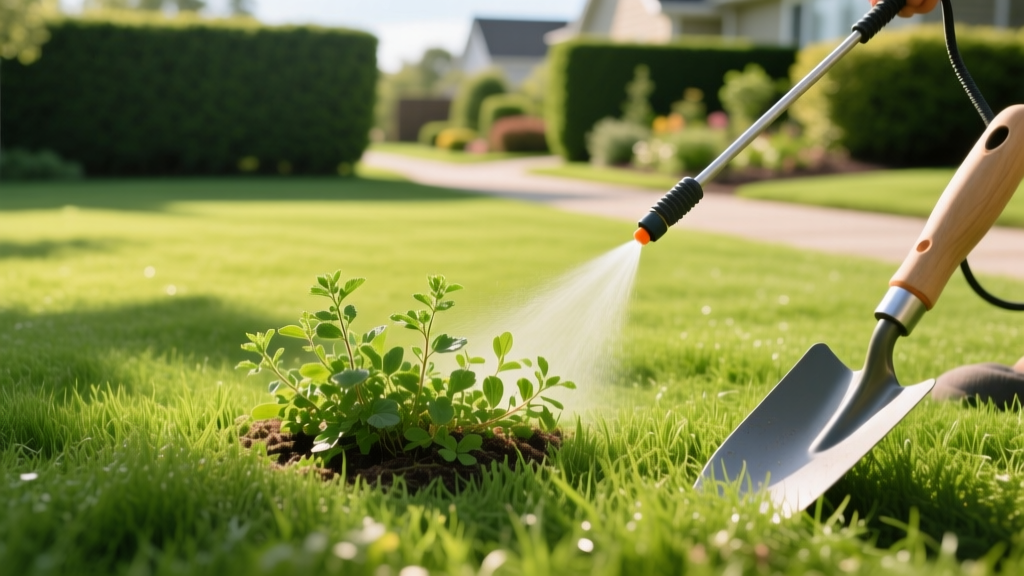
How to Get Rid of Weeds: A Spot-Treatment Guide for Lawns
The Economics and Agronomy of Spot-Treatment
Broadcast spraying your entire lawn with pre-emergents and post-emergents is an outdated, expensive approach that damages soil microbiomes and accelerates herbicide resistance. When figuring out how to get rid of weeds efficiently, spot-treatment is the superior strategy. By targeting individual weeds or isolated patches, you reduce chemical usage by up to 85%, save roughly $120 to $200 annually on commercial-grade herbicides, and preserve the beneficial nematodes and mycorrhizal fungi in your untreated soil. According to Purdue University's Turfgrass Science program, localized treatment also prevents the 'rebound effect' where broad-spectrum applications wipe out competing desirable grasses, inadvertently creating bare spots for new weed seeds to germinate.
The Spot-Treatment Decision Matrix
Selecting the wrong active ingredient is the primary reason homeowners fail to eradicate weeds. Use this matrix to match the weed species with the correct chemical profile.
| Weed Category | Target Species | Active Ingredient | Product Example (2026 Pricing) |
|---|---|---|---|
| Broadleaf (Taproot) | Dandelion, Plantain | 2,4-D + Dicamba + MCPP | Ortho WeedClear for Lawns (~$15/gal) |
| Broadleaf (Stoloniferous) | White Clover, Ground Ivy | Triclopyr + Quinclorac | Celsius WG (~$130/10oz pro-grade) |
| Grassy (Annual) | Crabgrass, Foxtail | Quinclorac | Bayer Advanced All-In-One (~$22/bottle) |
| Grassy (Perennial) | Dallisgrass, Johnsongrass | Fluazifop-p-butyl | Ortho Grass B Gon (~$18/bottle) |
| Sedge | Nutsedge (Yellow/Purple) | Halosulfuron-methyl | SedgeHammer+ (~$28/packet) |
Identifying and Treating Broadleaf Weeds
Broadleaf weeds are generally the easiest to control due to their distinct vascular systems, which allow selective herbicides to kill them without harming monocot turfgrasses. The most effective chemistry for common invaders like dandelions and clover is a three-way blend of 2,4-D, dicamba, and MCPP.
Application Protocol for Taproot Weeds
Dandelions and plantains rely on deep taproots that can extend 10 to 15 inches into compacted soil. If you only burn off the top growth, the weed will resprout within three weeks. To achieve total root kill:
- Timing: Apply when daytime temperatures are between 65°F and 85°F. Herbicide translocation (the movement of the chemical from leaf to root) halts when temperatures exceed 90°F or drop below 50°F.
- Coverage: Spray until the leaves are visibly wet, but not dripping. A single 1-gallon pump sprayer should cover roughly 1,000 square feet of spot-treatment area.
- Patience: Systemic herbicides take 7 to 14 days to kill the root. You will see the leaves begin to curl and twist (epinasty) within 48 hours. Do not re-spray during this window.
⚠️ Volatility Warning: Never apply ester-based 2,4-D formulations when temperatures exceed 85°F. The chemical will vaporize and drift into neighboring garden beds, causing severe twisting and damage to sensitive broadleaf plants like tomatoes and hydrangeas. Always opt for amine formulations during late spring and summer.
Tackling Grassy Weeds: The Harder Battle
Grassy weeds share the same biological classification as your turf, making selective eradication significantly more complex. The EPA's guidelines on safe pest control emphasize strict adherence to label rates for these chemicals, as overdosing will cause severe phytotoxicity to your desirable lawn.
Crabgrass and Quinclorac Chemistry
Quinclorac is the gold standard for post-emergent crabgrass control. However, it is highly dependent on adjuvants. If you are mixing a professional concentrate like Drive XLR8, you must add a Non-Ionic Surfactant (NIS) at a rate of 0.25% v/v (approximately 1/2 ounce per gallon of water). The surfactant breaks the surface tension of the waxy cuticle on the crabgrass leaf, allowing the herbicide to penetrate. Without it, efficacy drops by over 60%.
🛑 Cultivar Edge Case: Do not use quinclorac on 'Floratam' St. Augustinegrass. It will cause severe chlorosis, stunting, and potential turf death. For Floratam lawns, rely on Atrazine (applied in cool weather) or manual extraction.
Step-by-Step Dallisgrass Extraction
Dallisgrass is a deep-rooted perennial that forms unsightly clumps. Herbicides alone rarely provide 100% control on mature clumps.
- Step 1: Use a weeding fork to loosen the soil in a 6-inch radius around the clump.
- Step 2: Extract the entire root mass (rhizomes). If fragments remain, they will regenerate.
- Step 3: Spot-treat any remaining perimeter shoots with Fluazifop (safe for most warm-season grasses) or manually pull them weekly for one month.
Equipment Calibration for Precision Spraying
The hardware you use dictates the success of your spot-treatment. Cheap, OEM nozzles included with hardware store sprayers produce uneven droplet sizes, leading to localized chemical burns and untreated gaps.
💡 Pro Equipment Upgrade: Swap your standard fan tip for a TeeJet 8002EVS extended-range flat spray nozzle (approx. $8). This delivers a precise, uniform droplet size at 40 PSI, reducing off-target drift by up to 30%. Pair this with a blue dye marker like Hi-Yield Spray Marker ($12/pint) to visually track exactly which weeds you have treated, preventing accidental double-dosing.
Post-Treatment Lawn Recovery and Overseeding
Once the weeds are dead, you must fill the voids to prevent new seeds from taking root. Timing is critical. Herbicide residues persist in the soil and will kill germinating grass seed.
- 2,4-D / Dicamba / Triclopyr: Wait a minimum of 28 days before overseeding or laying new sod.
- Quinclorac: Wait at least 21 days; some sensitive fescue blends require 45 days.
- Mesotrione (Tenacity): Can be applied at the exact time of seeding, making it the only viable option for weed control during a fall renovation.
After the waiting period, rake out the dead weed debris, apply a starter fertilizer (look for an N-P-K ratio of 18-24-12), and sow your grass seed at the recommended rate (e.g., 6-8 lbs per 1,000 sq ft for Tall Fescue). For comprehensive regional turf management strategies, consult your local university extension, such as the Penn State Turfgrass Extension resources.
Expert FAQ on Weed Eradication
How long does it take for spot-treated weeds to die?
Systemic broadleaf herbicides (2,4-D, Triclopyr) take 7 to 14 days for complete root kill, though visible leaf curling occurs in 48 hours. Contact herbicides like Diquat burn the foliage in 24 hours but do not kill the roots of perennial weeds.
Is it safe for pets to walk on the lawn after spot-treatment?
Yes, once the liquid application has completely dried. This typically takes 2 to 4 hours depending on humidity and sunlight. Keep pets and children off the treated zones until the grass blades are dry to the touch to prevent paw-pad irritation and accidental ingestion.
Why did my clover survive the weed killer?
White clover has a waxy leaf cuticle that repels water-based sprays. If your product does not contain a built-in surfactant, the chemical will bead up and roll off the leaf. Add a liquid dish soap (1/4 teaspoon per gallon) or a commercial NIS to your tank mix to ensure the herbicide adheres to and penetrates the clover leaves.

