
Lawn Care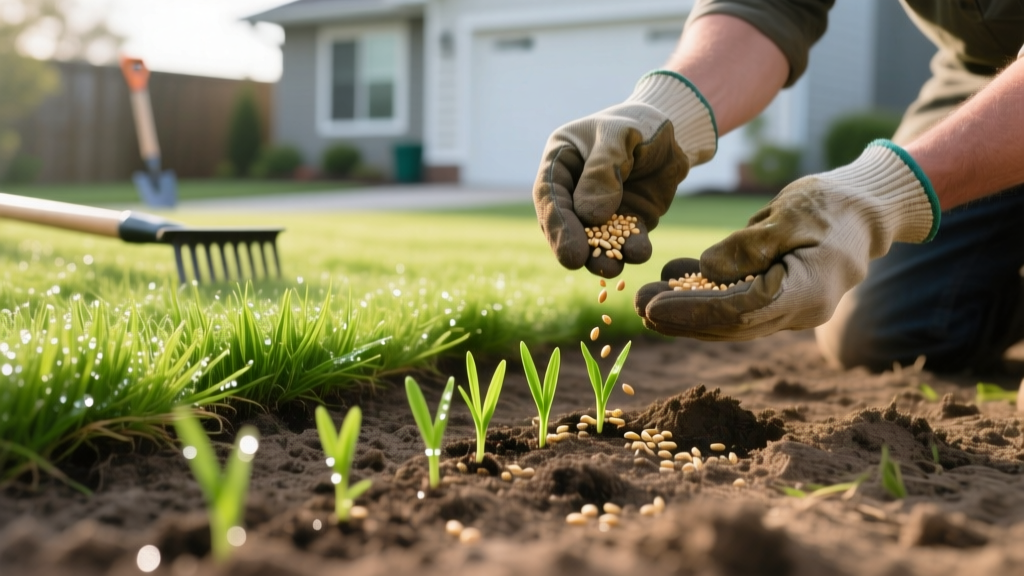
How to Grow Grass on Dirt: Bare Soil Seeding Masterclass
The Reality of Bare Dirt: Why Seed Fails Without Intervention
There is a fundamental agronomic difference between "dirt" and "soil." Dirt is dead, compacted mineral matter lacking organic carbon, microbial life, and cation exchange capacity (CEC). If you broadcast grass seed directly onto bare dirt, you will face a germination failure rate exceeding 80%. The seeds will either wash away, bake in the sun, or fail to establish root contact. Learning how to grow grass on dirt requires a systematic approach to transforming lifeless dirt into a biologically active seedbed.
This guide bypasses generic advice and provides exact measurements, product specifications, and agronomic frameworks to establish a thick, resilient lawn from a bare dirt canvas.
Phase 1: Subgrade Preparation and Grading
Before adding amendments, the physical structure of the dirt must be corrected. Bare dirt in new construction or heavily trafficked areas is often compacted to a bulk density above 1.6 g/cm³, which physically restricts root penetration.
💡 The Percolation Test: Dig a hole 12 inches deep and 12 inches wide. Fill it with water and let it drain. Refill it and measure the drop in water level after one hour. If it drops less than 1 inch, your dirt is severely compacted and requires deep mechanical aeration or tilling before planting.
Step-by-Step Subgrade Prep
- Clear Debris: Remove all rocks larger than 1 inch, construction debris, and existing weed roots. Use a heavy-duty landscape rake.
- Mechanical Tilling: Use a rear-tine rototiller to break the dirt to a depth of 4 to 6 inches. Do not till when the dirt is wet; this creates hard clods that ruin the seedbed. The dirt should crumble when squeezed in your fist.
- Establish Grade: Slope the bare dirt away from your home's foundation at a minimum drop of 1/4 inch per linear foot. Use a 4-foot carpenter's level and a wooden stake to verify the pitch.
Phase 2: Amending Dirt into Soil
According to Penn State Extension, establishing turf on unamended subsoil leads to chronic nutrient deficiencies and drought stress. You must integrate organic matter to increase the soil's water-holding capacity and microbial activity.
Amendment Matrix by Soil Texture
Perform a simple "Mason Jar Test" (fill a jar 1/3 with dirt, add water and a drop of dish soap, shake, and let settle for 24 hours) to determine your base dirt texture, then apply the corresponding amendments:
| Base Dirt Type | Primary Issue | Required Amendment (per 1,000 sq ft) | Estimated Material Cost (2026) |
|---|---|---|---|
| Heavy Clay | Poor drainage, severe compaction, crusting | 2 cubic yards compost + 100 lbs Profile Porous Ceramic (PPC) | $120 - $160 |
| Sandy Dirt | Nutrient leaching, low water retention | 3 cubic yards peat-based compost + 50 lbs biochar | $150 - $190 |
| Silt/Loam | Moderate drainage, lacks organic carbon | 1 cubic yard screened topsoil + 1 cubic yard leaf compost | $70 - $100 |
Application Protocol: Spread the amendments evenly over the tilled dirt. Run the rototiller over the area a second time at a depth of 4 inches to thoroughly blend the organic matter into the mineral dirt. Rake the surface smooth with a leveling rake (like the Rocklin Industry Levelawn Pro) to eliminate low spots where water will pool.
Phase 3: Seed Selection and Sowing Mechanics
Choosing the right seed is critical. Bare dirt lacks the thermal mass of established soil, meaning temperature fluctuations are extreme. Consult the UMass Extension Turf Program for regional adaptability, but generally, you must select seeds with high vigor ratings.
Premium Seed Cultivar Recommendations
- Cool-Season (Northern/Midwest): Jonathan Green Black Beauty Ultra. This blend includes endophyte-enhanced Tall Fescue and Kentucky Bluegrass. Endophytes naturally deter surface-feeding insects like chinch bugs. Seeding Rate: 8 to 10 lbs per 1,000 sq ft.
- Warm-Season (South/Sunbelt): Pennington Sahara Bermudagrass. Engineered for rapid germination in high-heat bare dirt environments. Seeding Rate: 2 to 3 lbs per 1,000 sq ft.
- Shade-Heavy Bare Dirt: Scotts Turf Builder Dense Shade Mix. Contains fine fescues that tolerate low light, though bare dirt in shade often requires a 20% higher seeding rate to account for lower photosynthetic vigor.
⚠️ The Cross-Hatch Sowing Technique: Never dump seed in one pass. Set your broadcast spreader (e.g., Scotts Elite Spreader) to half the recommended dial setting. Walk North-to-South applying the first half of the seed, then walk East-to-West applying the second half. This eliminates striping and ensures uniform density.
Phase 4: Seed-to-Soil Contact and Mulching
Grass seed requires direct physical contact with the soil to imbibe water and trigger germination. Seed left sitting on top of loose dirt will desiccate within hours.
- Rake In: Use a leaf rake (turned upside down) or a specialized seed roller to press the seed into the top 1/8 inch of the soil. Do not bury it deeper than 1/4 inch, or the coleoptile will exhaust its energy before reaching the surface.
- Apply Starter Fertilizer: Use a high-phosphorus starter fertilizer like Scotts Turf Builder Starter Food (20-27-5). Phosphorus is immobile in soil and must be placed near the seed zone to drive early root development (radicle emergence).
Mulch the Seedbed: Bare dirt dries out rapidly. Apply a 1/4 inch layer of hydro-mulch, peat moss, or clean weed-free straw. Pro Tip: Use Penn Mulch (recycled newspaper pellets) which expands when wet, holds 4x its weight in water, and eliminates the risk of importing weed seeds via agricultural straw.
Phase 5: The Germination Watering Protocol
Overwatering bare dirt causes "damping-off" (a fatal fungal disease), while underwatering kills the fragile radicle. The Cornell University Turfgrass Program emphasizes frequent, light irrigation during the first 21 days.
21-Day Watering Schedule
| Days Post-Seeding | Watering Frequency | Duration per Zone | Visual Soil Target |
|---|---|---|---|
| Days 1 - 10 | 3 to 4 times daily | 3 to 5 minutes | Surface is constantly damp, never pooling |
| Days 11 - 18 | 2 times daily | 8 to 10 minutes | Top 1 inch is moist, subsoil begins to dry slightly |
| Days 19 - 28 | 1 time daily (early morning) | 15 to 20 minutes | Encouraging roots to chase deeper moisture |
🛑 Hydrophobic Dirt Warning: If your bare dirt has a high clay content and bakes in the sun, it can become hydrophobic (water-repellent). If water beads up and runs off instead of absorbing, apply a liquid soil surfactant like SimpleLawn Solutions Soil Surfactant to break the surface tension and allow water to penetrate the seed zone.
Phase 6: The First Mow and Root Establishment
Do not mow the lawn until the new grass reaches a height of 3.5 to 4 inches. When you do mow, adhere strictly to the 1/3 Rule: never remove more than one-third of the grass blade in a single pass. Set your mower deck to 3 inches. Ensure your mower blade is razor-sharp; a dull blade will shred young, tender grass tissue, opening the door for Pythium blight and pulling shallow-rooted seedlings completely out of the dirt.
Troubleshooting Bare Dirt Failures
- Patchy Germination: Usually caused by uneven seed distribution or poor seed-to-soil contact. Fix by lightly raking bare spots and overseeding at half the normal rate.
- Yellowing Seedlings: Indicates a nitrogen deficiency or a pH lockout. Bare dirt often has extreme pH levels. If you skipped a soil test, apply a light dose of liquid chelated iron and a balanced 10-10-10 fertilizer to correct the deficiency.
- Washouts: If heavy rain washed your seed away before germination, you failed to use a tackifier or mulch. Re-grade the ruts, apply a hydromulch with a tackifier, and reseed.
Transforming barren dirt into a thriving lawn is a test of patience and precision. By mechanically breaking the compaction, aggressively amending the organic profile, and managing the micro-climate of the seedbed through targeted irrigation, you will establish a dense turf that will outcompete weeds and withstand environmental stress for years to come.

