
Lawn Care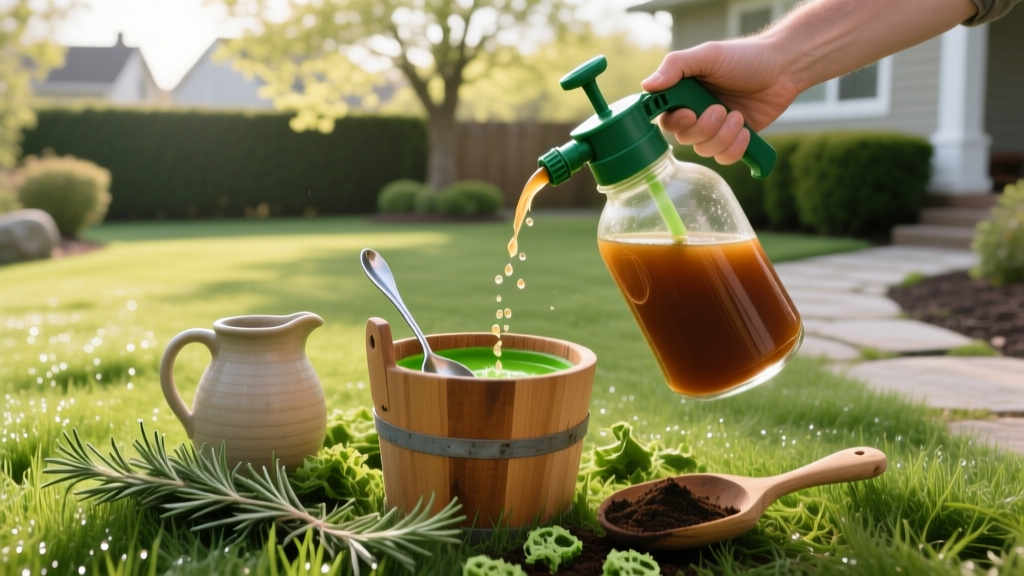
How to Prepare Fertilizer for Lawns: Liquid Mixing & Organic Teas
The Economics and Agronomy of DIY Fertilizer Preparation
Knowing how to prepare fertilizer at home shifts your lawn care strategy from passive consumer to active agronomist. While pre-packaged liquid lawn foods and granular blends offer convenience, they carry a massive markup for water weight and proprietary branding. In 2026, a premium branded liquid lawn fertilizer costs roughly $0.015 per square foot. By sourcing raw soluble salts and preparing your own liquid concentrates, or by brewing biologically active organic compost teas, you can drop your cost to under $0.002 per square foot while gaining complete control over your soil's nitrogen-phosphorus-potassium (NPK) ratios and microbial life.
Preparing fertilizer is not simply dumping powder into water. It requires an understanding of solubility limits, chemical compatibility, and biological aeration. According to turfgrass researchers at the University of Minnesota Extension, precise calibration and proper nutrient mixing are critical to preventing leaf burn and ensuring uniform application.
The Math: Calculating NPK for Liquid Fertilizer Blends
When preparing synthetic liquid fertilizers, you will work with soluble fertilizer salts. Unlike granular coated fertilizers, these salts dissolve completely in water, providing immediate foliar and root uptake. However, each salt has a maximum solubility limit—the maximum amount that will dissolve in a gallon of water at 68°F (20°C) before it precipitates out and clogs your sprayer nozzles.
Common Soluble Salts and Their Profiles
| Fertilizer Salt | N-P-K Ratio | Solubility (lbs/gal at 68°F) | Primary Use Case |
|---|---|---|---|
| Urea (Prilled/Soluble) | 46-0-0 | 9.0 lbs | Rapid vegetative growth, spring green-up |
| Ammonium Sulfate | 21-0-0 (24% S) | 5.8 lbs | Alkaline soil correction, sulfur deficiency |
| Potassium Nitrate | 13-0-46 | 2.5 lbs | Summer stress tolerance, disease resistance |
| Monoammonium Phosphate (MAP) | 11-52-0 | 3.2 lbs | Root development, fall establishment |
| Calcium Nitrate | 15.5-0-0 (19% Ca) | 10.5 lbs | Cell wall strength, blossom end rot prevention |
⚠️ CRITICAL CHEMISTRY WARNING: Precipitation Lockout
Never mix Calcium Nitrate with Ammonium Sulfate, MAP, or Potassium Sulfate in the same concentrated stock tank. The calcium will react with the sulfates or phosphates to create calcium sulfate (gypsum) or calcium phosphate, which are highly insoluble. This results in a white, chalky sludge that will permanently ruin your sprayer pump and lock up the nutrients so your grass cannot absorb them. Always mix incompatible salts in separate tanks or apply them on different days.
Step-by-Step: How to Prepare Liquid Synthetic Fertilizers
To prepare a standard maintenance liquid fertilizer targeting 0.5 lbs of Nitrogen per 1,000 square feet, follow this exact protocol using Urea (46-0-0).
- Calculate the Salt Requirement: To get 0.5 lbs of actual Nitrogen from Urea (which is 46% N), divide 0.5 by 0.46. You need 1.08 lbs of soluble Urea per 1,000 sq ft.
- Determine Carrier Water Volume: Liquid applications require a carrier to distribute the salt evenly without burning the grass blades. Use 1.5 to 2.0 gallons of water per 1,000 sq ft.
- Pre-Dissolve the Salt: Fill your sprayer tank halfway with warm water (warm water increases solubility and speeds up the dissolving process). Add the 1.08 lbs of Urea per 1,000 sq ft you plan to cover.
- Agitate: Stir vigorously or use a sprayer with a mechanical agitation loop until the water is completely clear. Urea dissolution is endothermic (it absorbs heat), so the water will feel noticeably cold.
- Top Off and Add Surfactant: Fill the rest of the tank with cold water to your target gallon mark. Add 0.5 oz of a non-ionic surfactant per gallon to break the water's surface tension, ensuring the fertilizer coats the leaf blade evenly rather than beading up and rolling off.
Brewing Organic Lawn Compost Tea (The Biological Approach)
If your goal is to improve soil structure and introduce beneficial microbes rather than just pushing synthetic NPK, preparing organic compost tea is the gold standard. Lawns thrive in bacterial-dominated soils. Unlike garden beds which benefit from fungal networks, turfgrass requires a high ratio of bacteria to break down thatch and cycle nutrients in the top two inches of soil.
Equipment and Ingredients for a 5-Gallon Brew
- Aeration: A linear air pump rated for at least 40 Liters/minute (L/min) with two 12-inch air stones. Standard aquarium pumps (10 L/min) do not provide enough dissolved oxygen to prevent anaerobic pathogens.
- Inoculant: 2 cups of high-quality, aerobically processed worm castings (vermicompost). Avoid cheap topsoil or manure, which harbor anaerobic bacteria.
- Bacterial Food Source: 2 tablespoons of unsulfured blackstrap molasses. Sulfured molasses contains sulfur dioxide, which acts as an antimicrobial and will kill your target bacteria.
- Mineral Catalyst: 1 tablespoon of liquid kelp extract (provides trace minerals and cytokinins for root growth).
- Water: 5 gallons of dechlorinated water. If using municipal tap water, let it sit uncovered with the air pump running for 2 hours before adding ingredients to allow chlorine to off-gas.
The 24-Hour Brew Cycle
Combine the water, molasses, kelp, and worm castings in a 5-gallon bucket. Suspend the air stones at the very bottom of the bucket. The rolling boil created by the aeration keeps the microbes suspended and oxygenated. Brew for exactly 24 to 36 hours at temperatures between 65°F and 80°F. If temperatures drop below 60°F, microbial reproduction slows drastically, and a 48-hour brew is required. Apply within 4 hours of turning off the pump; once oxygen levels drop, the beneficial aerobic bacteria will die and anaerobic pathogens will take over.
Calibration: Matching Your Preparation to Your Sprayer
Preparing the perfect fertilizer is useless if your sprayer applies it unevenly. The Clemson University Home & Garden Information Center emphasizes that sprayer calibration is the most frequently overlooked step in lawn care. Use the 1/128th Acre Method to calibrate your equipment before applying your prepared mix.
The 128 oz Calibration Trick: There are 128 ounces in a gallon. If you measure the output of your sprayer in ounces over a specific test area that equals 1/128th of an acre, the number of ounces collected directly equals the gallons your sprayer applies per full acre. For a sprayer with a 10-foot swath width, walk exactly 340 feet in a straight line while spraying water into a catch bucket. If you catch 40 ounces of water, your sprayer outputs 40 gallons per acre.
Expert Troubleshooting & Edge Cases
Even with precise measurements, environmental and chemical variables can cause issues during application. Use this decision matrix to troubleshoot common preparation failures.
| Symptom | Probable Cause | Corrective Action |
|---|---|---|
| White crust on grass blades after drying | Salt precipitation due to low carrier water volume or high salinity index. | Increase carrier water to 2.5 gallons per 1,000 sq ft. Water the lawn lightly after application to wash salts into the soil. |
| Sprayer nozzle clogging mid-application | Incompatible salts mixed (e.g., Calcium + Phosphorus) or undissolved prills. | Flush tank with warm water and white vinegar. Never mix Calcium Nitrate with MAP or sulfates. |
| Compost tea smells like rotten eggs or sewage | Anaerobic conditions due to insufficient aeration or brewing past 48 hours. | Dump the batch. Do not apply anaerobic tea to lawns as it introduces pathogens. Upgrade to a higher L/min air pump. |
| Lawn shows tip burn 48 hours after liquid Urea application | Foliar burn from applying during peak heat or exceeding 0.75 lbs N per 1,000 sq ft in liquid form. | Limit liquid Urea to 0.5 lbs N per 1,000 sq ft. Only apply liquid synthetics when ambient temperatures are below 85°F. |
Mastering how to prepare fertilizer transforms your lawn care routine from a guessing game into a precise science. Whether you are blending soluble urea for a rapid spring green-up or brewing a bacterial-rich compost tea to rebuild depleted soil biology, the key lies in respecting the chemistry, adhering to solubility limits, and calibrating your equipment to deliver exact doses. By controlling the inputs, you ensure your turf receives exactly what it needs, when it needs it, without paying the premium for pre-packaged water weight.

