
Lawn Care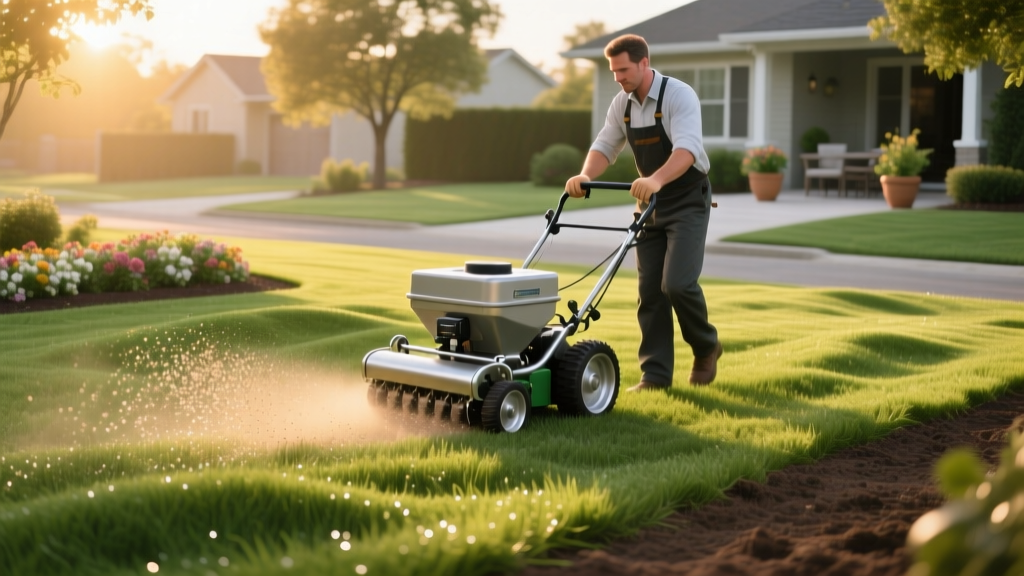
How to Put Fertilizer on Grass: Spreader Calibration and Even Coverage Guide
Applying fertilizer is arguably the most critical mechanical task in lawn care. While selecting the right N-P-K ratio matters, improper application is responsible for the vast majority of lawn burn incidents, nutrient runoff, and unsightly striping. Knowing how to put fertilizer on grass correctly requires understanding spreader mechanics, precise calibration, and environmental timing.
This guide moves beyond generic advice to provide exact calibration mathematics, spreader selection frameworks, and professional-grade application protocols used by turf managers.
The Pre-Application Soil Test: Establishing Your Baseline
Before opening a bag of fertilizer, you must know what your soil actually lacks. Blindly applying high-nitrogen synthetic fertilizers to soil that is already saturated with phosphorus or potassium wastes money and increases the risk of salt-induced root burn.
Pro Tip: The Mehlich-3 Extraction Standard
When ordering a soil test from your local university extension office (typically $15 to $30), ensure they use the Mehlich-3 extraction method. This is the industry standard for accurately measuring phosphorus, potassium, calcium, and magnesium in acidic to neutral soils common in most residential lawns.
When ordering a soil test from your local university extension office (typically $15 to $30), ensure they use the Mehlich-3 extraction method. This is the industry standard for accurately measuring phosphorus, potassium, calcium, and magnesium in acidic to neutral soils common in most residential lawns.
According to Penn State Extension, lawns with soil test phosphorus levels above 50 ppm should receive zero-phosphorus fertilizers (e.g., a 32-0-4 blend) to prevent nutrient runoff into local watersheds, which the EPA identifies as a primary driver of harmful algal blooms.
Choosing the Right Spreader for Your Lawn Architecture
The physical layout of your property dictates the type of spreader you need. Using a broadcast spreader on a narrow, obstacle-heavy lot guarantees fertilizer will land in your flowerbeds, while using a drop spreader on a 1-acre open lot will take hours and risk severe striping.
| Spreader Type | Best For | Pros & Cons | Price Range |
|---|---|---|---|
| Broadcast (Rotary) e.g., Scotts EdgeGuard Deluxe |
Open lawns over 5,000 sq. ft. | Fast coverage, wide swath (8-12 ft). Con: Throws granules into adjacent beds without edge guards. | $55 - $85 |
| Drop Spreader e.g., Scotts Classic Drop |
Narrow yards, tight borders, near water features. | Pinpoint accuracy, zero overspray. Con: Slow, requires 100% overlap precision to avoid striping. | $40 - $60 |
| High-Wheel Commercial e.g., Lesco High Wheel |
Large estates (>10,000 sq. ft.), uneven terrain. | Pneumatic tires prevent ruts, stainless steel hopper resists corrosion. Con: Heavy, bulky storage. | $120 - $160 |
Step-by-Step: How to Put Fertilizer on Grass Without Burning It
The most common failure mode in DIY fertilization is 'hopper burn'—leaving the spreader gate open while turning or stopping, which dumps a concentrated pile of salt-heavy granules onto the turf, killing it down to the roots within 48 hours.
1. The Perimeter Pass (The Safety Buffer)
Always start with a perimeter pass. If using a broadcast spreader, engage the edge-guard feature (or use a physical deflector shield) and walk the exact boundary of your lawn. This creates a double-layered buffer zone and ensures you have a clear turning area for your main passes, preventing the spreader from dumping excess product while you pivot.
2. The Main Passes and the 50% Overlap Rule
Broadcast spreaders distribute granules in a teardrop pattern, with the heaviest concentration in the center and a light dusting at the edges. To achieve an even application rate, you must overlap your passes by exactly 50%.
- Visual Cue: Align the right wheel of your spreader with the left wheel track of your previous pass.
- Pacing: Maintain a consistent walking speed of 2.75 to 3.0 miles per hour (a brisk, purposeful walk). Spreader calibration is mathematically tied to this speed; walking slower will over-apply, while walking faster will under-apply.
3. The Shutoff Protocol
Close the spreader gate two full steps before you reach the end of your run. When turning around, ensure the spreader is in motion before you pull the lever to open the gate again. Never open the gate while stationary.
Spreader Calibration: The 100 Square Foot Catch Test
Do not blindly trust the settings printed on the fertilizer bag. Those settings assume a specific walking speed, granule size, and humidity level. UMass Extension recommends physically calibrating your spreader using the catch test to guarantee accuracy.
The Calibration Math Framework
1. Measure a 10 ft x 10 ft area on your driveway (100 sq. ft.).
2. Place a shallow catch pan (or tarp) in this area.
3. Fill your spreader and walk over the pan at your normal pace with the gate open.
4. Weigh the caught granules on a digital kitchen scale.
5. Formula: If the bag rate is 3.6 lbs per 1,000 sq. ft., you need to catch exactly 0.36 lbs (5.76 ounces) in your 100 sq. ft. pan. Adjust the micrometer dial up or down until you hit this exact weight.
1. Measure a 10 ft x 10 ft area on your driveway (100 sq. ft.).
2. Place a shallow catch pan (or tarp) in this area.
3. Fill your spreader and walk over the pan at your normal pace with the gate open.
4. Weigh the caught granules on a digital kitchen scale.
5. Formula: If the bag rate is 3.6 lbs per 1,000 sq. ft., you need to catch exactly 0.36 lbs (5.76 ounces) in your 100 sq. ft. pan. Adjust the micrometer dial up or down until you hit this exact weight.
Post-Application Watering and Cleanup Protocols
Once the granules are on the lawn, your immediate next steps dictate whether the nutrients reach the root zone or cause foliar burn.
The 0.25 Inch Wash-In Rule
Synthetic fertilizers (like urea or ammonium sulfate) are highly soluble salts. If left resting on the grass blades, they will draw moisture out of the leaf tissue via osmosis, resulting in 'tip burn.' Within 24 hours of application, apply exactly 0.25 to 0.5 inches of water via irrigation or rely on a forecasted light rain. This washes the granules off the blade and into the soil profile without causing deep leaching past the root zone.
Hardscape Cleanup
Never use a hose to wash stray fertilizer granules off your driveway or sidewalks into the street. This directly introduces nitrogen and phosphorus into storm drains, which flow untreated into local waterways. Always use a leaf blower or stiff push broom to sweep stray granules back onto the turf where they can break down safely.
Troubleshooting Common Application Mistakes
If your lawn shows irregular patterns 7 to 14 days after application, use this diagnostic matrix to identify the mechanical or human error.
| Symptom | Root Cause | Corrective Action |
|---|---|---|
| Alternating dark green and pale yellow stripes. | Insufficient overlap (less than 50%) with a broadcast spreader, or misaligned wheels with a drop spreader. | On the next application cycle, use the 50% wheel-track overlap rule. Mark wheel tracks with temporary lawn paint if necessary. |
| Severe brown, dead patches at the ends of the lawn runs. | Hopper left open while turning or stopping at the perimeter. | Implement the 2-step shutoff rule. Heavily water the burned spots daily for 5 days to flush the excess salts below the root zone. |
| Lawn looks burnt along the edges near flowerbeds. | Edge guard disengaged, or wind drift pushing granules into concentrated piles against physical barriers. | Always engage mechanical deflectors near hardscapes. Avoid applying when wind speeds exceed 5 mph. |
Mastering how to put fertilizer on grass is less about the brand of fertilizer you buy and more about the mechanical precision of your delivery system. By calibrating your spreader, respecting the 50% overlap geometry, and executing a proper post-application wash-in, you will achieve the uniform, deep-green turf characteristic of professionally managed properties.

