
Lawn Care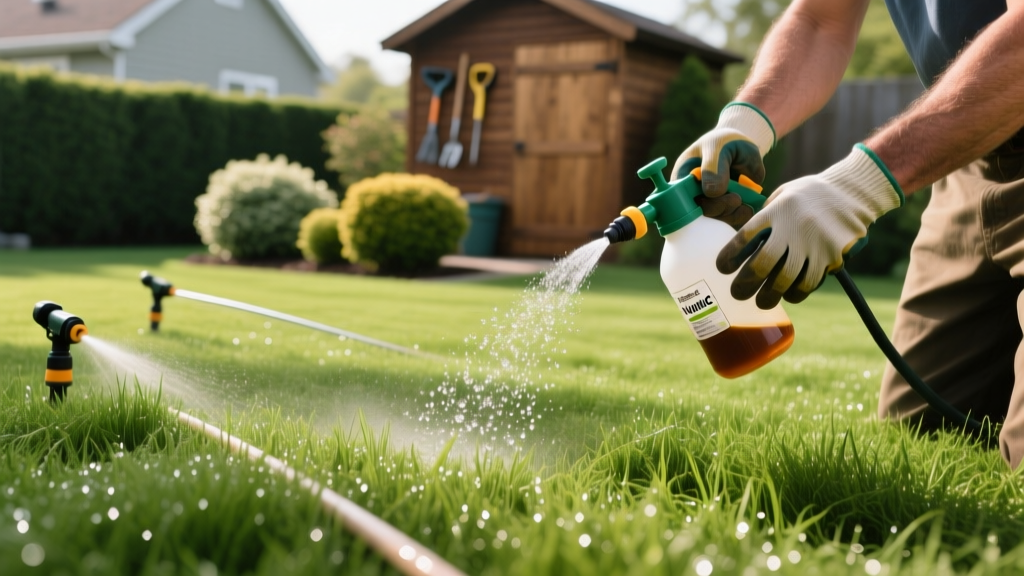
Humic Acid Lawn Application: A Step-by-Step Maintenance Guide
The Science Behind Humic Acid for Turfgrass
Humic acid is not a fertilizer; it is a highly complex soil conditioner derived from decomposed organic matter (leonardite or lignite). When applied to a lawn, humic substances act as chelating agents, binding to micronutrients like iron, zinc, and manganese, making them bioavailable to turfgrass roots. According to research frameworks established by the Soil Science Society of America, humic acids significantly increase a soil's Cation Exchange Capacity (CEC), effectively expanding the soil's ability to hold onto positively charged nutrients that would otherwise leach away during heavy irrigation or rainfall.
For lawn maintenance professionals and dedicated homeowners, integrating humic acid into a seasonal program bridges the gap between synthetic fertilization and long-term soil biology. However, improper application—specifically incorrect dilution or tank-mixing incompatibilities—can render the product useless or clog expensive spray equipment. This guide outlines the exact step-by-step procedures for applying humic acid to cool- and warm-season lawns.
Step 1: Soil Testing for Cation Exchange Capacity (CEC)
Before purchasing any humic substances, you must understand your soil's baseline chemistry. Submit a soil sample to a reputable lab (such as Logan Labs or your local university extension) and specifically request a CEC measurement.
- CEC below 10 meq/100g: Your soil is likely sandy or highly degraded. It struggles to retain nutrients. Humic acid will provide massive structural and chemical benefits here.
- CEC between 10 and 20 meq/100g: Average loam or clay-loam. Humic acid will act as an efficiency multiplier for your existing fertilizer program.
- CEC above 25 meq/100g: Heavy clay soils. While CEC is high, nutrients may be tightly bound. Humic acid helps loosen these bonds, but physical aeration is equally critical.
Expert Tip: Do not rely on cheap DIY soil test kits for CEC. They only measure N-P-K and pH. You need a comprehensive Mehlich-3 or ammonium acetate extraction test to see the true cation exchange metrics.
Step 2: Choosing Between Liquid and Granular Formulations
The market is split between liquid humic/fulvic blends and dispersible granular (DG) products. Your choice depends on your equipment, budget, and the specific goals of your lawn care program.
| Feature | Liquid Humic Acid (e.g., N-EXT Humic12) | Granular Humic DG (e.g., Andersons Humic DG) |
|---|---|---|
| Application Rate | 3 to 6 oz per 1,000 sq ft | 2 to 4 lbs per 1,000 sq ft |
| Cost per 1,000 sq ft | ~$0.011 (based on $45/gallon covering 4k sq ft) | ~$0.0035 (based on $35/40lb bag covering 10k sq ft) |
| Speed of Results | Fast (contains fulvic acid for immediate foliar uptake) | Slow (requires microbial breakdown and watering-in) |
| Equipment Needed | Pump sprayer or hose-end sprayer | Rotary or drop broadcast spreader |
| Primary Drawback | High risk of sprayer clogging if mixed incorrectly | Must be watered in immediately to activate DG pellets |
Step 3: Sprayer Calibration and the 'Jar Test'
If you opt for liquid humic acid, you must perform a compatibility test before filling your main sprayer tank. Humic acid molecules are large and carry a negative charge. When mixed with liquid fertilizers high in calcium, magnesium, or certain phosphorus forms, the humic acid will bind to the cations and precipitate out of the solution—a process called flocculation. This creates a thick sludge that will permanently ruin your sprayer nozzles and filters.
How to Perform the Jar Test:
- Take a clean glass mason jar and fill it with 16 oz of the water you plan to use for spraying.
- Add the exact proportional amount of liquid humic acid (e.g., 1 oz) and your liquid fertilizer (e.g., 2 oz of 18-24-12).
- Stir vigorously and let it sit for 15 minutes.
- Pass: The mixture remains uniform and dark. You are safe to tank-mix.
- Fail: The mixture separates into clumps, sludge, or a cottage-cheese texture. You must apply the humic acid and fertilizer in separate passes.
Warning on Hard Water: If you use well water with high calcium hardness (above 150 ppm), the calcium will bind to the humic acid before it even reaches the soil. Always use a water conditioning agent (like Ammonium Sulfate at 1 lb per 100 gallons of water) to soften the spray solution before adding humic acid.
Step 4: Application Timing and Technique
Timing your humic acid application to coincide with peak turfgrass root growth maximizes the chelation benefits. Research highlighted by NC State University's Turfgrass Program emphasizes that soil amendments are most effective when the plant is actively seeking nutrients.
Seasonal Application Schedule:
- Spring Green-Up (Soil temps 55°F+): Apply liquid humic/fulvic acid to stimulate early root development and help the grass utilize spring pre-emergents and starter fertilizers.
- Summer Stress (June - August): Tank-mix liquid humic acid with liquid kelp (seaweed extract). The humic acid improves soil moisture retention, while the kelp provides cytokinins to fight heat and drought stress. Apply during the coolest part of the morning.
- Fall Root Building (September - October): This is the most critical application. Apply granular humic DG alongside your high-potassium fall winterizer fertilizer. The humic acid will chelate the potassium, ensuring it remains in the root zone through winter leaching events.
Spraying Technique (Liquid):
Calibrate your sprayer to deliver 1.5 to 2.0 gallons of water per 1,000 sq ft. This volume is critical; if you spray too dry (e.g., 0.5 gallons/1k), the humic acid will coat the leaf blade and dry out before reaching the soil profile. Walk at a steady pace of 3 mph, using a cross-hatch (crisscross) pattern to ensure even distribution without streaking.
Step 5: Watering-In and Post-Application Integration
Humic acid must reach the root zone to interact with the soil's clay and organic matter particles. Leaving it on the surface limits its efficacy.
Watering Requirements by Formulation:
- Liquid Formulations: If applied at a higher water volume (2 gal/1k sq ft), the carrier water is often sufficient to wash the product off the leaf blade and into the thatch. However, a light syringe cycle of 0.1 inches of irrigation immediately after application guarantees soil penetration.
- Granular DG Formulations: Dispersible granules are designed to break apart upon contact with moisture. You must apply exactly 0.25 to 0.5 inches of irrigation within 24 hours of spreading. If left dry on the surface for several days, UV degradation and wind displacement will reduce the product's effectiveness by up to 30%.
Common Failure Modes and Troubleshooting
Even experienced lawn care operators make mistakes with humic substances. Here is how to troubleshoot the most common issues:
| Symptom | Probable Cause | Corrective Action |
|---|---|---|
| Sprayer nozzle clogs mid-application | Flocculation due to tank-mixing with calcium-based products or hard water. | Flush system immediately. Perform a jar test. Use a water conditioner or apply humic acid in a separate pass. |
| No visible improvement in turf color or vigor | Soil pH is extremely acidic (below 5.0) or alkaline (above 8.0), locking up nutrients despite chelation. | Humic acid buffers pH but cannot fix extremes. Apply calcitic lime or elemental sulfur first to bring pH to 6.2-6.8. |
| Brown staining on concrete driveways | Liquid humic acid overspray drying on porous surfaces. | Always edge and blow off hard surfaces immediately after spraying. Stains will fade with UV and rain but require pressure washing if severe. |
Final Integration Advice
Humatic acid is a long-game soil amendment. Unlike synthetic nitrogen, which provides a visual flush of growth within 72 hours, humic substances build soil structure over 12 to 18 months. For the best results in your lawn maintenance program, pair humic acid applications with annual core aeration and consistent organic topdressing. This triad of mechanical, biological, and chemical soil management will yield a turfgrass canopy that is deeply rooted, highly drought-tolerant, and naturally resistant to nutrient lockout.

