
Lawn Care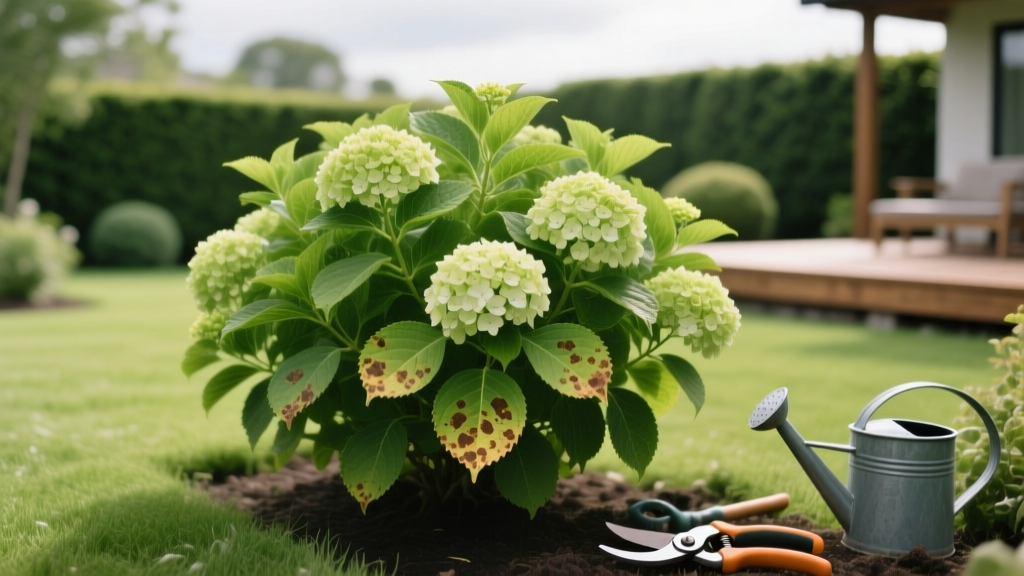
Why Hydrangea Leaves Have Brown Spots: Diagnosis and Rescue Fixes
The Diagnostic Matrix: Identifying the Exact Culprit
When hydrangea leaves have brown spots, the immediate instinct is often to apply a broad-spectrum fungicide. This is a critical mistake. The visual characteristics of the necrotic tissue, the location of the damage on the canopy, and the prevailing weather conditions dictate entirely different treatment protocols. Misdiagnosing environmental scorch as a fungal pathogen wastes chemical treatments and allows the actual issue to compromise the shrub's vascular system.
According to plant pathology research from NC State Extension, accurately distinguishing between biotic pathogens and abiotic stressors requires examining the spot margins, color gradients, and canopy distribution. Use the diagnostic matrix below to isolate the primary trigger.
| Symptom Profile | Likely Culprit | Spot Appearance & Margins | Canopy Distribution | Primary Environmental Trigger |
|---|---|---|---|---|
| Circular to angular lesions with tan/gray centers and dark purple/brown borders. | Cercospora Leaf Spot (Cercospora hydrangeae) | Distinct margins, often 1/8 to 1/4 inch. Centers may fall out, leaving a 'shot-hole' effect. | Starts on lower, interior leaves; splashes upward during rain. | Prolonged leaf wetness, overhead irrigation, 70°F–85°F temperatures. |
| Large, irregular brown blotches with concentric rings; blooms may also show brown rot. | Anthracnose (Colletotrichum gloeosporioides) | Bullseye patterns, fuzzy spore masses under high humidity. Margins are less defined. | Affects both upper and lower canopy, including flower heads. | Heavy nitrogen fertilization combined with hot, humid, rainy spells. |
| Crispy, bleached-white to light-brown patches between leaf veins or at leaf margins. | Sunscald / Environmental Scorch | No dark borders. Tissue is entirely desiccated and brittle. No fungal fruiting bodies. | Top of the canopy, south/west-facing foliage exposed to direct afternoon sun. | Sudden heat spikes, lack of soil moisture, insufficient canopy shade. |
| Small, raised, corky brown or rust-colored bumps on the underside of leaves. | Edema (Oedema) | Not true spots; these are ruptured epidermal cells. Cannot be rubbed off. | Lower leaves, heavily shaded areas with poor air circulation. | Warm soil and cool air causing root water uptake to exceed leaf transpiration. |
Fungal Pathogens: Targeted Chemical Rescue Treatments
If your diagnosis points to Cercospora or Anthracnose, cultural controls alone will not halt an active infection. You must deploy targeted fungicides. However, continuous use of a single chemical class leads to rapid pathogen resistance. Professional landscapers manage this by tracking Fungicide Resistance Action Committee (FRAC) codes and rotating active ingredients.
Chlorothalonil vs. Copper-Based Fungicides
For severe Cercospora outbreaks, a contact fungicide containing Chlorothalonil (FRAC Group M05) provides the most reliable protective barrier. Products like GardenTech Daconil (29.6% Chlorothalonil concentrate) remain an industry standard. As of 2026, a 32-ounce bottle of Daconil concentrate retails for approximately $16 to $19. The precise mixing rate for active hydrangea infections is 1 tablespoon (0.5 fl oz) per gallon of water, applied to the point of runoff every 7 to 10 days.
For organic landscapes or early-stage Anthracnose, copper-based sprays are highly effective. Bonide Liquid Copper Fungicide (FRAC Group M01) utilizes copper octanoate. A 32-ounce ready-to-spray bottle costs around $14. Copper disrupts fungal enzyme systems, but it must be applied when temperatures are below 85°F to prevent phytotoxicity (copper burn) on the hydrangea foliage.
⚠️ CRITICAL WARNING: Fungicide Phytotoxicity
Never apply copper-based fungicides or horticultural oils to hydrangeas when ambient temperatures exceed 85°F or when the shrub is drought-stressed. The combination of heat and chemical salts will strip the leaf cuticle, causing rapid defoliation that mimics the very disease you are trying to cure.
The 4-Step Surgical Pruning and Cleanup Protocol
Chemical sprays cannot penetrate dead, necrotic tissue. Fungal spores overwinter in fallen debris and dead stems. Before applying any fungicide, you must execute a strict sanitation protocol to reduce the local spore load. Research from Penn State Extension emphasizes that removing infected tissue is the foundational step in breaking the disease cycle.
- Sterilize Your Bypass Pruners: Use high-quality bypass pruners (such as the Felco F-2). Submerge the blades in 70% isopropyl alcohol for 30 seconds. Do not use a 10% bleach solution, as sodium hypochlorite pits the steel and ruins the cutting edge.
- Execute Precision Cuts: Remove leaves that are more than 50% compromised. Cut the petiole (leaf stem) at a 45-degree angle, exactly 1/4 inch above a healthy leaf node. This angle prevents water from pooling on the fresh wound, which would invite secondary bacterial infections.
- Re-sterilize Between Every Cut: This is the most frequently skipped step. Wiping blades on a rag is insufficient. Dip the blades in alcohol between every single cut to prevent mechanically transmitting Anthracnose spores from an infected branch to a healthy one.
- Clear the Drip Line: Rake out all fallen leaves, decaying mulch, and plant debris from within the shrub's drip line. Bag this material and send it to a municipal composting facility that reaches 140°F+; do not compost it in a standard backyard bin where temperatures are too low to kill Cercospora spores.
Environmental Corrections: Irrigation and Canopy Management
Hydrangea leaves have brown spots largely because of microclimate mismanagement. Hydrangeas (particularly Hydrangea macrophylla and Hydrangea quercifolia) require consistent moisture but despise wet foliage. Overhead watering via oscillating sprinklers guarantees the leaf wetness duration required for Cercospora spore germination, which only requires 4 to 6 hours of continuous moisture.
Transitioning to Drip Irrigation
Replace overhead watering with a localized drip system. Install 1/2-inch drip tubing with inline emitters rated at 0.5 to 1.0 Gallons Per Hour (GPH). Lay the tubing in a spiral pattern starting 6 inches from the main trunk and extending to the edge of the canopy. Set the timer to deliver approximately 1 inch of water per week, split into two early-morning cycles (e.g., 4:00 AM) to allow surface soil to dry slightly before nightfall.
Correcting Soil Nutrition and Mulching
Anthracnose thrives on soft, succulent tissue growth caused by excessive nitrogen. Avoid high-nitrogen synthetic fertilizers (like 24-8-16 formulations). Instead, use a slow-release, acid-forming organic fertilizer with a lower nitrogen ratio, such as Espoma Holly-tone (4-3-4). Apply at a rate of 1 cup per foot of branch spread in early spring and again in late May.
Finally, apply a 2-to-3-inch layer of arborist wood chips or pine bark mulch over the root zone. This serves three vital functions: it suppresses soil-borne spores from splashing onto lower leaves during heavy rain, it regulates soil temperature to prevent edema, and it retains moisture to prevent sunscald during mid-summer heat domes. Keep the mulch exactly 3 inches away from the main crown of the hydrangea to prevent crown rot.

