
Lawn Care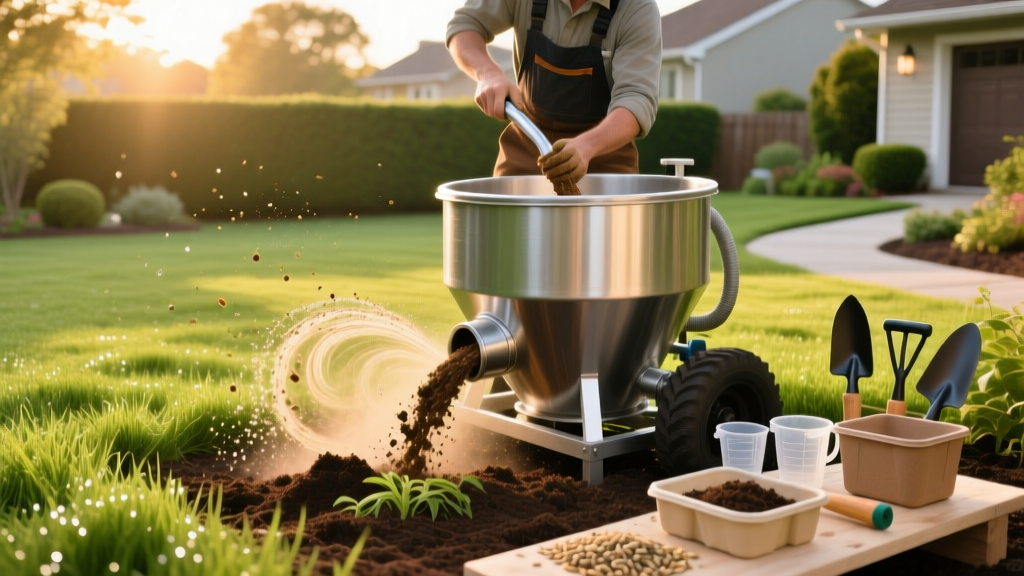
Hydroseeder DIY Build: Organic Slurries for Chemical-Free Lawns
The Case for Organic Hydroseeding
Broadcasting seed over bare soil typically yields a 20-30% germination rate, while professional hydroseeding pushes that success rate to 80-90%. However, commercial hydroseed slurries frequently rely on synthetic polyacrylamide tackifiers and high-salt chemical fertilizers that degrade the soil microbiome and contribute to nutrient runoff. According to the Environmental Protection Agency (EPA), synthetic lawn fertilizers are a primary driver of nonpoint source water pollution. Building a hydroseeder DIY rig allows homeowners to apply seed using 100% organic, chemical-free matrices, establishing a deep-rooted, resilient turf that aligns with the ecological principles outlined by the UMass Extension Turf Program.
This guide details the exact hardware specifications, organic slurry formulations, and application protocols required to successfully hydroseed a chemical-free lawn.
Engineering Your Hydroseeder DIY Rig
Commercial hydroseeders cost between $3,000 and $15,000. A highly effective DIY rig can be assembled for $600 to $900 using off-the-shelf agricultural and plumbing components. The critical requirement is maintaining a suspension of heavy wood mulch and seed without clogging the discharge line.
Core Hardware Specifications
- Tank: 55-gallon food-grade HDPE poly drum or a 110-gallon IBC tote. Ensure the top opening is at least 12 inches wide for manual agitation and cleaning.
- Pump: 2-inch semi-trash water pump powered by a 4-stroke gas engine (e.g., Honda GX160 or NorthStar 158 GPM model). Semi-trash pumps handle solids up to 0.25 inches, which is necessary for wood fiber mulch.
- Plumbing Manifold: Schedule 40 PVC piping with two 2-inch ball valves. One valve controls the discharge to the spray hose, while the second controls a recirculation loop that returns slurry to the top of the tank for continuous agitation.
- Spray Hose and Nozzle: 50 feet of 1-inch lay-flat hose paired with a wide-fan agricultural spray nozzle (e.g., TeeJet 8006) to ensure an even, 6-foot swath width.
Expert Tip: Never use a standard clear-water centrifugal pump. The impeller vanes on clear-water pumps are too tight and will instantly jam when wood fiber mulch or hydrated guar gum enters the housing. Always specify a semi-trash or trash pump.
The Chemical-Free Slurry Matrix
The slurry is the heart of the hydroseeding process. It must hold moisture, bind the seed to the soil, and provide immediate biological nutrition. Conventional operations use synthetic polymers and urea-based fertilizers. For an organic approach, we substitute these with natural polysaccharides and biologically active amendments.
| Component | Conventional Chemical | Organic Alternative | Function | Cost per 100 Gal |
|---|---|---|---|---|
| Tackifier | Polyacrylamide | Food-Grade Guar Gum | Binds mulch/seed to soil | $12.00 |
| Fertilizer | Synthetic Urea (46-0-0) | Hydrolyzed Fish Emulsion | Provides immediate N-P-K | $18.00 |
| Biostimulant | None / Synthetic Rooting Hormones | Liquid Kelp Extract | Reduces transplant shock | $9.00 |
| Mulch | Dyed Cellulose | Undyed Wood Fiber / Straw | Moisture retention matrix | $15.00 |
Exact Mixing Protocol (100-Gallon Batch)
Order of operations is critical when mixing organic hydroseed. Guar gum hydrates rapidly and will form impenetrable dry clumps (known as fish-eyes) if dumped directly into a full tank of water. Follow this exact sequence for a 100-gallon batch, which covers approximately 2,000 square feet of bare soil.
- Pre-Hydrate the Tackifier: In a separate 5-gallon bucket, mix 1.5 lbs of food-grade guar gum with 4 gallons of warm water (90°F to 100°F). Agitate vigorously with a drill-mounted paint mixer for 3 minutes until it forms a thick, viscous gel.
- Fill the Main Tank: Add 75 gallons of clean water to the 55-gallon drum (leaving headspace for displacement and agitation).
- Start Recirculation: Fire up the semi-trash pump and open the recirculation ball valve 100% while keeping the discharge valve closed. This creates a vortex in the tank.
- Add Wood Fiber Mulch: Slowly feed 15 lbs of organic, undyed wood fiber mulch into the vortex. Allow it to break down and suspend for 5 minutes.
- Incorporate the Gel: Pour the pre-hydrated guar gum gel into the vortex. The slurry will immediately thicken and turn viscous.
- Add Biologicals: Pour in 2 gallons of hydrolyzed fish emulsion (e.g., Neptune's Harvest) and 1 quart of liquid kelp extract.
- Add Seed: Finally, add 12 to 15 lbs of endophyte-enhanced tall fescue or native grass seed. Never add seed before the mulch and tackifier, or the heavy seed will sink to the bottom and be crushed by the pump impeller. Mix for 3 final minutes.
Soil Preparation and Application Dynamics
Organic hydroseed requires a biologically active seedbed. The USDA Natural Resources Conservation Service emphasizes that soil organic matter is the foundation of plant health. Before spraying, core aerate the soil and apply a 1/4-inch topdressing of screened, mature compost. This introduces the mycorrhizal fungi necessary to process the organic fish and kelp amendments in your slurry.
When spraying, maintain a consistent distance of 4 to 5 feet from the soil surface. Use a side-to-side sweeping motion, overlapping each pass by 30%. The organic guar gum slurry will appear as a translucent, slightly milky coating over the wood fibers. Unlike synthetic slurries that use bright green dyes to track coverage, organic slurries rely on the natural color of the wet wood fiber. Do not over-apply; a slurry layer thicker than 1/8 inch will crust and suffocate emerging seedlings.
Troubleshooting Organic Slurry Failures
Working without synthetic chemicals introduces specific physical variables. Use this diagnostic guide to address common edge cases during your hydroseeder DIY project.
- Symptom: Pump Cavitation and Loss of Pressure
- Cause: The wood fiber mulch was not fully broken down, or the guar gum ratio is too high, creating a fluid too thick for the 2-inch impeller.
Fix: Shut off the pump immediately to prevent seal damage. Add 10 gallons of water to thin the matrix and recirculate for 5 minutes before resuming. - Symptom: Slurry Washes Away After Light Rain
- Cause: Insufficient tackifier on slopes exceeding a 15% grade, or the soil surface was too dry and hydrophobic when sprayed.
Fix: For slopes, increase guar gum to 2.5 lbs per 100 gallons. Always lightly mist the bare soil with plain water 30 minutes before applying the slurry to ensure immediate chemical bonding to the soil particles. - Symptom: Poor Germination and Yellowing Seedlings
- Cause: Phytotoxicity from using raw, uncomposted manure or high-nitrogen synthetic fertilizers in the mix, which burned the delicate radicle (first root).
Fix: Stick strictly to hydrolyzed fish emulsion and kelp. These provide slow-release, biologically mediated nitrogen that will not burn emerging turfgrass tissue.

