
Lawn Care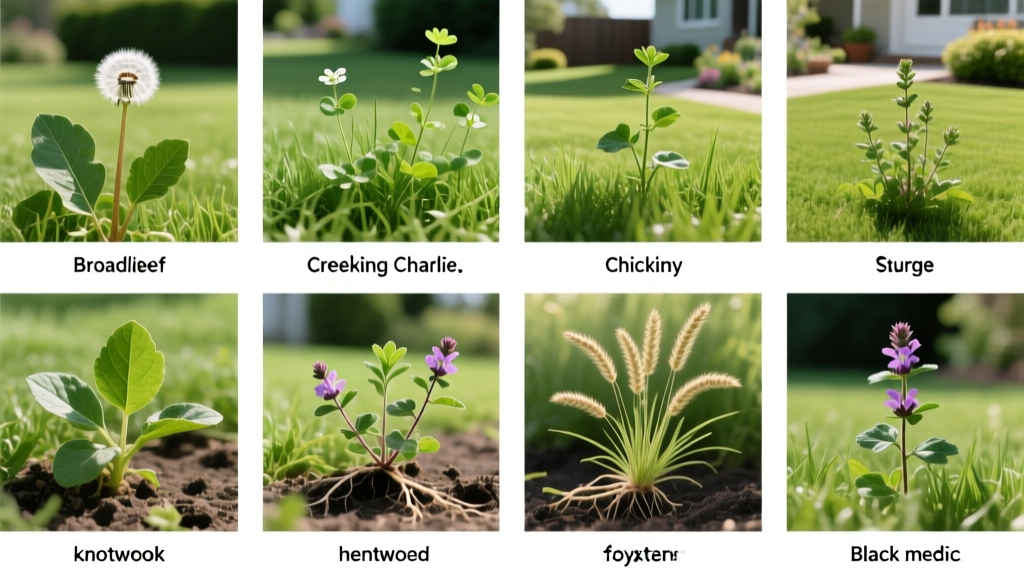
10 Types of Weeds With Pictures: Lawn ID & Control Guide
The Botanical Framework: Why Visual ID Dictates Chemical Control
Misidentifying a lawn weed is the most expensive mistake in turf management. Applying a broadleaf herbicide to a grassy weed, or a standard grass killer to a sedge, results in wasted chemicals, phytotoxicity to your desirable turf, and a rapidly expanding weed population. According to the NC State Extension, accurate visual identification is the mandatory first step before selecting pre-emergent or post-emergent chemistry.
This guide breaks down 10 types of weeds with pictures and specific morphological traits, pairing each with the exact active ingredients and application rates required for eradication in 2026.
The 3-Step Weed Triage Framework
- Step 1: Leaf Venation. Parallel veins indicate grasses or sedges. Net-like (branching) veins indicate broadleaf weeds.
- Step 2: Stem Cross-Section. Roll the stem between your fingers. Round = grass. Triangular = sedge. Square = broadleaf (often mint family).
- Step 3: Growth Habit. Bunch-type, stoloniferous (above-ground runners), or rhizomatous (below-ground runners) dictates whether you need a systemic or contact herbicide.
The Broadleaf Invaders (Net-Like Veins)
1. Dandelion (Taraxacum officinale)
Visual ID: Deeply lobed, toothed leaves forming a basal rosette. The hollow, milky-sap-filled stem supports a single bright yellow flower that matures into a white, wind-dispersed seed head. Features a thick, brittle taproot that can extend 10 to 15 inches deep.
Control Protocol: Systemic broadleaf herbicides are required to kill the taproot. Apply a mixture containing 2,4-D and Dicamba at a rate of 2.0 pints per acre (approx. 0.75 fl oz per 1,000 sq ft). Apply when daytime temperatures are between 65°F and 80°F to prevent turf burn and ensure optimal translocation to the root.
2. Broadleaf Plantain (Plantago major)
Visual ID: Wide, oval-shaped leaves with distinct, parallel-like ribs (though technically a broadleaf, the veins appear prominent and ribbed). Leaves grow in a low, dense rosette and thrive in heavily compacted soils where turfgrass roots struggle to penetrate.
Control Protocol: Plantain is highly resistant to single-active-ingredient herbicides. Use a three-way herbicide containing Triclopyr, 2,4-D, and Dicamba. For severe compaction issues, pair chemical control with core aeration to restore turf density and outcompete future plantain germination.
3. White Clover (Trifolium repens)
Visual ID: Creeping, stoloniferous growth habit with leaves divided into three distinct, tear-drop-shaped leaflets, often featuring a white 'V' shaped watermark. Produces small, spherical white or pinkish flower heads from late spring through early fall.
Control Protocol: Clover fixes its own nitrogen, making it immune to nitrogen-deprivation strategies. The most effective active ingredient is Mecoprop (MCPP), often combined with Quinclorac. Apply at 1.5 fl oz per 1,000 sq ft. Two applications spaced 21 days apart are usually required to exhaust the stolon energy reserves.
4. Creeping Charlie (Glechoma hederacea)
Visual ID: Square stems (indicating the mint family) with round to kidney-shaped leaves featuring scalloped (crenate) edges. Emits a strong, pungent mint odor when crushed. Thrives in moist, shaded areas where cool-season grasses thin out.
Control Protocol: Spring applications often fail because the plant is actively pushing energy upward to flower. The optimal application window is early autumn (late September to mid-October) when the plant is pulling carbohydrates down into its rhizomes. Use Triclopyr + Dicamba at label rates, ensuring thorough foliar coverage without runoff.
The Grassy Weed Menace (Parallel Veins, Round Stems)
5. Crabgrass (Digitaria sanguinalis)
Visual ID: Light green, coarse-textured grass that grows in a prostrate, star-like pattern from a central root zone. The leaf sheath is distinctly hairy, and the seed heads resemble a turkey foot with 3 to 7 finger-like spikes. According to the University of California IPM, crabgrass thrives in thin, under-fertilized turf and along hot pavement edges.
Control Protocol: Post-emergent control of mature crabgrass is notoriously difficult and often damages desirable turf. The gold standard is pre-emergent control using Prodiamine (applied at 1.15 lbs per 1,000 sq ft) when soil temperatures at a 2-inch depth reach 55°F for three consecutive days in early spring. For post-emergent rescue, use Quinclorac (0.73 fl oz per 1,000 sq ft) on young, pre-tillering crabgrass.
6. Goosegrass (Eleusine indica)
Visual ID: Often confused with crabgrass, but goosegrass features a distinct silver or white base at the stem and a flattened (compressed) stem rather than a round one. The seed heads are arranged in a zipper-like pattern along the spikes. Highly tolerant of close mowing and compacted soils.
Control Protocol: Goosegrass germinates slightly later than crabgrass, requiring a split pre-emergent application. Use Dithiopyr in late spring, which offers early post-emergent activity on young goosegrass. For mature plants, Fenoxaprop-p-ethyl is the safest post-emergent option for cool-season lawns, applied at 0.25 fl oz per 1,000 sq ft.
7. Annual Bluegrass (Poa annua)
Visual ID: Bright, apple-green color with a distinct 'boat-shaped' leaf tip. Features a membranous, pointed ligule at the collar. Produces prolific white seed heads even at mowing heights as low as 0.5 inches, making it a primary pest on golf greens and highly maintained residential lawns.
Control Protocol: Poa annua is a cool-season winter annual. Pre-emergent barriers must be established in late summer (August/September) using Prodiamine or Pendimethalin. For post-emergent control in warm-season turf (like Bermuda or Zoysia), Foramsulfuron or Revolver (Foramsulfuron + Trifloxysulfuron) can be used during winter dormancy to selectively remove Poa without harming the desirable grass.
The Sedges (Parallel Veins, Triangular Stems)
8. Yellow Nutsedge (Cyperus esculentus)
Visual ID: The classic 'sedges have edges' weed. The stem is sharply triangular. Leaves are glossy, light green, and grow in groups of three at the base. It grows significantly faster than surrounding turf in the heat of summer, creating a spiky, uneven canopy just days after mowing. Produces small, edible, nut-like tubers (nutlets) underground.
Control Protocol: Standard grass herbicides (like Glyphosate or 2,4-D) will not kill nutsedge. You must use a specialized sedge herbicide containing Halosulfuron-methyl (e.g., SedgeHammer). Apply at 0.9 oz per 1,000 sq ft with a non-ionic surfactant. Do not mow for 48 hours before and after application to maximize leaf surface area for absorption.
9. Purple Nutsedge (Cyperus rotundus)
Visual ID: Similar to yellow nutsedge but with a distinct reddish-purple tint at the base of the stem and leaf sheaths. The seed heads are dark purple to reddish-brown. Purple nutsedge forms extensive underground chains of tubers connected by rhizomes, making it vastly more difficult to eradicate than the yellow variety.
Control Protocol: Halosulfuron alone is often insufficient for purple nutsedge chains. The most effective chemistry is a combination of Sulfentrazone and Imazaquin (e.g., Image for Nutsedge or Blindside). Apply at 1.5 to 2.0 fl oz per 1,000 sq ft. Expect to make three applications at 21-day intervals to exhaust the deep tuber chain.
10. Wild Violet (Viola sororia)
Visual ID: While technically a broadleaf, wild violet behaves like a stubborn perennial sedge in terms of resistance. Features heart-shaped leaves with a waxy, water-repellent cuticle and small, five-petaled purple or white flowers that bloom in early spring. Spreads via both seeds and thick, fleshy rhizomes.
Control Protocol: The waxy leaf cuticle causes standard liquid herbicides to bead up and roll off. You must use a product containing Carfentrazone-ethyl (e.g., SpeedZone), which acts as a 'burn-down' agent to strip the waxy cuticle, allowing the 2,4-D and MCPP to penetrate the leaf tissue. Apply at 1.5 fl oz per 1,000 sq ft in the fall when the plant is storing energy in its rhizomes.
Herbicide Active Ingredient Matrix
Selecting the wrong chemistry is a primary cause of turf damage. Use this matrix to cross-reference your weed ID with safe active ingredients for your specific grass type.
| Active Ingredient | Target Weed Category | Safe for Cool-Season Turf? | Safe for Warm-Season Turf? | Primary Mode of Action |
|---|---|---|---|---|
| Halosulfuron-methyl | Sedges (Yellow/Purple) | Yes | Yes | ALS Inhibitor (Systemic) |
| Quinclorac | Grassy (Crabgrass) & Broadleaf | Yes | Yes (Bermuda/St. Augustine caution) | Synthetic Auxin |
| Triclopyr | Broadleaf (Clover, Violets, Charlie) | Yes | No (Severe injury to Bermuda/Zoysia) | Synthetic Auxin |
| Fenoxaprop-p-ethyl | Grassy (Goosegrass, Crabgrass) | Yes | No (Toxic to Centipede/St. Augustine) | ACCase Inhibitor |
| Sulfentrazone | Sedges & Broadleaf | Yes | Yes | PPO Inhibitor (Contact/Systemic) |
Seasonal Application Timelines & Expert Troubleshooting
Expert Troubleshooting Note: Homeowners frequently misidentify mature Crabgrass as Goosegrass or Quackgrass. To differentiate, pull the weed from the soil. If the base is white/silver and flattened, it is Goosegrass. If the base is round and the sheath is hairy, it is Crabgrass. If the roots contain long, yellowish-white underground runners (rhizomes) that smell sweet, it is Quackgrass. Quackgrass requires non-selective Glyphosate treatment and lawn renovation, as no selective post-emergent herbicide currently exists for it in residential turf.
Timing your applications to the plant's biological growth cycle is just as critical as the chemical selection. Pre-emergent herbicides for summer annuals (Crabgrass, Goosegrass) must be applied when 2-inch soil temperatures consistently hit 55°F. Conversely, post-emergent applications for perennial broadleaves (Creeping Charlie, Violets, Dandelions) yield a 40% to 60% higher kill rate when applied in early autumn, as the weeds are actively translocating sugars to their root systems for winter storage, pulling the systemic herbicide deep into the crown where it prevents spring regrowth.

