
Lawn Care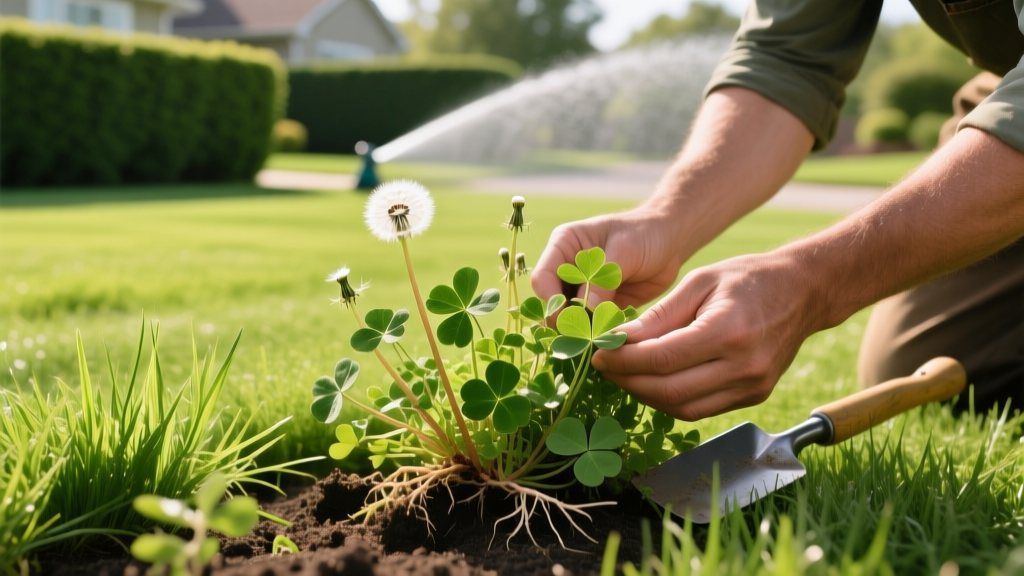
How to Identify and Treat Common Types of Weeds in Lawns
The Science of Weed Identification: Why Guessing Costs You Money
Misidentifying a weed is the most expensive mistake in lawn care. Applying a broadleaf herbicide to a grassy weed, or a standard weed killer to a sedge, results in zero control and wasted chemical. Turfgrass weeds are botanically divided into three distinct categories: broadleaf (dicots), grassy (monocots), and sedge (monocots with unique morphology). Correct identification dictates the exact active ingredient, application timing, and surfactant requirement needed for eradication.
According to the NC State University TurfFiles database, effective weed control relies on matching the herbicide's mode of action to the specific physiological vulnerabilities of the target weed family. Below is the definitive framework for identifying and eliminating the most common types of weeds in lawns.
The Big Three: Weed Category Comparison Matrix
Before selecting a chemical, you must determine the weed's structural classification. Use this diagnostic matrix to narrow down the invader.
| Category | Stem/Leaf Structure | Root System | Common Examples | Primary Herbicide Class |
|---|---|---|---|---|
| Broadleaf | Wide leaves, net-like veins, often showy flowers | Taproots or fibrous, spreading stolons | Dandelion, Clover, Ground Ivy | Synthetic Auxins (2,4-D, Dicamba, Triclopyr) |
| Grassy | Narrow leaves, parallel veins, round/hollow stems | Fibrous, shallow to deep depending on species | Crabgrass, Poa Annua, Goosegrass | Pre-emergents (Dithiopyr) & Selective Post-emergents (Quinclorac) |
| Sedge | Narrow leaves, solid triangular stem ('sedges have edges') | Nut-like tubers (nutlets) on rhizomes | Yellow Nutsedge, Purple Nutsedge | Sulfonylureas (Halosulfuron-methyl) |
Broadleaf Weeds: Identification and Targeted Eradication
Broadleaf weeds are dicotyledons. Because they are botanically distant from monocot turfgrasses, they are generally the easiest to kill selectively without harming your lawn.
Dandelion (Taraxacum officinale)
Identification: Deeply lobed, jagged leaves forming a basal rosette. Produces a hollow, milky-sap-filled flower stalk topped with a yellow composite flower. Features a thick, brittle taproot that can extend 10 to 15 inches deep.
Treatment Protocol: Spot-treat with a three-way herbicide containing 2,4-D, Dicamba, and MCPP. For mature dandelions with established taproots, add Aminopyralid to the mix. Apply when daytime temperatures are between 65°F and 80°F. Do not mow for 48 hours before or after application to maximize foliar absorption.
White Clover (Trifolium repens)
Identification: Creeping perennial with three-leaflet leaves, often featuring a distinct white 'V' or chevron watermark. Spreads via above-ground stolons and thrives in nitrogen-deficient soils.
Treatment Protocol: Clover is highly resistant to standard 2,4-D. You must use a herbicide containing Triclopyr or Quinclorac. Because clover has a waxy leaf cuticle, mixing a non-ionic surfactant (NIS) at a rate of 0.25% volume-to-volume is mandatory to break surface tension and allow the chemical to penetrate the leaf tissue.
Grassy Weeds: The Pre-Emergent Imperative
Grassy weeds are monocots, making them genetically similar to your actual turf. This similarity means post-emergent herbicides that kill grassy weeds can easily stunt or kill your lawn. Therefore, pre-emergent herbicides are the cornerstone of grassy weed control.
Crabgrass (Digitaria spp.)
Identification: A summer annual that germinates in spring. Seedlings resemble small corn plants. Mature plants feature wide, light-green leaves and a prostrate growth habit with stems radiating from a central hub like a starfish.
Pre-Emergent Strategy: Apply Dithiopyr (Dimension) or Prodiamine (Barricade). Timing is critical: apply when the soil temperature at a 2-inch depth reaches 50°F to 53°F for three consecutive days. Dithiopyr offers a distinct advantage as it provides early post-emergent control, killing crabgrass up to the pre-tiller (3-leaf) stage if you miss the exact germination window.
Annual Bluegrass (Poa Annua)
Identification: A winter annual with boat-shaped leaf tips and a distinct crinkled mid-leaf texture. Produces aggressive, prolific white seed heads even when mowed at 2 inches.
Pre-Emergent Strategy: Unlike crabgrass, Poa Annua germinates in late summer/early fall. Apply Prodiamine in late August to early September (when soil temps drop below 70°F). For post-emergent control in cool-season lawns, Ethofumesate is highly effective when applied in early spring to stunt winter growth.
Warning for Warm-Season Lawns: Never apply post-emergent grassy weed killers containing Quinclorac or MSMA to St. Augustinegrass or Centipedegrass during summer green-up. These chemicals will cause severe chlorosis and stunting. Rely strictly on pre-emergents and hand-pulling for these sensitive turf types.
Sedge Weeds: The Imposters That Defy Standard Herbicides
Sedges look like grass but are structurally distinct. The old turf manager's adage holds true: 'Sedges have edges, rushes are round, grasses have nodes that go all the way to the ground.' If you roll the stem between your fingers and feel a distinct triangle, you have a sedge.
Yellow Nutsedge (Cyperus esculentus)
Identification: Grows 2x to 3x faster than surrounding turf in summer heat. Leaves are light green, thick, and waxy with a prominent midrib. The stem is triangular, and the root system produces small, brown, edible tubers (nutlets) that can remain dormant in the soil for up to three years.
Treatment Protocol: Standard broadleaf and grassy weed killers will not kill nutsedge. You must use a sulfonylurea herbicide. Halosulfuron-methyl (SedgeHammer) is the industry standard. Apply at a rate of 0.66 oz per acre (or 1/2 teaspoon per 1,000 sq ft for residential mixing). Halosulfuron is systemic; it absorbs through the leaves and translocates down into the root system to kill the nutlets. Expect 14 to 21 days to see complete necrosis. A second application 30 days later is often required to catch secondary flushes from dormant tubers.
Cost Analysis: DIY Chemical Control vs. Professional Services
Understanding the economics of weed control helps homeowners decide between buying commercial-grade chemicals or hiring a licensed applicator. Prices below reflect average residential costs for a 5,000 sq ft lawn.
| Treatment Approach | Estimated Annual Cost | Pros | Cons |
|---|---|---|---|
| DIY (Consumer Grade) | $60 - $120 | Low upfront cost; readily available at big-box stores. | Weak active ingredient concentrations; requires frequent re-application. |
| DIY (Pro-Grade Generic) | $150 - $250 | Commercial strength (e.g., generic Prodiamine, Triclopyr); highly effective. | Requires purchasing a $100+ backpack sprayer and a soil thermometer; mixing math required. |
| Professional Lawn Service | $350 - $650 | Zero labor; commercial equipment; guaranteed callbacks if weeds survive. | Higher cost; locked into annual contracts; less control over exact application dates. |
Frequently Asked Questions on Weed Identification
Why do weeds keep coming back after I spray them?
Perennial weeds like Ground Ivy and Field Bindweed store massive energy reserves in their root systems. A single foliar application of herbicide often only burns the top growth. To achieve total control, you must apply systemic herbicides (like Triclopyr) in the early fall. During autumn, plants actively translocate carbohydrates down into their roots for winter storage, pulling the herbicide directly into the root crown and killing the plant from the bottom up.
Can I mix pre-emergent and post-emergent herbicides in the same tank?
Yes, this is known as a 'tank mix' and is a standard practice for spring cleanups. You can mix a liquid post-emergent (like 2,4-D for existing dandelions) with a liquid pre-emergent (like Prodiamine) to kill current weeds while establishing a barrier for future crabgrass. However, never mix a granular pre-emergent with a liquid post-emergent in a sprayer, as the granules will clog the nozzle and ruin the pump.
Does pulling weeds by hand actually work?
Hand-pulling is highly effective for taproot weeds like Dandelions and Plantain, provided you use a weeding fork to extract the entire root. However, hand-pulling is counterproductive for nutsedge and bermudagrass. Pulling these weeds snaps the rhizomes, leaving fragments in the soil that immediately sprout multiple new shoots, effectively multiplying the infestation. Always use chemical translocation for rhizomatous and tuberous weeds.
For ongoing regional identification support, the University of Minnesota Extension and the UC Statewide IPM Program maintain excellent visual databases tailored to specific climate zones, helping you match local weed pressures with precise cultural and chemical controls.

