
Lawn Care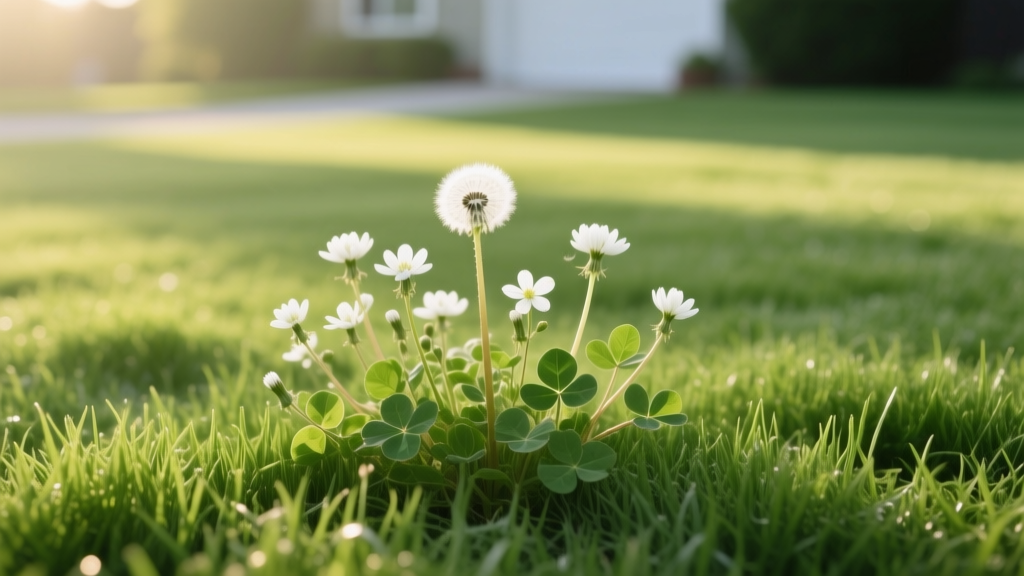
White Flower Weeds in Grass: Identification and Spot-Treatment Guide
The Usual Suspects: Identifying White Flower Weeds in Grass
Spotting white flower weeds in grass is the first indicator that your lawn's ecological balance is off. While a few scattered blooms might seem harmless, species like white clover and common chickweed are aggressive competitors that choke out desirable turfgrass by monopolizing light, water, and soil nutrients. Effective eradication begins with precise botanical identification, as the root structure and growth habit of each weed dictate the required herbicide chemistry and application timing.
White Clover (Trifolium repens)
White clover is a perennial broadleaf weed recognizable by its creeping stolons (above-ground stems) and trifoliate leaves, which often feature a faint white 'V' chevron pattern. The flowers are dense, spherical heads composed of 40 to 80 tiny white florets. Clover thrives in nitrogen-deficient soils because it possesses root nodules containing Rhizobium bacteria, allowing it to fix atmospheric nitrogen. If your soil lacks adequate synthetic or organic nitrogen inputs, clover will rapidly outcompete your turf.
Common Chickweed (Stellaria media)
Unlike clover, common chickweed is a winter annual that germinates in early fall, overwinters as a small rosette, and explodes into growth during the cool, moist days of spring. It features small, smooth, oval leaves arranged in opposite pairs along sprawling stems. The flowers are tiny, star-shaped, and white, often appearing to have ten petals due to deep clefts in the five actual petals. Chickweed relies on a shallow, fibrous root system and thrives in compacted, poorly drained, and shaded lawn areas.
Pearlwort (Sagina procumbens)
Often mistaken for moss, pearlwort forms dense, low-growing mats in highly compacted soil or thin turf. Its leaves are minuscule, needle-like, and arranged oppositely. The white flowers are incredibly small, solitary, and feature four or five tiny petals that are easily overlooked without a magnifying lens. Pearlwort is notoriously difficult to pull by hand due to its brittle stems and shallow taproots, making chemical spot-treatment necessary for heavy infestations.
| Weed Species | Leaf Structure | Growth Habit | Root System | Preferred Conditions |
|---|---|---|---|---|
| White Clover | Trifoliate (3 leaflets), chevron markings | Creeping stolons | Deep taproot with lateral branches | Low nitrogen, moderate compaction |
| Common Chickweed | Oval, opposite, smooth margins | Mat-forming, sprawling | Shallow, fibrous | Cool, moist, shaded areas |
| Pearlwort | Tiny, needle-like, opposite | Dense, moss-like mat | Shallow fibrous with weak taproot | Highly compacted, thin turf |
Spot-Treatment Protocols: Chemical vs. Organic Herbicides
Blanket spraying an entire lawn for localized weed outbreaks is an inefficient use of chemicals and increases environmental runoff. Spot-treating targets the specific weeds while preserving the surrounding desirable turf. The choice between synthetic selective herbicides and organic alternatives depends on your lawn's grass type, the severity of the infestation, and your environmental management goals.
⚠️ Critical Herbicide Warning: Always verify your grass type before applying broadleaf herbicides. Products containing 2,4-D or Dicamba can cause severe phytotoxicity (leaf curling, stunting, or death) to warm-season grasses like St. Augustine and Centipedegrass if applied during active summer growth or at excessive rates. For St. Augustine, rely on Atrazine-based products or spot-treat with extreme precision.
Selective Post-Emergent Herbicides (Synthetic)
For rapid and complete eradication of white flower weeds in grass, multi-active ingredient selective herbicides are the industry standard. These formulations target broadleaf plant physiology without harming monocot turfgrasses.
- Fertilome Weed Free Zone: Contains 2,4-D, MCPP, Dicamba, and Carfentrazone. The addition of Carfentrazone provides a 'burn-down' effect, showing visible wilting on chickweed and clover within 24 hours. Mix rate: 1.5 fluid ounces per gallon of water per 1,000 sq ft. Cost: Approximately $35 for a 16 oz bottle.
- SpeedZone Lawn Weed Killer: A professional-grade ester formulation that excels in cooler temperatures (below 75°F) when amine-based herbicides struggle to translocate. Mix rate: 1.5 fl oz per gallon. Cost: $45 to $55 for a 20 oz jug.
- Triclopyr-based products (e.g., Ortho GroundClear Poison Ivy & Tough Brush Killer): While labeled for brush, diluted Triclopyr is highly effective on stubborn white clover and wild violets that resist 2,4-D. Use strictly as a spot treatment to avoid turf damage.
Organic and Iron-Based Alternatives
If you manage an organic lawn or have concerns regarding synthetic auxin herbicides near sensitive garden beds, chelated iron products offer a viable spot-treatment route.
- Fiesta Turf Weed Killer (FeHEDTA): Chelated iron causes oxidative stress and tissue necrosis in broadleaf weeds, which absorb iron differently than grasses. Application: Apply at 3 to 4 fl oz per gallon. Caveat: Iron-based herbicides are contact killers; they do not translocate to the roots. You must apply 2 to 3 treatments spaced 3 weeks apart to exhaust the root reserves of perennial clover. Cost: $60 to $75 per gallon.
- Horticultural Vinegar (20% to 30% Acetic Acid): Non-selective and highly caustic. This will burn the foliage of chickweed and pearlwort but will also kill any desirable grass it touches. Use only for weeds growing in driveway cracks or isolated dirt patches, never directly in the turf canopy.
Step-by-Step Spot-Spraying Technique
Proper application mechanics are just as critical as the chemical chosen. Poor coverage or incorrect weather conditions will result in herbicide failure and wasted money.
- Calibrate Your Equipment: Use a 1-gallon or 2-gallon pump sprayer equipped with a flat-fan nozzle (such as the TeeJet 8002VS). Avoid cone nozzles, which waste product by spraying upward into the air rather than coating the leaf surface.
- Add a Surfactant: White clover and pearlwort possess a waxy leaf cuticle that repels water-based sprays. Add a non-ionic surfactant (NIS) or methylated seed oil (MSO) at a rate of 0.25% v/v (roughly 1/4 teaspoon per gallon). This breaks the surface tension, allowing the herbicide to spread evenly across the leaf and penetrate the stoma.
- Check Environmental Conditions: Apply only when temperatures are between 65°F and 85°F. Herbicides volatilize (turn into gas) above 85°F, which can drift and damage nearby ornamental plants. Ensure wind speeds are below 5 mph to prevent physical drift.
- Execute the Spot Spray: Spray the weed until the leaves are visibly wet, but not to the point of dripping (runoff). A fine mist coating is sufficient. Keep the wand close to the ground (6 to 10 inches) to minimize aerosolization.
- Observe the Re-Entry and Rainfast Periods: Most synthetic selective herbicides require 12 to 24 hours to become rainfast and translocate to the roots. Do not irrigate or mow the lawn for at least 48 hours post-application.
Cultural Practices to Prevent White Flowering Weeds
Chemical spot-treatments address the symptom, but cultural practices address the underlying agronomic cause. Weeds are opportunistic; they only establish where turfgrass is weak or absent.
'White clover is the ultimate indicator weed for nitrogen deficiency. If your lawn is heavily populated by clover, the soil is practically screaming for nitrogen.' — Dr. Peter Dernoeden, Turfgrass Science, University of Minnesota
To permanently suppress white flower weeds in grass, implement the following cultural framework:
- Optimize Nitrogen Inputs: Conduct a soil test to establish baseline nutrient levels. For cool-season grasses (Kentucky Bluegrass, Fescue), apply 2.5 to 4.0 lbs of Nitrogen per 1,000 sq ft annually, split across spring and fall applications. Dense, vigorously growing turf will shade out chickweed and clover seedlings.
- Adjust Mowing Heights: Maintain your mower deck at 3.0 to 4.0 inches. Taller grass blades cast deeper shadows, inhibiting the photosynthesis of low-growing, shade-intolerant weeds like pearlwort and chickweed.
- Alleviate Soil Compaction: Pearlwort and clover thrive in hardpan soil where turfgrass roots struggle to penetrate. Perform core aeration in the early fall (for cool-season grasses) or late spring (for warm-season grasses) to extract 2-to-3-inch soil plugs, improving oxygen and water infiltration.
- Correct Soil pH: Most turfgrasses prefer a pH between 6.0 and 7.0. If your soil test reveals a pH below 5.5, apply pelletized lime at the recommended rate to unlock bound nutrients and improve turf vigor.
Authoritative Resources and Further Reading
For localized weed identification and region-specific herbicide recommendations, consult your local university cooperative extension office. The following resources provide in-depth agronomic data on the weeds discussed in this guide:

