
Lawn Care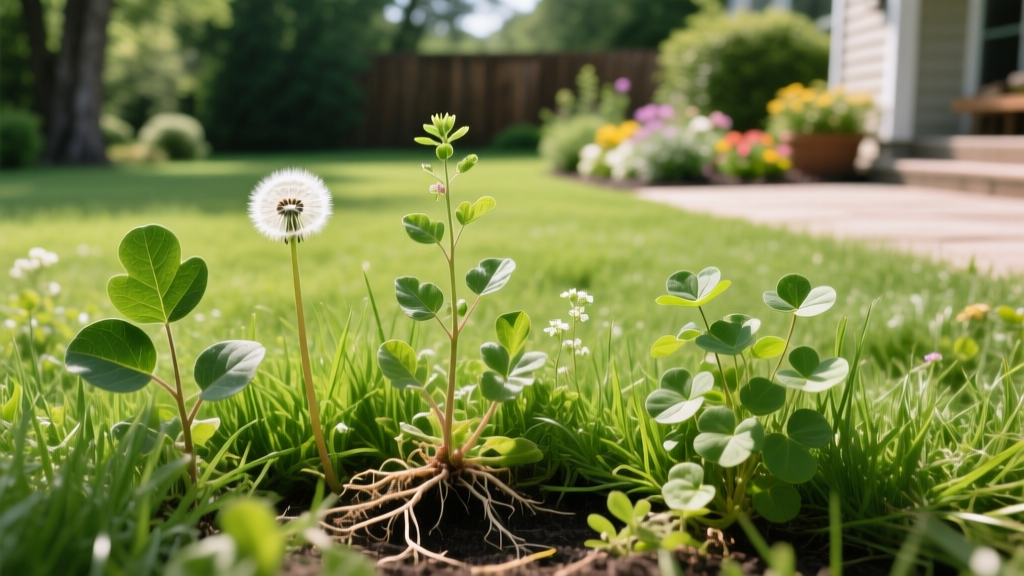
How to Identify Weeds by Picture: A Visual Lawn Care Guide
Misidentifying a lawn weed is the most expensive mistake a homeowner can make. Applying a post-emergent grassy weed killer to a sedge, or a broadleaf herbicide to a grassy invader, results in wasted chemicals, damaged turfgrass, and a rapidly spreading infestation. Learning to accurately identify weeds by picture requires more than snapping a blurry photo of a green patch; it demands a systematic approach to capturing specific morphological traits. This guide provides the visual frameworks, decision trees, and chemical protocols required to diagnose and eradicate the most common turf invaders.
The Morphology of a Weed Photo: What to Capture
When you attempt to identify weeds by picture using digital tools or extension office databases, a single top-down shot of the lawn is useless. Botanists and AI algorithms require specific structural data points. When photographing an unknown weed, capture these three distinct angles:
- The Rosette or Base: Photograph the weed at soil level. Look for the crown, root structure (taproot vs. fibrous), and the arrangement of the lowest leaves.
- The Stem and Node: Capture the transition point where the leaf meets the stem. Look for ligules (membranous or hairy outgrowths) and auricles (claw-like appendages that clasp the stem), which are critical for distinguishing grassy weeds.
- The Leaf Margin and Venation: Take a macro shot of a single leaf. Note whether the edges are smooth (entire), toothed (serrate), or lobed, and whether the veins run parallel or form a net-like pattern.
Visual Decision Tree: Broadleaf, Grassy, or Sedge?
Before consulting an app, run your visual evidence through this primary classification framework. This initial split dictates the entire chemical strategy.
The 3-Way Classification Test
1. Broadleaf Weeds (Dicots): Leaves are generally wider with net-like (reticulate) venation. Stems are often solid and branching. Examples: Dandelion, Creeping Charlie, Plantain.
2. Grassy Weeds (Monocots): Leaves are narrow with parallel venation. Stems are typically hollow, round, and have distinct nodes. Examples: Crabgrass, Quackgrass, Goosegrass.
3. Sedges and Rushes: Leaves are similar to grasses (parallel veins), but the stems are solid and triangular in cross-section. Remember the field adage: "Sedges have edges, rushes are round." Examples: Yellow Nutsedge, Purple Nutsedge.
The Lookalike Matrix: 5 Most Misidentified Lawn Weeds
Visual similarities frequently lead to catastrophic herbicide mismatches. Use this comparison matrix to separate common turf lookalikes based on high-resolution visual cues.
| Weed Species | Common Lookalike | Key Visual Distinguisher | Correct Active Ingredient |
|---|---|---|---|
| Yellow Nutsedge (Cyperus esculentus) | Standard Turfgrass | Triangular stem; leaves are 3-ranked; grows 3x faster than surrounding turf in summer heat. | Halosulfuron-methyl |
| Crabgrass (Digitaria sanguinalis) | Quackgrass | Crabgrass has a wide, pale-green collar and lacks auricles. Quackgrass has sharp, claw-like auricles clasping the stem. | Quinclorac (Crabgrass) / Glyphosate (Quackgrass) |
| Creeping Charlie (Glechoma hederacea) | Wild Violet | Charlie has scalloped leaf margins and emits a minty odor when crushed. Violets have heart-shaped leaves with a pointed tip. | Triclopyr + 2,4-D + Dicamba |
| Goosegrass (Eleusine indica) | Crabgrass | Goosegrass features a distinct white-to-silver flattened stem base and a zipper-like seedhead. | Fenoxaprop-p-ethyl |
| Prostrate Spurge (Euphorbia supina) | Purslane | Spurge exudes a milky white sap when the stem is broken and has a dark red spot in the leaf center. Purslane has thick, succulent leaves. | 2,4-D + MCPP |
Top Digital Tools to Identify Weeds by Picture
While university extension databases remain the gold standard for verification, AI-driven applications have drastically reduced identification time. When you need to identify weeds by picture in the field, these tools offer the highest accuracy for turfgrass scenarios:
- PictureThis (Premium Tier): Currently the most accurate commercial AI for specific weed cultivars. It excels at differentiating between smooth and hairy crabgrass based on stem trichomes (hairs). Requires a paid subscription for unlimited scans.
- iNaturalist: A joint initiative by the California Academy of Sciences and the National Geographic Society. It relies on community verification rather than pure AI. Upload your macro photos, and professional botanists will verify the ID within 24 to 48 hours. Best for broadleaf weeds and wildflowers.
- Seek by iNaturalist: Provides real-time, on-camera AI identification without requiring an account. Excellent for quick broad-stroke classifications (e.g., confirming a plant is a sedge), though it may struggle with specific turfgrass subspecies.
⚠️ Warning: The App-to-Herbicide Pipeline Risk
Never purchase a chemical herbicide based solely on an app's primary suggestion. AI tools frequently misidentify dormant winter annuals as perennial broadleaves. Always cross-reference your app's result with a regional database, such as the University of Minnesota Extension Weed Guide or the UC Statewide IPM Program, to confirm the weed's life cycle before selecting a pre-emergent or post-emergent chemical.
From Identification to Eradication: A Chemical Framework
Once you have positively identified the weed visually, execute the treatment protocol using these precise chemical parameters. Broadcast spraying without targeting the specific weed's biological vulnerabilities is inefficient.
1. Treating Sedges (Yellow/Purple Nutsedge)
Sedges reproduce via underground tubers (nutlets). Pulling them by hand snaps the rhizome, leaving the nutlets to sprout multiple new plants. Protocol: Apply Halosulfuron-methyl (e.g., SedgeHammer) at a rate of 13.5 grams per 1,000 square feet. Critical Step: You must add a non-ionic surfactant (NIS) at a 0.25% v/v ratio (approx. 1/2 teaspoon per gallon of water) to break the waxy cuticle of the sedge leaf. Apply when the weed is actively growing in early summer, avoiding application during drought stress.
2. Treating Grassy Weeds (Crabgrass/Goosegrass)
Selective post-emergent control of grassy weeds in cool-season lawns (Fescue, Kentucky Bluegrass) requires precise timing. Protocol: For Crabgrass, apply Quinclorac when the weed is in the 1- to 3-tiller stage. If the crabgrass has matured past the 4-tiller stage, Quinclorac efficacy drops by over 60%, and a second application 21 days later is mandatory. For Goosegrass, Fenoxaprop-p-ethyl is required, applied at lower temperatures to prevent phytotoxicity to desirable turf.
3. Treating Broadleaf Weeds (Creeping Charlie/Violet)
Creeping Charlie's waxy leaves and extensive stolons make it highly resistant to basic 2,4-D formulations. Protocol: Use an ester-based 3-way herbicide containing Triclopyr, 2,4-D, and Dicamba. Ester formulations penetrate the waxy leaf cuticle far better than amine formulations. The optimal application window is early autumn (when daytime highs drop below 75°F), as the weed is actively translocating carbohydrates to its roots for winter storage, pulling the herbicide deep into the root system.
Frequently Asked Questions
Can I use a picture of a dead weed for identification?
Identifying weeds by picture after they have desiccated or gone dormant is highly unreliable. Structural features like stem cross-sections, ligules, and leaf margins collapse and distort upon death. Always photograph the weed while it is actively growing and green, or preserve a fresh sample in a sealed plastic bag with a damp paper towel if you must transport it to a local extension office.
Why did my app identify my lawn grass as a weed?
AI image recognition models are heavily trained on agricultural weeds and wildflowers. Desirable turfgrasses like Tall Fescue or Perennial Ryegrass are often misclassified as forage weeds or invasive grasses because the apps lack context regarding the plant's intended use. If the app identifies your primary turf as "Quackgrass" but the visual traits (auricles, rhizomes) don't match, trust the morphological decision tree over the AI.
Is it better to photograph the flower or the leaf?
While flowers provide definitive botanical identification, they are only present for a few weeks of the year. For practical lawn care, the leaf collar, ligule, and stem base provide year-round diagnostic data. Prioritize macro shots of the leaf-to-stem junction over the flower head for the most consistent results.

