
Lawn Care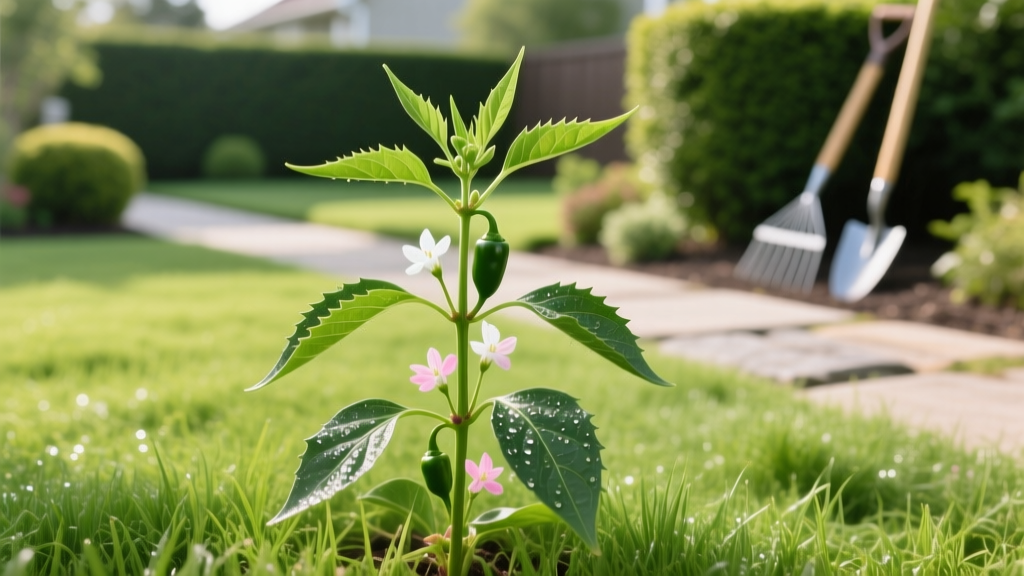
Weeds That Look Like Pepper Plants: Identification and Removal Guide
Why Pepper Lookalikes Invade Your Lawn and Garden
Finding a plant resembling a bell pepper or jalapeño sprouting in your turfgrass or vegetable garden is a common source of confusion for homeowners. These botanical imposters belong to the Solanaceae (nightshade) family, the exact same botanical family as edible peppers, tomatoes, and eggplants. Because they share a genetic lineage, their leaf structures, flower shapes, and fruiting bodies are remarkably similar to cultivated peppers.
However, unlike your carefully tended garden crops, these opportunistic weeds are aggressive, highly adaptable, and in many cases, toxic to humans and pets. Correct identification is the critical first step before you attempt removal, as misidentifying a toxic nightshade as a stray pepper seedling can lead to accidental ingestion or improper disposal.
⚠️ TOXICITY WARNING: Most wild nightshades contain solanine and solamargine alkaloids. Ingestion of the leaves, stems, or unripe berries by children, dogs, cats, or livestock can cause severe gastrointestinal distress, neurological symptoms, and in rare cases, respiratory failure. Never consume berries from an unidentified lawn weed.
The Prime Suspects: Identifying the Imposters
When homeowners report 'weeds that look like pepper plants,' they are almost always dealing with one of three specific broadleaf weeds. Here is how to tell them apart based on morphological markers.
1. Eastern Black Nightshade (Solanum ptychanthum)
This is the most common culprit. In its early vegetative stage, Eastern Black Nightshade features ovate, dark green leaves with slightly wavy margins that closely mimic the foliage of young pepper transplants. As it matures, it produces small, white, star-shaped flowers with prominent yellow anthers in the center. The fruit starts as a hard, green berry (often mistaken for a tiny, round pepper) before ripening to a dull, matte black. According to NC State Extension, this weed thrives in disturbed soils and can produce up to 100,000 seeds per plant, which remain viable in the soil seed bank for up to five years.
2. Carolina Horsenettle (Solanum carolinense)
If the 'pepper plant' in your lawn has spikes, you are dealing with Carolina Horsenettle. While the leaves share the alternating, lobed structure of a pepper plant, the stems and leaf veins are armed with sharp, yellowish prickles. The flowers are typically pale violet to white, and the fruit resembles a miniature, striped watermelon that eventually turns bright yellow. Unlike black nightshade, horsenettle spreads via deep, brittle rhizomes. If you pull it and the root snaps, the remaining fragments will quickly regenerate new shoots.
3. Cutleaf Groundcherry (Physalis angulata)
While technically a different genus within the nightshade family, cutleaf groundcherry often confuses gardeners. Its leaves are deeply lobed and highly reminiscent of hot pepper varieties like serranos. The defining feature, however, is the fruit: a small, green berry encased in a papery, lantern-like husk (calyx) that expands as the fruit matures. While less toxic than black nightshade, it is still a noxious agricultural and lawn weed that aggressively competes for soil nitrogen.
Comparison Matrix: Pepper Lookalikes at a Glance
| Feature | Eastern Black Nightshade | Carolina Horsenettle | Cutleaf Groundcherry |
|---|---|---|---|
| Leaf Margins | Wavy to slightly lobed | Deeply lobed, spiky edges | Deeply cut, serrated |
| Stem Texture | Smooth or slightly hairy | Covered in sharp prickles | Smooth, angular |
| Flower Color | White with yellow center | Pale violet or white | Pale yellow with dark center |
| Fruit Appearance | Green turning matte black | Striped green turning yellow | Encased in papery husk |
| Root System | Fibrous, shallow taproot | Deep, brittle rhizomes | Fibrous, branching |
Strategic Eradication: Lawns vs. Garden Beds
Eradicating nightshade weeds requires a tailored approach depending on whether they have invaded your turfgrass or your cultivated vegetable beds. Because these weeds share a family tree with your edible crops, chemical controls in garden beds carry a high risk of collateral damage.
Turfgrass Protocols (Post-Emergent Control)
In lawns, broadleaf herbicides are highly effective if timed correctly. Nightshades are most vulnerable to chemical control during their early vegetative stage (when they have 4 to 6 true leaves) before they develop a thick, waxy cuticle that repels herbicides.
- Active Ingredients: Look for three-way herbicides containing 2,4-D, dicamba, and MCPP. For stubborn horsenettle, products containing triclopyr or quinclorac offer superior systemic translocation down to the rhizomes.
- Application Technique: Apply liquid formulations using a pump sprayer calibrated to deliver 1.5 gallons per 1,000 square feet. Add a non-ionic surfactant (at 0.25% v/v) to break the surface tension of the nightshade's waxy leaves.
- Timing: Spray when daytime temperatures are between 65°F and 85°F. Avoid application if rain is forecast within 24 hours or if the turf is experiencing drought stress.
Garden Bed Protocols (Mechanical and Targeted Control)
You cannot safely spray broadleaf herbicides near your actual pepper, tomato, or eggplant crops. Drift or root uptake will kill your vegetables.
- The 'Soak and Pull' Method: Water the garden bed deeply the evening before weeding. This softens the soil, allowing you to extract the entire taproot of black nightshade or the deep rhizomes of horsenettle. If a horsenettle root snaps, mark the spot; it will resprout in 10 to 14 days and require a second pass.
- Thermal Weeding: For weeds growing in the cracks of patios or far from crop roots, a propane flame weeder is highly effective. Pass the flame over the weed until the leaves wilt (do not incinerate them to ash). This boils the water inside the plant cells, destroying the weed without leaving chemical residue.
- Smothering: Apply a 3-inch layer of arborist wood chips or use overlapping layers of cardboard topped with mulch. This blocks the photosynthesis required for nightshade seeds to germinate.
Preventing Future Outbreaks
Nightshade seeds are primarily dispersed by birds that eat the berries and deposit the seeds in your lawn via droppings. To break this cycle, implement a robust pre-emergent strategy.
Apply a pre-emergent herbicide containing prodiamine or dithiopyr in early spring. The critical metric is soil temperature: apply the pre-emergent when soil temperatures at a 2-inch depth reach 55°F for three consecutive days. This creates a chemical barrier in the top inch of soil that halts cell division in germinating nightshade seeds. Maintain a thick, healthy turfgrass canopy by mowing at the highest recommended height for your grass species (typically 3 to 4 inches for cool-season fescues), which shades the soil and prevents nightshade seeds from receiving the light required for germination.
Frequently Asked Questions
Can I compost pulled nightshade weeds?
Only if your compost pile consistently reaches and maintains temperatures above 145°F for several days. Most residential compost bins do not get hot enough to destroy nightshade seeds or the alkaloids present in the foliage. If the weeds have already produced berries, bag them and send them to the municipal landfill to prevent re-seeding your property.
Are these weeds harmful to my lawn's soil health?
While they do not permanently damage the soil, nightshades are heavy nitrogen feeders. A dense patch of black nightshade will strip localized areas of your lawn of available nitrogen, leading to yellowing, stunted turfgrass that is more susceptible to fungal diseases like dollar spot or brown patch.
How do I tell the difference between a weed and a volunteer pepper plant?
Volunteer pepper plants (grown from seeds dropped by last year's crop) will have smoother, more vibrant green leaves and lack the distinct white star-shaped flowers of black nightshade. Furthermore, crushing a true pepper leaf between your fingers will release a distinct, spicy, vegetal aroma, whereas nightshade leaves have a faint, earthy, and somewhat foul odor.

