
Lawn Care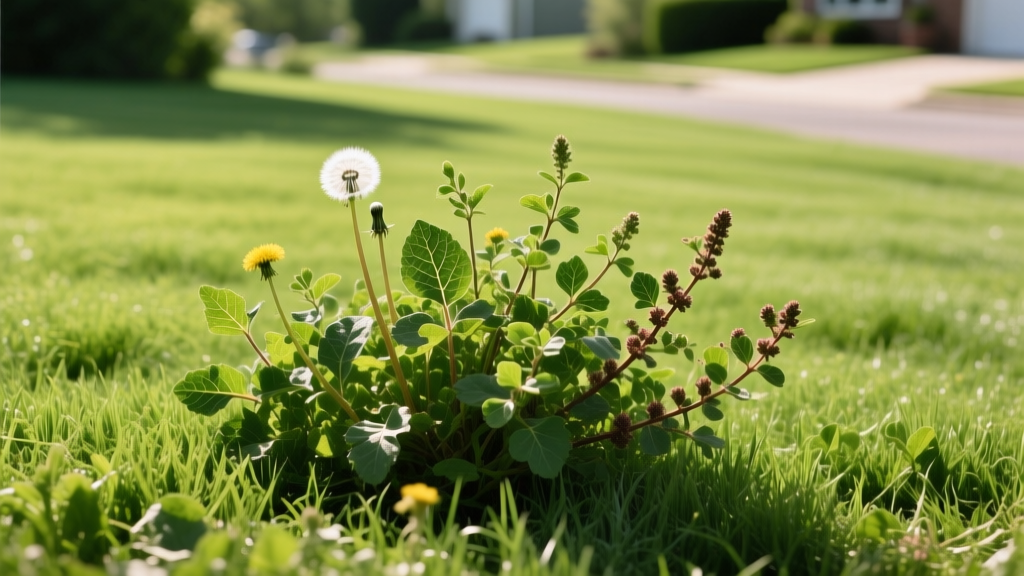
How to Identify and Spot-Treat Bushy Weeds in Lawns
The Anatomy of a Bushy Weed: Why They Resist Standard Treatments
When homeowners and turf managers refer to "bushy weeds," they are typically describing mature summer annuals or perennials that have developed thick, multi-stemmed, semi-woody bases. Unlike low-growing creeping weeds (such as prostrate spurge or creeping charlie), species like Kochia (Bassia scoparia), Redroot Pigweed (Amaranthus retroflexus), and Common Lambsquarters (Chenopodium album) grow vertically. In unmowed lawn edges, garden borders, or thin turf areas, these invaders can rapidly reach 12 to 36 inches in height, forming dense, shrub-like canopies.
The primary challenge with bushy weeds is their defense mechanism. Once these plants mature past the 4-leaf stage and begin developing secondary stems, they produce a thick, waxy cuticle and lignified (woody) lower tissue. Standard off-the-shelf aqueous herbicides—particularly amine-based 2,4-D formulations—will bead up and roll off this waxy surface, resulting in failed applications and wasted chemical. According to turf specialists at NC State TurfFiles, overcoming this cuticle requires specific surfactant chemistry and ester-based active ingredients.
Identification Matrix: The Usual Suspects
Accurate identification dictates your chemical selection. While all three weeds below exhibit a "bushy" growth habit in their mature stages, their leaf structures and root systems require slightly different management approaches.
| Weed Species | Visual Identifiers (Mature Stage) | Root System | Primary Herbicide Vulnerability |
|---|---|---|---|
| Kochia (Burningbush) | Highly branched, pyramid-shaped, reddish-green stems, narrow hairy leaves. | Deep, extensive taproot. | Highly susceptible to dicamba and carfentrazone-ethyl. |
| Redroot Pigweed | Erect, bushy, distinct red taproot, ovate leaves with prominent white veins underneath. | Shallow but dense fibrous taproot. | Vulnerable to 2,4-D ester and triclopyr combinations. |
| Common LambsquartersMulti-branched, dusty white/green mealy coating on new growth, diamond-shaped leaves. | Shallow taproot with lateral branches. | Susceptible to MCPP and dicamba; highly resistant to glyphosate. |
⚠️ WARNING: Herbicide Resistance
Kochia has developed widespread resistance to Group 2 (ALS-inhibitors) and Group 9 (Glyphosate) herbicides. If you are spot-treating bushy kochia in lawn edges, avoid generic "weed and feed" products relying solely on sulfentrazone or imazaquin. You must use a multi-mode-of-action synthetic auxin blend.
The Surfactant Secret: Breaking the Waxy Cuticle
The most critical component of spot-treating mature bushy weeds is not the active ingredient, but the adjuvant. Water alone has a high surface tension and cannot penetrate the lignified stems of a 20-inch pigweed. You must lower the surface tension of your spray solution.
- Non-Ionic Surfactants (NIS): Products like Southern Ag Surfactant are adequate for weeds under 6 inches tall. Use at 0.25% v/v (approx. 1/2 teaspoon per gallon of water).
- Methylated Seed Oil (MSO): For mature, bushy weeds over 8 inches tall, MSO is mandatory. MSO actively dissolves the waxy cuticle, allowing ester-based herbicides to penetrate the woody stem. Use at 1% v/v (1.25 fl oz per gallon of water). Expect to pay around $18 to $25 per quart for a high-quality MSO like Drexel Methylated Seed Oil.
Precision Spot-Treatment Protocol
Broadcast spraying a lawn to kill a few isolated bushy weeds is environmentally irresponsible and economically inefficient. Use a dedicated 1-gallon or 2-gallon pump sprayer for precision spot-treatment. The University of Minnesota Extension recommends targeting the weed directly while minimizing soil contact to protect turfgrass roots.
Step 1: Mechanical Disruption
If the bushy weed is over 18 inches tall, use a string trimmer to lightly scalp the top third of the canopy. This removes the oldest, most waxy leaves and exposes the tender, newer growth near the base. Wait exactly 24 hours after trimming before applying herbicide; this allows the plant to begin pushing new sap upward, which will actively pull the systemic herbicide down into the root zone.
Step 2: Mix the Solution
For a professional-grade spot treatment, bypass consumer ready-to-spray bottles and mix your own using PBI/Gordon SpeedZone Broadleaf Herbicide. This formulation contains 2,4-D ester, MCPP, dicamba, and carfentrazone-ethyl. The carfentrazone provides a rapid 24-hour burn-down, while the esters translocate to kill the deep taproot.
- Water: 1 Gallon
- SpeedZone Herbicide: 2.0 fl oz (approx. $0.55 per gallon mix based on a $140/gallon bulk price)
- MSO Surfactant: 1.25 fl oz
Note: Always add water first, then herbicide, then surfactant to prevent excessive foaming in the tank.
Step 3: Application Technique
Equip your sprayer with a TeeJet 8002VS flat fan nozzle. Adjust your pump to 40 PSI. Spray the bushy weed until the leaves are uniformly wet but not dripping (the "glistening" stage). Ensure you coat the lower stems where they meet the soil, as this is where the cuticle is thinnest and absorption is highest.
Post-Treatment Lawn Recovery
Once the bushy weed turns black and collapses (typically 5 to 10 days after a SpeedZone application), you are left with a bare patch in your turf. Leaving this soil exposed invites the next flush of weed seeds.
- Remove the Carcass: Pull the dead weed, ensuring you extract the taproot. If the stem snaps, use a dandelion digger to extract the remaining root mass.
- Loosen the Soil: Bushy weeds like pigweed compact the soil around their base. Use a hand cultivator to break up the top 2 inches of soil.
- Overseed and Topdress: Apply a starter fertilizer (such as Scotts Turf Builder Starter Food for New Grass at 3.5 lbs per 1,000 sq ft) and sow a matching turf seed blend. Cover with 1/4 inch of peat moss or compost to retain moisture.
Expert Troubleshooting & Edge Cases
"I sprayed the bushy weed, and the top leaves died, but two weeks later, it's growing back from the base."
The Fix: This is a classic sign of herbicide antagonism or poor translocation. If you mixed a fast-acting contact herbicide (like carfentrazone) at too high a rate without sufficient MSO, the leaf tissue died before the systemic chemicals could travel to the taproot. Reduce your contact herbicide rate by 25%, increase your MSO to 1.5% v/v, and ensure you are spraying the lower stems, not just the top canopy.
Temperature Volatility Constraints
Ester-based herbicides (crucial for penetrating bushy weed cuticles) are highly volatile. If daytime temperatures exceed 85°F (29°C), the 2,4-D ester will vaporize and drift, potentially killing nearby ornamental shrubs, tomato plants, or desirable broadleaf perennials. During peak summer months, restrict your spot-treatments to early morning hours (between 6:00 AM and 8:00 AM) when temperatures are below 80°F and humidity is higher, which suppresses vapor drift.
Cost Analysis: Spot-Treating vs. Broadcast Applications
Many homeowners default to hiring lawn services to broadcast spray entire properties when a few bushy weeds appear. Understanding the true cost of DIY spot-treatment highlights its economic advantage.
| Method | Chemical Cost (Per Application) | Equipment/Time | Turfgrass Impact |
|---|---|---|---|
| Professional Broadcast | $65 - $120 (per 5,000 sq ft lot) | Zero (outsourced) | Unnecessary chemical load on healthy turf. |
| Consumer RTU Sprays | $15 - $25 (per 1.33 gal bottle) | Low (ready to use) | High failure rate on mature bushy weeds; requires repeat buys. |
| DIY Pro Spot-Treatment | $0.60 - $1.10 (per 1,000 sq ft area) | Medium (requires mixing and calibration) | Zero impact on surrounding healthy turf; highly targeted. |
By investing $160 upfront in a gallon of professional ester-based herbicide and a quart of MSO, a homeowner can effectively spot-treat bushy weeds for up to five years, yielding a per-application cost that is virtually negligible compared to broadcast services or ineffective retail sprays.

