
Lawn Care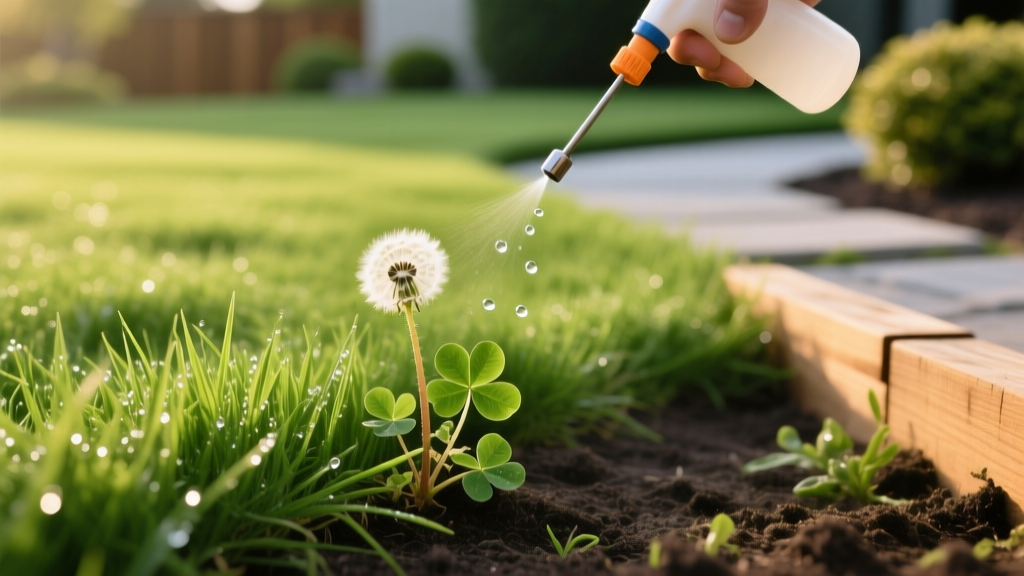
Spot-Treatment Guide: How to Eradicate Tiny Weeds Fast
Tiny weeds—often dismissed as harmless seedlings, moss, or minor turf thinning—can rapidly colonize a lawn if left unchecked. Because their root systems are shallow and their leaf surface area is minimal, treating micro-weeds requires a fundamentally different approach than tackling mature, deep-rooted perennials. Standard broadcast spraying often fails on tiny weeds because the droplets bounce off their waxy cotyledon leaves or miss them entirely. This guide details exact identification markers, precision application techniques, and chemical matrices to eradicate tiny weeds before they establish.
The 5 Most Common Tiny Weeds Invading Lawns
Accurate identification dictates your herbicide selection. According to the University of Missouri Weed ID database, these five species are the most frequent early-stage invaders in residential turf.
1. Hairy Bittercress (Cardamine hirsuta)
Identification: Forms tiny, 1-inch rosettes with pinnately compound leaves. Often found in damp, shaded areas of the lawn. If you touch the mature seed pods, they explosively discharge seeds.
Vulnerability Window: Highly susceptible to post-emergent broadleaf herbicides when in the 2- to 4-leaf rosette stage.
2. Prostrate Spurge (Euphorbia maculata)
Identification: Creeps flat against the soil in a starburst pattern, rarely exceeding 2 inches in diameter when young. Snapping the tiny red-tinged stems releases a milky white sap.
Vulnerability Window: Must be treated before the taproot thickens. Once the central taproot exceeds 1 inch in depth, spot-treatment efficacy drops by 40%.
3. Common Chickweed (Stellaria media)
Identification: Features tiny, bright lime-green oval leaves connected by a single line of hairs running down the stem. Forms dense, low-lying mats.
Vulnerability Window: Best treated in early spring or late fall when soil temperatures are below 65°F.
4. Lawn Burweed / Spurweed (Soliva sessilis)
Identification: Looks like miniature, finely dissected parsley lying flat against the soil. It develops sharp, needle-like burs that make walking barefoot painful.
Vulnerability Window: Winter annual. Spot-treat in December or January before the burs harden in late February.
5. White Clover Seedlings (Trifolium repens)
Identification: Before developing the classic three-leaf pattern, clover seedlings start as tiny, heart-shaped single leaves on thin, wiry petioles.
Vulnerability Window: Seedlings lack the waxy cuticle of mature clover, making them highly susceptible to lower-concentration herbicide mixes.
Spot-Treatment Decision Matrix: Chemical vs. Organic
Selecting the right active ingredient depends on your grass type, the specific tiny weed species, and your tolerance for synthetic chemicals. Below is a 2026 pricing and efficacy matrix for spot-treating micro-weeds.
| Treatment Type | Active Ingredient(s) | Target Tiny Weeds | Avg. Cost (2026) | Best Application Method |
|---|---|---|---|---|
| Synthetic Broadleaf | 2,4-D, Quinclorac, Dicamba | Bittercress, Chickweed, Clover | $18 - $24 / 32oz | Low-pressure wand with fan nozzle |
| Precision Gel | Glyphosate (2% ready-to-use) | Spurge, isolated grassy weeds | $9 - $12 / wand | Direct wick application to leaves |
| Organic Contact | Ammoniated Soap of Fatty Acids | All tiny seedlings (non-selective) | $15 - $20 / 32oz | Trigger spray on dry, sunny days |
| Pre-Emergent | Prodiamine or Dithiopyr | Prevents all seed germination | $45 - $60 / lb | Drop spreader (granular) |
Precision Application: How to Treat Without Killing Grass
When treating tiny weeds, the primary risk is herbicide drift damaging the surrounding desirable turf. Follow this exact protocol for micro-targeting:
- Mix with a Surfactant: Tiny weed leaves are highly hydrophobic. Add 1 teaspoon of a non-ionic surfactant (like Southern Ag Surfactant, approx. $14/gallon) to every gallon of mixed herbicide. This breaks the surface tension, forcing the chemical to spread across the micro-leaf rather than beading up and rolling into the soil.
- Calibrate for Low Pressure: Pump your sprayer to only 20-25 PSI. High pressure creates micro-droplets that drift on the wind. You want a heavy, coarse spray pattern.
- Use a Shielded Nozzle: For weeds growing directly adjacent to desirable grass blades, use a physical spray shield (a simple plastic cone attachment, ~$8) to block lateral drift.
- Deploy Gel Wands for Isolated Invaders: If you only have 10 to 20 tiny spurge plants scattered across the lawn, liquid spraying is inefficient and risky. Use a Glyphosate precision gel wand. Touch the sponge tip directly to the center of the tiny weed rosette. The gel transfers instantly without dripping.
⚠️ Temperature Inversion Warning: Never spot-treat tiny weeds early in the morning when a temperature inversion is present (fog or heavy dew). Inversions trap herbicide vapor near the soil surface, causing it to drift laterally and burn the tips of your desirable grass. Apply treatments between 10:00 AM and 2:00 PM when the air is mixing and temperatures are between 65°F and 85°F.
The Pre-Emergent Strategy: Stopping Tiny Weeds at the Seed
Spot-treating is reactive. To eliminate the constant cycle of tiny weeds, you must disrupt the seed bank. According to NC State Extension TurfFiles, pre-emergent herbicides create a chemical barrier in the top 0.5 inches of soil, killing weed seeds as they germinate.
The Soil Temperature Rule: Do not apply pre-emergents based on the calendar. Apply when the soil temperature at a 2-inch depth reaches 52°F to 55°F for three consecutive days in the spring (to stop spurge and bittercress) and drops to 70°F in the fall (to stop annual bluegrass and chickweed). Use a digital soil probe thermometer ($15-$25) rather than relying on ambient air temperature apps.
Troubleshooting Spot-Treatment Failures
If your tiny weeds are turning yellow but not dying, or if they bounce back within 14 days, evaluate these common failure modes:
- Mowing Too Soon: Mowing within 48 hours of application removes the treated leaf tissue before the herbicide has translocated to the tiny root system. Wait at least 3 days.
- Hard Water Interference: If mixing liquid concentrates with well water or hard municipal water, calcium and magnesium ions will bind to the herbicide molecules (especially Glyphosate and 2,4-D), rendering them inactive. Add 1 tablespoon of ammonium sulfate per gallon of water to condition the mix.
- Waxy Cuticle Barrier: Some tiny weeds develop a thick waxy coating even at the seedling stage if exposed to drought stress. If liquid treatments fail, switch to an emulsifiable concentrate (EC) formulation rather than a water-dispersible granule (WG), as the solvents in EC formulations penetrate waxy cuticles more effectively.
Frequently Asked Questions
Can I just pull tiny weeds by hand?
Hand-pulling is only effective if the soil is heavily saturated and the weed has a single taproot (like young spurge). For fibrous-rooted tiny weeds like chickweed or creeping charlie, hand-pulling almost always leaves microscopic root fragments behind, which regenerate into new plants within 7 to 10 days. Chemical or organic contact treatment is vastly more efficient for fibrous micro-weeds.
Will household vinegar kill tiny weeds?
Standard 5% household white vinegar will burn the top growth of tiny weed seedlings, but it lacks the systemic action required to kill the roots. Furthermore, the EPA notes that repeated applications of acetic acid drastically lower soil pH, potentially locking up vital nutrients like phosphorus and calcium in your lawn's soil. If using an organic contact killer, opt for commercially formulated 20% horticultural vinegar with added clove oil, and apply it strictly as a spot treatment.
How long does it take for tiny weeds to die after spot-treatment?
With a proper surfactant mix and ideal temperatures (70°F-80°F), tiny broadleaf weeds will show visible wilting and curling within 12 to 24 hours. Complete root death and browning typically occur within 5 to 7 days. If using an organic fatty acid soap, desiccation happens in 2 to 4 hours, but multiple applications spaced 5 days apart are usually required to exhaust the seedling's energy reserves.

