
Lawn Care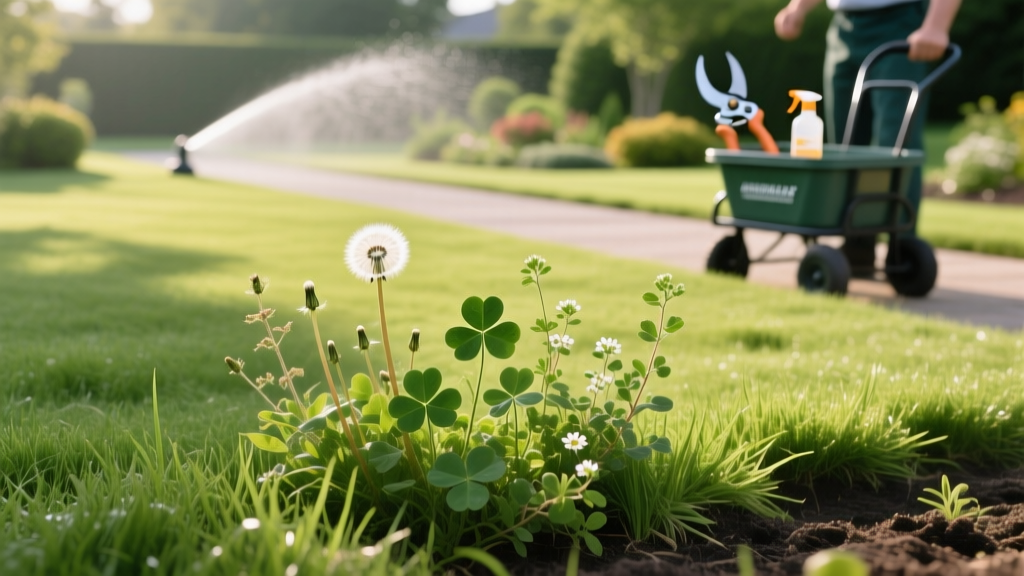
How to Identify and Treat the Most Common Types of Lawn Weeds
Applying the wrong herbicide to your lawn does more than waste $30 to $60 on chemicals; it can severely stunt your turfgrass or fail to disrupt the weed's reproductive cycle. Successful weed management hinges entirely on accurate identification. The types of lawn weeds invading your yard dictate the exact active ingredients, application timing, and cultural practices required for eradication.
According to turfgrass specialists at NC State Extension's TurfFiles, weeds are broadly categorized into three distinct botanical families. Understanding these structural differences is the first step in selecting a targeted control strategy.
The Three Botanical Categories of Lawn Weeds
Before purchasing any selective or non-selective herbicide, examine the weed's leaf structure, stem, and root system. This comparison matrix outlines the primary identifiers for the three main types of lawn weeds.
| Category | Leaf Vein Structure | Stem & Root Traits | Common Examples | Primary Chemical Control |
|---|---|---|---|---|
| Broadleaf | Net-like (reticulate) veins | Solid stems; taproots or fibrous mats | Dandelion, Clover, Chickweed | Synthetic auxins (2,4-D, Dicamba, Triclopyr) |
| Grassy | Parallel veins | Hollow, rounded stems; fibrous roots | Crabgrass, Poa Annua, Goosegrass | Pre-emergents (Prodiamine) & specific post-emergents (Quinclorac) |
| Sedge | Parallel veins (V-shaped) | Solid, triangular stems; rhizomes/nutlets | Yellow Nutsedge, Purple Nutsedge | ALS inhibitors (Halosulfuron-methyl, Sulfentrazone) |
Broadleaf Weeds: Identification and Targeted Treatments
Broadleaf weeds are the easiest to spot because their wide leaves and net-like veins contrast sharply with turfgrass. They are generally controlled using systemic selective herbicides that mimic plant growth hormones, causing the weed to grow itself to death.
Dandelion (Taraxacum officinale)
Recognizable by its rosette of deeply lobed leaves and bright yellow flowers, the dandelion's true challenge is its deep taproot, which can extend 10 to 15 inches into the soil. Pulling them manually often leaves the root tip behind, resulting in regrowth within weeks.
- Active Ingredient: A three-way blend of 2,4-D, Dicamba, and MCPP.
- Product Recommendation: SpeedZone Broadleaf Herbicide (approx. $45 per pint). Mix at 1.5 fl oz per gallon of water for spot treatments.
- Application Timing: Fall is optimal. As temperatures drop, dandelions pull nutrients (and herbicides) down into their taproots to store for winter, ensuring a complete kill.
White Clover (Trifolium repens)
Clover features three-leaflet leaves with distinct white chevrons and spreads via creeping stolons. Standard 2,4-D formulations often fail against mature clover because its waxy leaf cuticle repels the chemical.
- Active Ingredient: Triclopyr is mandatory for effective clover control.
- Product Recommendation: Ortho WeedClear for Lawns (contains Triclopyr, 2,4-D, and Dicamba). Expect to pay around $25 for a 32 oz ready-to-spray bottle covering 5,000 sq ft.
- Pro Tip: Add a non-ionic surfactant (like methylated seed oil) to your tank mix to break down the clover's waxy leaf barrier.
Grassy Weeds: The Pre-Emergent Imperative
Grassy weeds mimic your actual turf, making selective post-emergent control incredibly difficult without damaging your lawn. For annual grassy weeds, prevention via pre-emergent herbicides is the gold standard. Penn State Extension notes in their turfgrass weed management guidelines that timing pre-emergent applications with soil temperature is critical for establishing a chemical barrier before germination.
Crabgrass (Digitaria)
A summer annual that germinates when soil temperatures at a 2-inch depth reach 50°F to 55°F for several consecutive days. It forms thick, pale green mats that choke out surrounding turf.
- Pre-Emergent Strategy: Apply Prodiamine (Barricade) or Dithiopyr (Dimension). A 5 lb bag of professional-grade Prodiamine costs roughly $80 and treats up to 10,000 sq ft, offering 4 to 6 months of residual control.
- Post-Emergent Fallback: If crabgrass breaks through, use Quinclorac (e.g., Drive XLR8). Note: Quinclorac is safe for most cool-season grasses and Bermudagrass, but will severely damage St. Augustine and Centipede grass.
Annual Bluegrass (Poa annua)
Poa Annua is a winter annual that germinates in late summer, thrives in cool weather, and dies off in late spring, leaving bare patches. It features a distinct boat-shaped leaf tip and produces prolific white seed heads even at low mowing heights.
- Pre-Emergent Strategy: Apply Prodiamine in late August or early September when soil temperatures drop below 70°F.
- Post-Emergent Option: For cool-season lawns, Ethofumesate (Prograss) can be applied in early spring to suppress mature Poa annua, though it is an expensive commercial-grade solution ($150+ per quart).
Warning: Sedge is Not a Grass!
Do not use grassy weed killers on Nutsedge. While it looks like a grassy weed, sedge belongs to a completely different botanical family. Applying standard crabgrass killers to nutsedge will yield zero results and waste your money. Remember the turf industry rhyme: "Sedges have edges, rushes are round, grasses have nodes from their feet to their heads."
Do not use grassy weed killers on Nutsedge. While it looks like a grassy weed, sedge belongs to a completely different botanical family. Applying standard crabgrass killers to nutsedge will yield zero results and waste your money. Remember the turf industry rhyme: "Sedges have edges, rushes are round, grasses have nodes from their feet to their heads."
Sedge Weeds: Moisture Indicators and Eradication
Sedges thrive in poorly drained, compacted, or over-irrigated soils. Identifying them requires feeling the stem—roll it between your fingers. If it feels distinctly triangular, you are dealing with sedge.
Yellow Nutsedge (Cyperus esculentus)
Yellow nutsedge grows significantly faster than surrounding turf, often shooting up two inches above the canopy just days after mowing. It reproduces via underground tubers (nutlets) that can remain dormant in the soil for years.
- Active Ingredient: Halosulfuron-methyl or Sulfentrazone.
- Product Recommendation: SedgeHammer (Halosulfuron-methyl). It is sold in small, water-soluble packets (approx. $25 for a box of 5 packets). One packet treats roughly 1,000 sq ft.
- Application Protocol: SedgeHammer is a slow-acting systemic herbicide. It takes 14 to 21 days to see visible yellowing and necrosis. Do not reapply prematurely. A second application is usually required 4 weeks later to kill secondary tuber flushes.
- Cultural Fix: Aerate the lawn and adjust irrigation schedules. Nutsedge will naturally thin out once the soil dries to a normal moisture level.
The 'If-Then' Weed Control Decision Framework
Use this rapid decision tree to formulate your seasonal herbicide strategy based on your specific turfgrass type and the weed pressure observed.
If You Have a Cool-Season Lawn (Fescue, Kentucky Bluegrass, Ryegrass)
- Spring (March-April): Apply Prodiamine pre-emergent for crabgrass. Spot-treat emerging broadleaves with a 3-way Triclopyr blend.
- Late Summer (August-September): Apply a second pre-emergent for Poa annua. Overseed bare spots to increase turf density, which naturally outcompetes weed seeds.
- Fall (October-November): Execute a comprehensive broadleaf sweep using SpeedZone. Fall applications are 3x more effective than spring applications for perennial broadleaves.
If You Have a Warm-Season Lawn (Bermuda, Zoysia, St. Augustine)
- Early Spring (February-March): Apply pre-emergent before the grass breaks dormancy. Crucial: Do not use pre-emergents containing Dithiopyr on newly sprigged or sodded warm-season lawns, as it can inhibit root establishment.
- Summer (June-July): Monitor for Nutsedge and Spurge. Treat Nutsedge with SedgeHammer. Treat broadleaf Spurge with a St. Augustine-safe herbicide like Atrazine (avoid 2,4-D on St. Augustine, as it causes severe phytotoxicity and leaf curling).
- Winter Dormancy (December-January): While the warm-season grass is brown and dormant, you can safely use non-selective herbicides like Glyphosate (Roundup) to spot-treat winter annuals like Poa annua and Henbit without harming your dormant turf.
Calibration is Non-Negotiable
The most common cause of herbicide failure—and turf damage—is poor sprayer calibration. Before applying any chemical, fill your tank with plain water and spray a 1,000 sq ft test area on your driveway to measure exactly how much liquid your sprayer outputs. Adjust your walking speed and nozzle pressure until you are applying exactly 1.5 gallons per 1,000 sq ft. Only then should you add the chemical concentrate to the tank.
The most common cause of herbicide failure—and turf damage—is poor sprayer calibration. Before applying any chemical, fill your tank with plain water and spray a 1,000 sq ft test area on your driveway to measure exactly how much liquid your sprayer outputs. Adjust your walking speed and nozzle pressure until you are applying exactly 1.5 gallons per 1,000 sq ft. Only then should you add the chemical concentrate to the tank.
Accurate identification of the types of lawn weeds in your yard transforms weed control from a frustrating guessing game into a predictable, science-based process. By matching the weed's botanical classification to the correct active ingredient and applying it during the plant's most vulnerable growth stage, you can reclaim your turf and minimize long-term chemical reliance.

