
Lawn Care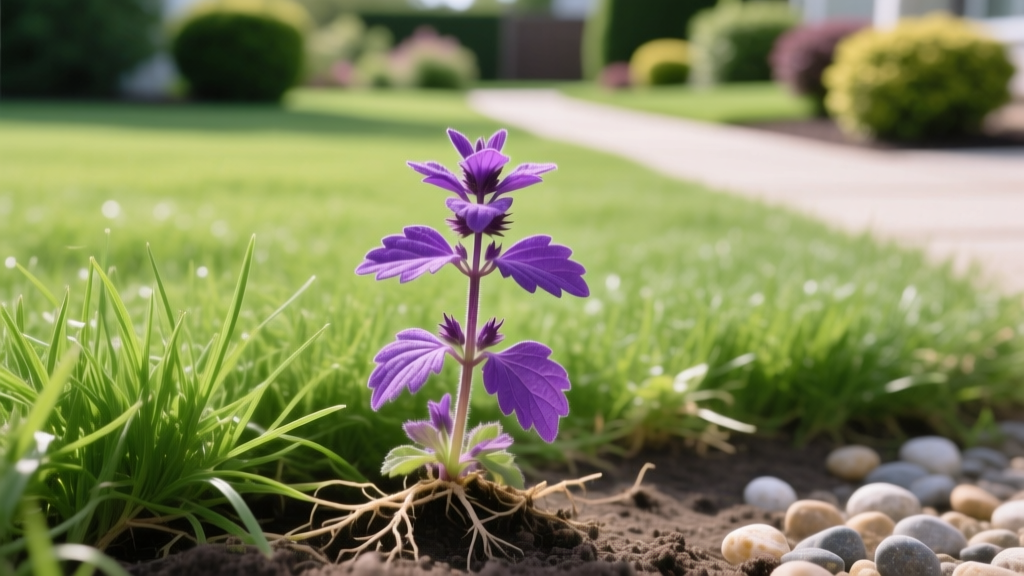
Purple Lawn Weed Identification and Spot Treatment Guide
The Biology of Purple Lawn Weeds
Spotting purple flowers in your turf is a clear biological indicator that specific weed families have infiltrated your lawn. Unlike generic broadleaf weeds, the species that produce purple or violet blooms typically belong to the mint family (Lamiaceae), the violet family (Violaceae), or the sedge family (Cyperaceae). Each family possesses distinct defense mechanisms, root structures, and chemical resistances that render standard, off-the-shelf 'weed and feed' products ineffective.
Successfully eradicating these invaders requires precise identification followed by targeted spot-treatment using specific active ingredients. Blanket spraying your entire lawn with generic 2,4-D is not only environmentally wasteful but will fail to kill perennial purple weeds like wild violets and creeping Charlie, which require specialized ester-based herbicides or systemic sedge killers.
Identification Matrix: The 'Big Four' Purple Weeds
Before mixing any chemicals, you must confirm the exact species. Misidentifying a sedge as a broadleaf weed will result in total treatment failure. Use this diagnostic matrix to classify the invader.
| Weed Species | Leaf Structure | Stem & Root Profile | Flower Detail | Life Cycle |
|---|---|---|---|---|
| Henbit (Lamium amplexicaule) | Round, scalloped edges, clasping stem | Square stem, shallow fibrous roots | Small, tubular, bright purple | Winter Annual |
| Wild Violet (Viola sororia) | Heart-shaped, waxy cuticle | Rhizomes, deep fleshy taproot | Five-petal, deep violet/purple | Perennial |
| Creeping Charlie (Glechoma hederacea) | Round to kidney-shaped, scalloped | Square stem, nodes root into soil | Funnel-shaped, bluish-purple | Perennial |
| Purple Nutsedge (Cyperus rotundus) | Grass-like, V-shaped, glossy | Triangular stem, underground nutlets | Reddish-purple spikelets | Perennial Sedge |
Chemical Spot-Treatment Protocols
Effective spot-treatment relies on matching the active ingredient to the weed's biological vulnerabilities. As of 2026, the most reliable professional-grade concentrates available to homeowners for these specific species are outlined below.
1. Henbit and Purple Deadnettle (Winter Annuals)
Because these are winter annuals, they germinate in early fall, overwinter, and flower in early spring. The optimal treatment window is late fall (October to November) when the plants are small and actively storing nutrients in their roots.
- Active Ingredients: 2,4-D combined with Dicamba and MCPP.
- Product Recommendation: SpeedZone Broadleaf Herbicide or Ortho WeedClear Lawn Weed Killer.
- Mixing Rate: 1.5 fl oz of concentrate per 1 gallon of water per 1,000 sq ft.
- Application Note: Spray until the leaves are uniformly wet but not dripping. Henbit's shallow roots absorb the chemical rapidly, usually showing necrosis within 48 hours.
2. Wild Violets (Perennial Broadleaf)
Wild violets are notoriously difficult to kill due to their thick, waxy leaf cuticle that repels water-based herbicides, and their deep rhizome networks that allow them to regenerate if the crown is not destroyed. Standard amine-based 2,4-D will simply roll off the leaves.
- Active Ingredients: Triclopyr (ester formulation) or Quinclorac.
- Product Recommendation: Cool Power (Triclopyr) or a professional three-way ester blend like Trimec Classic.
- Mixing Rate: 1.0 to 1.5 fl oz per gallon of water.
- Critical Additive: You must add a non-ionic surfactant (like Hi-Yield Spreader Sticker) at a rate of 0.25% (approx. 1/2 teaspoon per gallon). The surfactant breaks the waxy surface tension, allowing the Triclopyr to penetrate the leaf tissue.
3. Creeping Charlie (Perennial Mint)
According to Michigan State University Extension, Creeping Charlie spreads aggressively via stolons and thrives in moist, shaded areas. While older internet myths suggest using borax, modern turf science confirms that synthetic auxin herbicides are vastly superior and safer for surrounding soil biology.
- Active Ingredients: Triclopyr is the gold standard here, often combined with Dicamba.
- Timing: Treat in the fall when the plant is pulling carbohydrates down into its roots for winter storage, carrying the herbicide directly to the nodes.
4. Purple Nutsedge (Perennial Sedge)
Purple nutsedge is not a broadleaf weed; it is a sedge. Broadleaf herbicides will have zero effect on it. It reproduces via underground tubers (nutlets) connected by rhizomes. Pulling it by hand usually snaps the stem, leaving the tubers intact to sprout multiple new shoots.
- Active Ingredient: Halosulfuron-methyl.
- Product Recommendation: SedgeHammer+ (which includes the surfactant in the packet).
- Cost & Rate: Expect to pay $25 to $30 for a box of 13.5g water-soluble packets. One 13.5g packet treats 1,000 sq ft. Mix with 1 to 2 gallons of water.
- Patience Required: Halosulfuron-methyl is a slow-acting ALS inhibitor. The nutsedge will stop growing immediately, but visible yellowing and necrosis can take 10 to 14 days. Do not reapply prematurely.
Warning: Warm-Season Grass Sensitivity
If you maintain a warm-season turf like St. Augustine, Centipede, or Zoysia, you must check the herbicide label for phytotoxicity warnings. Triclopyr and high doses of 2,4-D can severely stunt or kill St. Augustine grass. For warm-season lawns, opt for Atrazine-based products (for broadleaves) or carefully spot-treat with a shielded wand to prevent drift.
If you maintain a warm-season turf like St. Augustine, Centipede, or Zoysia, you must check the herbicide label for phytotoxicity warnings. Triclopyr and high doses of 2,4-D can severely stunt or kill St. Augustine grass. For warm-season lawns, opt for Atrazine-based products (for broadleaves) or carefully spot-treat with a shielded wand to prevent drift.
Manual and Organic Spot-Treatments
For homeowners managing small patches or maintaining strictly organic lawns, chemical herbicides are off the table. However, organic spot-treatment requires intense physical diligence.
Deep-Root Extraction Tools
For wild violets, surface pulling is useless. You must extract the entire rhizome. Use a stand-up weeder with serrated claws (such as the Fiskars 3-Claw Weeder, typically priced around $35). Push the tool deeply into moist soil directly over the violet crown, step on the lever, and pull. Inspect the extracted soil plug to ensure the fleshy white taproot is fully removed.
Horticultural Vinegar (Acetic Acid)
Standard 5% household vinegar is ineffective against mature purple weeds. You need horticultural vinegar containing 20% to 30% acetic acid (e.g., Green Gobbler 30% Vinegate). Note: This is a non-selective contact burn-down agent. It will instantly kill the foliage of henbit and creeping Charlie, but it will also burn your turfgrass if you drift. Furthermore, it rarely kills the deep roots of wild violets, requiring repeated applications every 7 days until the root starves.
Post-Eradication Lawn Recovery
Successfully killing purple weeds leaves bare spots in your turf canopy. If left unaddressed, these bare patches will be immediately colonized by new weed seeds or invasive grasses like Poa annua.
- Neutralize the Soil (If Necessary): If you used heavy horticultural vinegar, flush the area with a deep watering to dilute the soil acidity before seeding.
- Overseed the Patch: For cool-season lawns, use a premium turf-type tall fescue or Kentucky bluegrass blend. Apply seed at a rate of 4 to 6 lbs per 1,000 sq ft for spot repairs.
- Apply Pre-Emergent: To stop henbit and deadnettle from returning the following year, apply a Prodiamine-based pre-emergent (like Barricade) in early September when soil temperatures drop to 70°F. This creates a chemical barrier that prevents the winter annual purple weed seeds from germinating.
For comprehensive regional identification and localized treatment schedules, consult the University of Minnesota Extension weed database or the UC Statewide IPM Program for western turf profiles. Consistent monitoring in early spring and late fall remains the most cost-effective defense against purple-flowered turf invaders.

