
Lawn Care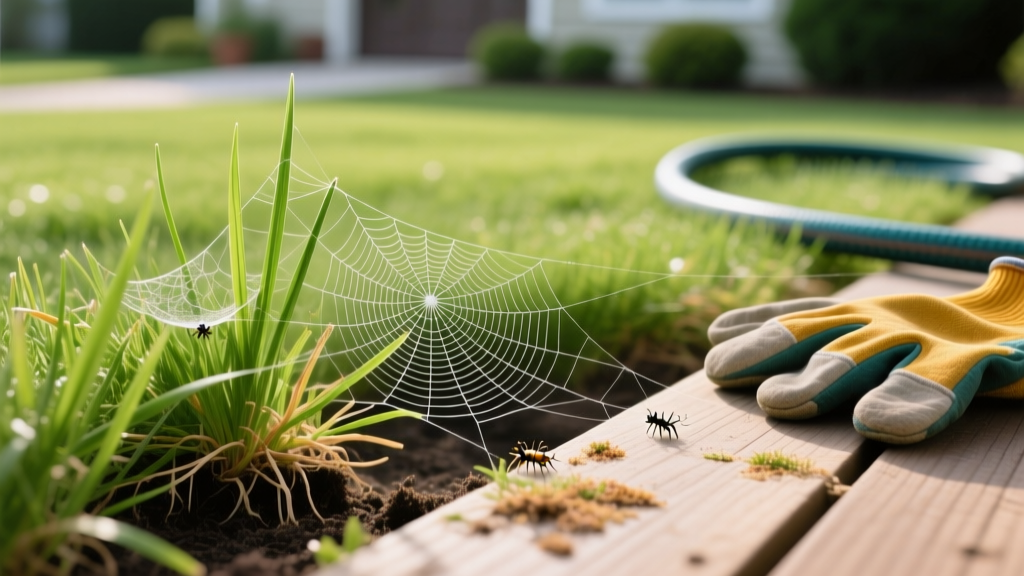
Identifying and Treating Webs in Grass: A Step-by-Step Maintenance Guide
The Diagnostic Dilemma: What Kind of Web Is It?
When homeowners spot webs in grass during their morning walk, the immediate assumption is often a spider infestation. However, in professional turfgrass management, surface webbing rarely indicates a dangerous arachnid problem. Instead, it usually signals one of three distinct biological events: harmless spider activity, destructive sod webworm larvae (Crambus and Herpetogramma species), or fungal mycelium networks. Misdiagnosing the source of these webs leads to wasted money on ineffective insecticides or fungicides, allowing the actual problem to escalate.
Before initiating any lawn maintenance procedures, you must accurately identify the webbing. Sod webworms spin silk tunnels in the thatch layer to hide from predators and sunlight while they chew on grass blades at night. Fungal pathogens like Dollar Spot (Clarireedia jacksonii) produce mycelium that looks exactly like a delicate cobweb when covered in morning dew. Spiders, conversely, build vertical or horizontal capture webs that do not damage the turf.
| Indicator | Harmless Spider Webs | Sod Webworm Silk | Fungal Mycelium (Dollar Spot) |
|---|---|---|---|
| Appearance | Intricate, geometric, or funnel-shaped structures suspended above or across the turf canopy. | Messy, dense silk tunnels buried in the thatch layer; often accompanied by tiny green fecal pellets (frass). | Faint, white, cobweb-like threads coating the grass blades; disappears as the sun dries the dew. |
| Time Visible | Morning (with dew) or late afternoon. | Visible in thatch when parting the grass; larvae active at night. | Strictly early morning before the sun burns off the dew. |
| Grass Damage | None. | Irregular brown patches; grass blades chewed off at the crown. | Straw-colored, sunken circular patches 1 to 6 inches in diameter. |
| Primary Location | >Suspended on grass tips or between blades.Base of the plant, within the top 0.5 inches of thatch. | Coating the surface of individual grass blades in the affected patch. |
Step 1: Perform the Soap Flush Diagnostic Test
If you suspect the webs in grass are caused by sod webworms, you must confirm the presence and population density of the larvae before applying any chemical controls. The industry standard for this is the soap flush test, which irritates the larvae and forces them to the surface.
Soap Flush Recipe & Procedure:
- Mix 2 tablespoons of lemon-scented liquid dish soap (like Dawn) into 1 gallon of water.
- Mark off a 1-square-yard area at the edge of a damaged brown patch (where the grass is still transitioning from green to brown).
- Slowly pour the soapy solution evenly over the marked area, allowing it to penetrate the thatch.
- Wait 10 to 15 minutes. Watch for small, grayish-brown or green caterpillars (0.5 to 1 inch long) wriggling to the surface.
Decision Framework: According to University of Kentucky Entomology, finding 4 to 6 larvae per square foot justifies a targeted insecticide application. If you find fewer than 4, the turf can usually outgrow the damage with proper cultural maintenance. If you find zero larvae but still see morning cobwebs and brown patches, you are likely dealing with a fungal infection, not an insect.
Step 2: Cultural Maintenance to Deter Webworms
Sod webworms thrive in neglected lawns with excessive thatch and compacted soil. Modifying your environment makes it inhospitable for adult moths to lay eggs and for larvae to survive.
Thatch Management and Aeration
Sod webworm larvae build their protective silk tunnels in the thatch layer. If your thatch exceeds 0.5 inches, it acts as an impenetrable bunker against both predators and surface-applied insecticides. Rent a power rake (dethatcher) and set the tines to penetrate exactly 0.25 inches into the soil surface. Follow up with core aeration using a machine that pulls 2-to-3-inch plugs, which introduces oxygen to the soil and accelerates the microbial breakdown of remaining thatch.
Irrigation and Mowing Adjustments
Adult sod webworm moths prefer to lay eggs in dry, closely cropped turf. Raise your mower deck to maintain a cutting height of 2.5 to 3.5 inches for cool-season grasses (like Tall Fescue and Kentucky Bluegrass) and 1.5 to 2.5 inches for warm-season grasses (like Bermuda). Taller grass shades the soil, creating a humid microclimate that discourages moth egg-laying. Furthermore, maintain a deep, infrequent watering schedule—applying 1 inch of water per week in a single session—to promote deep root growth that can tolerate minor insect feeding.
Step 3: Targeted Eradication Protocols
If the soap flush test confirms a damaging population of sod webworms, you must select the appropriate treatment based on the larvae's life stage and your environmental preferences.
Biological Controls (Early Instar Larvae)
If you catch the infestation in late summer when larvae are young (early instars), biological controls are highly effective and safe for beneficial insects. Products containing Bacillus thuringiensis var. kurstaki (Bt), such as Monterey Bt, target the digestive system of caterpillars. Apply Bt in the late afternoon, as UV light degrades the bacteria rapidly. The larvae must ingest the treated grass blades for it to work, so do not water immediately after application.
Chemical Curatives (Late Instar Larvae)
For larger, mature larvae causing rapid destruction in early fall, synthetic pyrethroids are required for immediate knockdown. Bifenthrin (found in products like Talstar P or Ortho BugClear) is the industry standard. Apply at a rate of 0.5 to 1.0 fluid ounces per 1,000 square feet.
Critical Application Note: Unlike grub treatments that require heavy watering into the soil, sod webworms live in the thatch. After applying Bifenthrin, water the lawn with exactly 0.1 to 0.25 inches of irrigation—just enough to wash the chemical off the grass blades and into the thatch layer where the webs and larvae are located. Overwatering will push the chemical past the target zone into the soil, rendering it useless against webworms.
Warning: The Fungus Trap
Never apply insecticides to webs in grass without performing the soap flush test first. If the webs are actually Dollar Spot mycelium, applying Bifenthrin or Bt will not cure the fungus. Worse, it will kill beneficial predatory beetles and spiders that naturally keep other turf pests in check, while the Clarireedia jacksonii fungus continues to destroy your turf. For confirmed fungal mycelium, switch to a contact fungicide like Chlorothalonil or a systemic like Propiconazole.
Never apply insecticides to webs in grass without performing the soap flush test first. If the webs are actually Dollar Spot mycelium, applying Bifenthrin or Bt will not cure the fungus. Worse, it will kill beneficial predatory beetles and spiders that naturally keep other turf pests in check, while the Clarireedia jacksonii fungus continues to destroy your turf. For confirmed fungal mycelium, switch to a contact fungicide like Chlorothalonil or a systemic like Propiconazole.
Post-Treatment Recovery Procedures
Once the larvae are eradicated, the lawn will be left with chewed crowns and brown patches. To prevent future generations from taking hold, utilize endophyte-enhanced grass seed for your overseeding procedure. Endophytes are naturally occurring, beneficial fungi that live inside the grass plant tissue. They produce alkaloids that are highly toxic to chewing insects, including sod webworms and chinch bugs.
Look for premium seed blends like Pennington Smart Seed or Jonathan Green Black Beauty, which explicitly list endophyte-enhanced perennial ryegrass and tall fescue on the label. Expect to pay between $40 and $60 for a 3-pound bag capable of overseeding 1,000 square feet. Keep the newly seeded areas consistently moist for 14 to 21 days until germination is complete, and avoid applying broadleaf herbicides until the new grass has been mowed at least three times. By combining accurate diagnosis with targeted biological or chemical interventions, you can permanently eliminate destructive webs in grass and restore a dense, resilient turf canopy.
For further regional guidance on turfgrass pests, consult your local cooperative extension office or review the comprehensive sod webworm management guidelines provided by Penn State Extension.

