
Lawn Care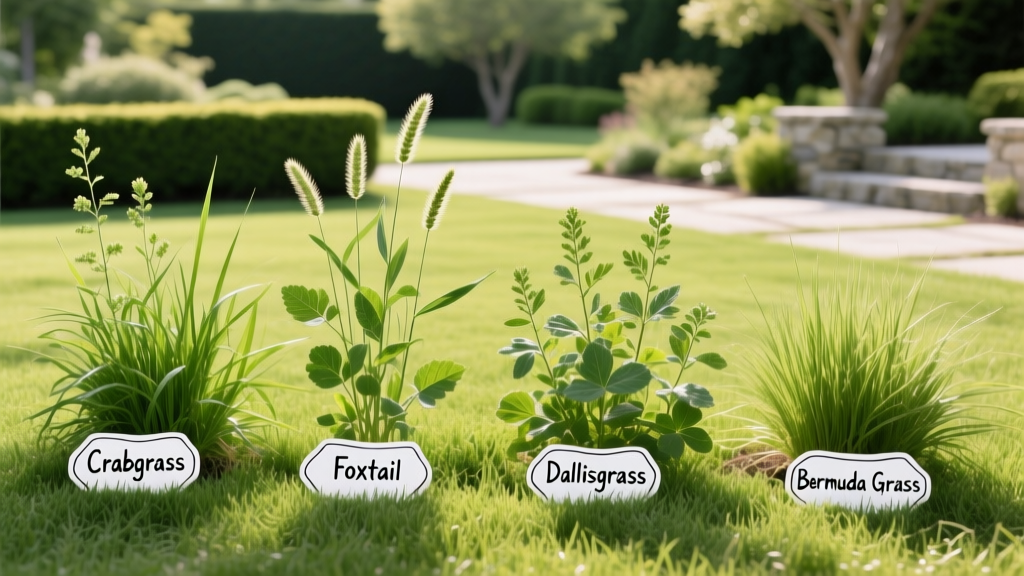
Types of Grassy Weeds: Identification and Control Guide
Understanding the Difference: Turf vs. Invaders
Maintaining a pristine lawn requires distinguishing between desirable turfgrass and invasive species. When categorizing the different types of grasses, weeds, and sedges, homeowners often misidentify invaders, leading to ineffective chemical applications and wasted money. Grassy weeds are particularly deceptive because they share the same narrow, parallel-veined leaf structure as your actual lawn. However, they typically exhibit faster vertical growth, different coloration, and aggressive spreading habits that choke out healthy turf.
Unlike broadleaf weeds (like dandelions or clover), grassy weeds cannot be controlled with standard 2,4-D amine herbicides. Eradicating them requires precise identification and targeted active ingredients. Below is a comprehensive breakdown of the most destructive grassy weeds and sedges, along with the exact chemical and cultural protocols required to eliminate them.
Visual Identification Matrix: Top 5 Lawn Invaders
Proper identification hinges on examining the weed's ligule (the membrane or fringe where the leaf blade meets the stem), growth habit, and root structure. Use this matrix to diagnose your lawn's specific infestation.
| Weed Species | Life Cycle | Key Identifying Feature | Ligule Type | Primary Active Ingredient |
|---|---|---|---|---|
| Smooth Crabgrass | Summer Annual | Prostrate growth, pale green, hairless sheath | Membranous, jagged | Prodiamine (Pre) / Quinclorac (Post) |
| Goosegrass | Summer Annual | White/silver base, rosette growth, zipper seedhead | Membranous, fringed | Fenoxaprop-P-ethyl / Fluazifop |
| Yellow Nutsedge | Perennial Sedge | Triangular stem, grows 3x faster than turf in summer | Absent | Halosulfuron-methyl / Sulfentrazone |
| Dallisgrass | Perennial Grass | Distinctive thick, finger-like seedheads, clump-forming | Membranous, hairy | MSMA (Restricted) / Fluazifop |
| Annual Bluegrass (Poa annua) | Winter Annual | Boat-shaped leaf tip, light green, produces seed at low mow | Membranous, long | Pronamide (Pre) / Foramsulfuron (Post) |
Summer Annuals: Crabgrass and Goosegrass
Crabgrass (Digitaria sanguinalis) and goosegrass (Eleusine indica) are the most pervasive summer annual weeds. They germinate in the spring, thrive in the heat of summer, and die after the first hard frost, leaving behind thousands of seeds for the following year.
Pre-Emergent Timing and Chemistry
The most cost-effective and environmentally sound method for controlling annual grassy weeds is a pre-emergent herbicide barrier. These chemicals inhibit cell division in the germinating seed. Timing is critical: apply pre-emergents when soil temperatures reach 53°F to 55°F at a 2-inch depth for three consecutive days. Relying on air temperature or calendar dates (like 'tax day') often results in mistimed applications.
Expert Cost & Product Breakdown: For residential lawns, Prodiamine 65 WDG (the active ingredient in Barricade) is the industry standard. A 5-pound bag costs approximately $45 to $60 and treats up to 2 acres. The standard application rate is 1.15 lbs of product per 1,000 square feet for a 4-month barrier, or 1.5 lbs for a 6-month barrier. Split applications (half-rate in early spring, half-rate 60 days later) provide the most consistent control and prevent barrier breakdown from heavy rainfall.
Post-Emergent Rescue Treatments
If crabgrass breaches the pre-emergent barrier, post-emergent control requires selective herbicides. Quinclorac (found in products like Drive XLR8, costing ~$80 per gallon) is highly effective on young crabgrass (1-3 tiller stage). However, mature crabgrass requires two applications spaced 14 days apart. Goosegrass is notoriously resistant to Quinclorac; it requires Fenoxaprop-P-ethyl (Acclaim Extra) or Fluazifop-P-butyl (Fusilade II), which selectively target grassy weeds without harming most cool-season turfgrasses.
Perennials and Sedges: The Subsurface Threat
While annuals rely on seed, perennial grassy weeds and sedges rely on complex subsurface survival structures. Misidentifying a sedge as a grass is the most common failure point in lawn care, as standard grass herbicides will not penetrate sedge biology.
Yellow and Purple Nutsedge
Nutsedge is technically a sedge, not a grass. You can confirm its identity by rolling the stem between your fingers; grasses have round stems, while sedges have distinctly triangular stems ('sedges have edges'). Yellow nutsedge (Cyperus esculentus) reproduces via underground tubers called nutlets. Pulling nutsedge by hand is counterproductive—the stem breaks, leaving the nutlet in the soil, which triggers the activation of multiple dormant tubers, effectively multiplying the weed.
Targeted Sedge Chemistry
Controlling nutsedge requires systemic herbicides that translocate down into the tubers. Halosulfuron-methyl (the active ingredient in SedgeHammer) is the gold standard. It costs roughly $25 for a box of five 13.5-gram water-soluble packets. Each packet treats 1,000 square feet. Critical Application Rule: Halosulfuron-methyl must be mixed with a non-ionic surfactant (NIS) at a rate of 0.25% v/v (roughly 1 teaspoon per gallon of water). Without the surfactant, the chemical beads up on the waxy nutsedge leaf and fails to penetrate the cuticle. Expect to see yellowing within 7 days and complete necrosis in 21 days.
Seasonal Decision Tree: Pre- vs. Post-Emergent Strategy
Use this framework to determine your immediate action plan based on the current season and weed life cycle.
- Early Spring (Soil Temp < 55°F): Apply Prodiamine or Dithiopyr pre-emergent. Do not aerate or dethatch after application, as this breaks the chemical barrier.
- Late Spring (Soil Temp 60°F - 75°F): Inspect for early crabgrass breakthrough. Spot-treat with Quinclorac if weeds are in the 1-3 leaf stage.
- Summer (High Heat): Pre-emergents have degraded. Focus on post-emergent spot treatments for nutsedge (Halosulfuron) and goosegrass (Fenoxaprop). Avoid blanket spraying cool-season lawns in high heat to prevent turf phytotoxicity.
- Early Fall (Soil Temp dropping below 70°F): Target winter annuals like Poa annua with a Pronamide pre-emergent, and apply post-emergent DCPA or Foramsulfuron for existing Poa annua patches.
'Cultural control is your first line of defense. Grassy weeds require high light intensity at the soil surface to germinate. If you maintain a mowing height of 3.5 to 4 inches for tall fescue or Kentucky bluegrass, the turf canopy shades the soil, naturally suppressing up to 80% of crabgrass germination without a single drop of herbicide.' — Dr. Jim Brosnan, Turfgrass Weed Science, University of Tennessee (Referenced via Purdue Turfgrass Weed Identification and NC State Turfgrass Weed Management protocols).
Frequently Asked Questions
Can I use a 'weed and feed' product for grassy weeds?
No. Standard retail 'weed and feed' granules contain 2,4-D, MCPP, and Dicamba. These are broadleaf herbicides. They will kill dandelions and clover but will have absolutely zero effect on crabgrass, goosegrass, or nutsedge. You must purchase specialized grassy-weed herbicides.
Why did my pre-emergent fail to stop crabgrass?
Pre-emergent failure usually stems from three specific errors: applying too late (after soil temperatures exceeded 55°F for multiple days), applying an insufficient rate (failing to meet the 1.15 lbs/1000 sq ft minimum for Prodiamine), or breaking the barrier by aerating, dethatching, or allowing heavy foot traffic on bare spots immediately after application.
Is Dallisgrass treatable with consumer chemicals?
Dallisgrass is highly resistant to most consumer-grade herbicides. Historically, MSMA was used, but it is now heavily restricted for residential use. For homeowners, selective control is nearly impossible without damaging surrounding turf. The most effective protocol is manual removal of the deep rhizomes or non-selective spot treatment with Glyphosate (Roundup), followed immediately by overseeding the bare patch. For more advanced chemical protocols, consult the UC ANR Integrated Pest Management Weed Guidelines.

