
Lawn Care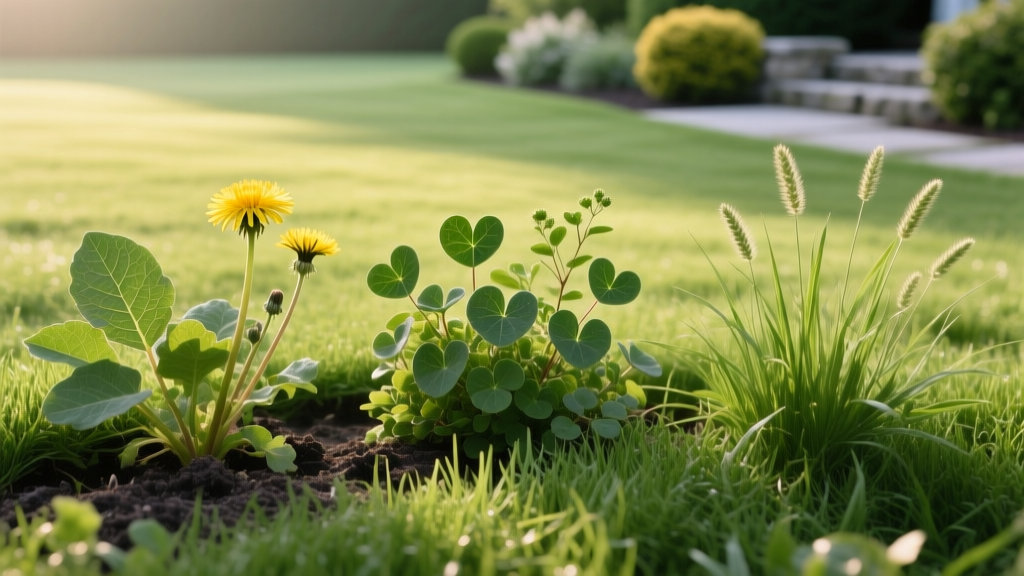
Guide to Different Types of Lawn Weeds: ID and Control Tactics
Effective weed control begins with accurate botanical classification. Applying a broadleaf herbicide to a grassy weed, or a standard grass herbicide to a sedge, results in wasted chemicals, turf damage, and persistent infestations. According to NC State Turfgrass Weed Science, lawn weeds are divided into three distinct biological categories: broadleaf weeds, grassy weeds, and sedges. Each category requires specific active ingredients, surfactant pairings, and application timings to achieve systemic kill.
The Big Three: Categorizing Lawn Weeds
Before selecting a herbicide, you must identify the weed's structural family. Misidentification is the primary cause of treatment failure in residential lawn care.
- Broadleaf Weeds: Dicotyledonous plants with wide leaves, net-like veins, and a distinct branching root system (taproots or fibrous).
- Grassy Weeds: Monocotyledonous plants that mimic turfgrass. They feature hollow, round stems, parallel leaf veins, and fibrous root systems.
- Sedges: Monocots that resemble grass but possess solid, triangular stems (remember the adage: 'sedges have edges'). They reproduce via underground tubers (nutlets) and rhizomes.
Broadleaf Weeds: Identification and Targeted Herbicides
Broadleaf weeds are generally the easiest to control because their biological differences from turfgrass allow for highly selective herbicides. The most effective post-emergent controls rely on synthetic auxins (Group 4 herbicides) that cause uncontrolled cellular growth, leading to plant death.
Dandelion (Taraxacum officinale)
A perennial broadleaf weed with a deep taproot that can extend 18 inches into compacted soil. If the taproot is severed during manual pulling, the weed will regenerate. Dandelions are best treated in the fall when they are actively translocating carbohydrates to their roots, pulling the herbicide down into the taproot.
White Clover (Trifolium repens)
A creeping perennial that spreads via stolons. Clover thrives in nitrogen-deficient soils. Because its leaves feature a waxy cuticle, herbicide solutions often bead up and roll off without a proper surfactant.
Common Chickweed (Stellaria media)
A winter annual that germinates in early fall, grows during cool winter months, and dies off as summer temperatures rise. Pre-emergent application of Isoxaben (Gallery) in early September provides excellent control.
Pro Tip: Surfactant Selection for Broadleafs
Always add a Non-Ionic Surfactant (NIS) at a rate of 0.25% v/v (1 teaspoon per gallon) when spraying broadleaf weeds. The NIS breaks the surface tension of the water, allowing the herbicide to penetrate the waxy cuticle of clover and chickweed leaves rather than beading up and dripping onto the soil.
Always add a Non-Ionic Surfactant (NIS) at a rate of 0.25% v/v (1 teaspoon per gallon) when spraying broadleaf weeds. The NIS breaks the surface tension of the water, allowing the herbicide to penetrate the waxy cuticle of clover and chickweed leaves rather than beading up and dripping onto the soil.
Grassy Weeds: The Hardest Category to Control
Grassy weeds are notoriously difficult to manage because their biological similarity to desirable turfgrass limits the number of safe, selective herbicides. Control heavily relies on precise pre-emergent timing and specialized post-emergent chemistry.
Crabgrass (Digitaria)
A summer annual that germinates when soil temperatures at the 1-inch depth reach 55°F for three to five consecutive days. Pre-emergent: Prodiamine (Barricade) applied at 0.58 G per 1,000 sq ft in early spring creates a chemical barrier in the top inch of soil. Post-emergent: Quinclorac (Drive XLR8) is the industry standard for visible crabgrass. Apply at 0.75 oz per 1,000 sq ft. Quinclorac requires a Methylated Seed Oil (MSO) surfactant, not a standard NIS, to effectively penetrate the grassy leaf tissue.
Annual Bluegrass (Poa annua)
A winter annual grassy weed that produces unsightly white seed heads in early spring. It thrives in compacted, overwatered soils. Post-emergent control in cool-season lawns is limited. Mesotrione (Tenacity) can be used at 5 oz per acre for pre-emergent and early post-emergent control, but it will temporarily bleach the Poa annua white before it dies.
Sedges: Not Grass, Not Broadleaf
Sedges require entirely different chemistry. Standard grassy weed killers (like Quinclorac) and broadleaf killers (like 2,4-D) will have zero effect on sedges.
Yellow Nutsedge (Cyperus esculentus)
Identifiable by its light green color, rapid vertical growth rate (often outgrowing the surrounding turf between mowings), and distinct V-shaped stem.
Warning: Never Pull Nutsedge by Hand
Pulling yellow nutsedge snaps the stem from the underground basal bulb, leaving the root system intact. Worse, the physical stress triggers the plant to activate dormant underground tubers (nutlets), resulting in one pulled plant turning into three or four new plants the following season. Chemical control is mandatory.
Pulling yellow nutsedge snaps the stem from the underground basal bulb, leaving the root system intact. Worse, the physical stress triggers the plant to activate dormant underground tubers (nutlets), resulting in one pulled plant turning into three or four new plants the following season. Chemical control is mandatory.
The Fix: Halosulfuron-methyl (SedgeHammer) is the most effective selective sedge killer. Mix at a rate of 1/2 teaspoon (0.66 oz per acre equivalent) per gallon of water for spot treatments. It halts cell division in the meristematic tissue. Expect to see yellowing within 7 days and complete necrosis in 21 days. A second application is often required 6 weeks later to catch late-emerging nutlets.
Herbicide Active Ingredients Cheat Sheet
Consult this matrix to match the weed category with the correct active ingredient, ensuring compatibility with your specific turfgrass species. For comprehensive turf safety data, refer to the University of Minnesota Extension Lawn Care guidelines.
| Weed Category | Active Ingredient | Common Brand Example | Turf Safety Warning |
|---|---|---|---|
| Broadleaf | 2,4-D + Dicamba + MCPP | Trimec Classic | Severe phytotoxicity on St. Augustine and Centipede grass. |
| Broadleaf (Fast Burn) | Carfentrazone-ethyl | SpeedZone | Safe on most warm/cool grasses; causes temporary spotting on Kentucky Bluegrass. |
| Grassy (Crabgrass) | Quinclorac | Drive XLR8 | Do not use on Bahiagrass or certain St. Augustine cultivars (e.g., Floratam). |
| Grassy (Poa Annua) | Mesotrione | Tenacity | Will bleach Bermudagrass and Zoysia; best used on cool-season lawns. |
| Sedge | Halosulfuron-methyl | SedgeHammer | Broad spectrum safety across almost all warm and cool-season turfgrasses. |
Common Application Mistakes and Failure Modes
Even with the correct chemical, environmental and mechanical errors can render a treatment useless. Avoid these documented failure modes:
1. Volatilization and Drift Damage
Applying ester-based formulations of 2,4-D when ambient temperatures exceed 85°F causes the chemical to vaporize (volatilize). This gas can drift into neighboring garden beds, causing severe twisting and cupping in sensitive ornamentals like tomatoes and hydrangeas. Always switch to amine-based formulations or postpone spraying when temperatures peak above 85°F.
2. Premature Mowing
Systemic herbicides require time to translocate from the leaf tissue down to the root crown. Mowing within 24 to 48 hours after a post-emergent application physically removes the treated leaf surface, drastically reducing the herbicide dose absorbed by the weed. Maintain a 48-hour mowing buffer before and after chemical applications.
3. Ignoring Soil pH Lockout
While this primarily affects turfgrass nutrient uptake, highly alkaline soils (pH > 7.5) can cause certain herbicides, particularly sulfonylureas like Halosulfuron-methyl, to persist longer in the soil profile, potentially causing root-pruning injury to sensitive turf species during overseeding. Always test soil pH and adjust with elemental sulfur before establishing a long-term chemical rotation.

