
Lawn Care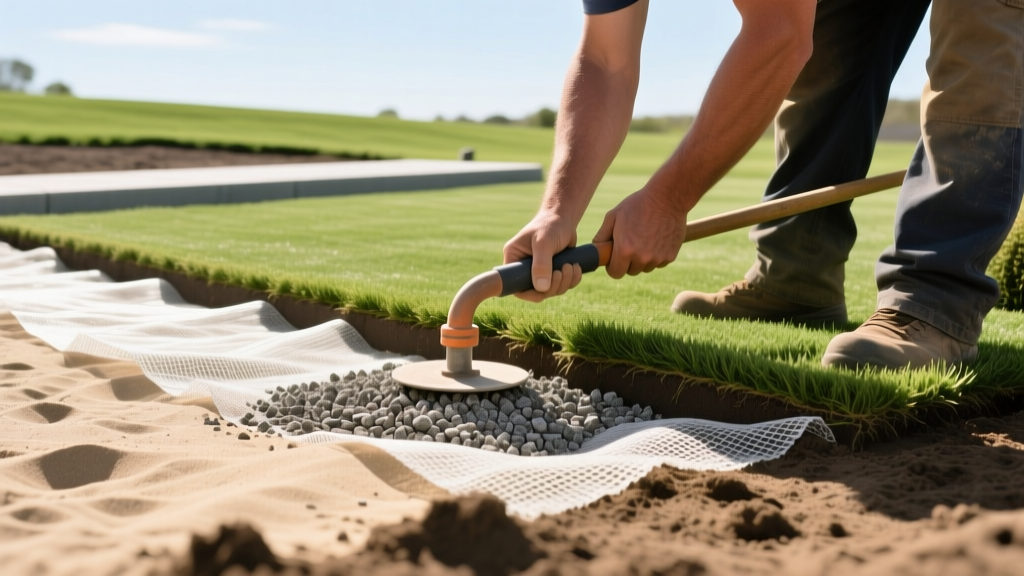
How to Install Artificial Grass on Dirt: Complete Base Prep Guide
The Physics of Dirt: Why Direct-to-Soil Installation Fails
Installing synthetic turf directly over native soil is the most common cause of premature lawn failure. Dirt is a dynamic, living medium that expands when wet, contracts during droughts, and shifts under thermal stress. If you lay artificial grass directly on dirt, you will experience surface undulations, pooling water, and seam separation within the first 14 months. To understand how to install artificial grass on dirt correctly, you must treat the native soil not as a foundation, but as a sub-grade that requires isolation and structural reinforcement.
⚠️ Critical Warning: Never skip the geotextile weed barrier. Native soil contains dormant weed seeds and rhizomes (like Bermuda or nutgrass) that can easily pierce through the primary backing of synthetic turf if a 3 oz to 4 oz non-woven geotextile fabric is not installed between the dirt and the aggregate base.
Material Specifications & Sourcing Guide
A successful installation relies on precise material selection. Do not substitute structural aggregates with generic fill dirt or playground sand. Consult the USDA Web Soil Survey to determine your native soil's drainage class before purchasing materials.
| Material | Specification | Purpose |
|---|---|---|
| Class II Road Base | 3/4-inch minus crushed rock | Primary load-bearing sub-base (bottom 2.5 inches) |
| Decomposed Granite (DG) | 1/4-inch minus or 3/8-inch minus | Leveling cap (top 1 inch) for smooth finish |
| Geotextile Fabric | 3 oz to 4 oz non-woven polypropylene | Weed suppression and sub-grade stabilization |
| Turf Adhesive | Dual-component polyurethane | Seam joining (resists thermal expansion) |
| Infill | Acrylic-coated silica sand (e.g., Durafill) | Blade support, UV protection, and cooling |
Step-by-Step Excavation and Base Construction
Proper base construction accounts for 70% of the total labor in a synthetic turf project. Follow these exact measurements to ensure structural integrity and optimal drainage.
Excavate to the Correct Depth
Remove 3.5 to 4 inches of native dirt across the entire installation area. If your native soil is heavy clay, excavate 4.5 inches to allow for a thicker aggregate base. Use a laser level or a string line to ensure consistent depth.
Grade for Surface Runoff
Establish a minimum 1% to 2% slope (1/8 inch to 1/4 inch drop per foot) away from your home's foundation. Even though synthetic turf is permeable, surface grading prevents hydrostatic pressure from building up under the turf during heavy downpours.
Deploy the Geotextile Barrier
Roll out the non-woven geotextile fabric directly over the excavated dirt. Overlap seams by at least 6 inches and secure the perimeter with 6-inch landscape staples. This layer separates the native dirt from your aggregate, preventing the base from sinking into soft soil over time.
Spread and Compact the Road Base
Spread the Class II Road Base to a depth of 2.5 inches. Lightly mist the aggregate with water to achieve optimal moisture content for compaction. Run a vibratory plate compactor (minimum 5,000 lbs of centrifugal force) over the area in overlapping passes until the base is rigid and shows no footprints.
Apply the Decomposed Granite Cap
Spread 1 inch of DG over the compacted road base. Use a leveling rake to create a perfectly smooth surface. Compact the DG with the plate compactor. This fine layer fills the voids in the road base and provides a glass-smooth surface for the turf backing to rest against.
Turf Deployment, Seaming, and Infill
Once the base is prepared, allow the synthetic turf rolls to acclimate in the sun for 24 hours before cutting. This relaxes the manufacturing folds and allows the backing to expand to its maximum thermal footprint. When joining seams, never use single-component adhesives or double-sided tape; these fail under the extreme heat differentials between day and night. Apply dual-component polyurethane adhesive to a 12-inch seaming tape, ensuring the turf fibers are kept out of the glue zone. According to the Synthetic Turf Council, proper seam integration is critical for maintaining warranty validity.
For infill, broadcast 1.5 to 2.0 lbs per square foot of acrylic-coated silica sand using a drop spreader. Avoid crumb rubber in residential settings due to heat retention and emerging environmental regulations regarding PFAS and microplastics. Brush the infill into the turf pile using a motorized power broom with nylon bristles, moving against the grain to stand the blades upright.
Troubleshooting Heavy Clay and Poor Drainage
If your native dirt is classified as heavy clay (percolation rate slower than 0.5 inches per hour), a standard base will not drain fast enough. Implement the following decision tree:
- Moderate Clay: Increase the Class II Road Base depth to 4 inches and incorporate a 4-inch perforated corrugated drain pipe wrapped in filter fabric along the lowest perimeter edge, daylighting it to a storm drain or dry well.
- Severe Clay / High Water Table: Excavate 6 inches. Install a 2-inch layer of clean, washed 3/4-inch drainage rock (no fines) at the very bottom, lay the geotextile, and then proceed with the standard 3.5-inch road base and DG cap. The clean rock layer acts as a subterranean reservoir to hold water temporarily while it percolates into the dense clay.
Cost Breakdown: DIY Base vs. Professional Installation
Understanding the financial commitment helps homeowners decide whether to tackle the base prep themselves or hire a certified installer. Prices below reflect 2026 average material and labor rates for a standard 1,000 sq. ft. rectangular lawn.
| Cost Category | DIY (Materials Only) | Professional Install (Turnkey) |
|---|---|---|
| Excavation & Haul Away | $300 - $500 (Dumpster rental) | Included ($1.50 - $2.00/sq ft) |
| Aggregate Base Materials | $800 - $1,200 | Included ($1.50 - $2.50/sq ft) |
| Turf & Accessories | $2,500 - $4,000 | Included ($4.00 - $6.00/sq ft) |
| Labor & Equipment | $150 (Plate compactor rental) | $3.00 - $5.00/sq ft |
| Total Estimated Cost | $3,750 - $5,850 | $8,500 - $13,500 |
By mastering the sub-base construction and understanding the specific requirements of your native dirt, you ensure your synthetic lawn remains flat, drainable, and visually pristine for its entire 15-to-20-year lifespan.

