
Lawn Care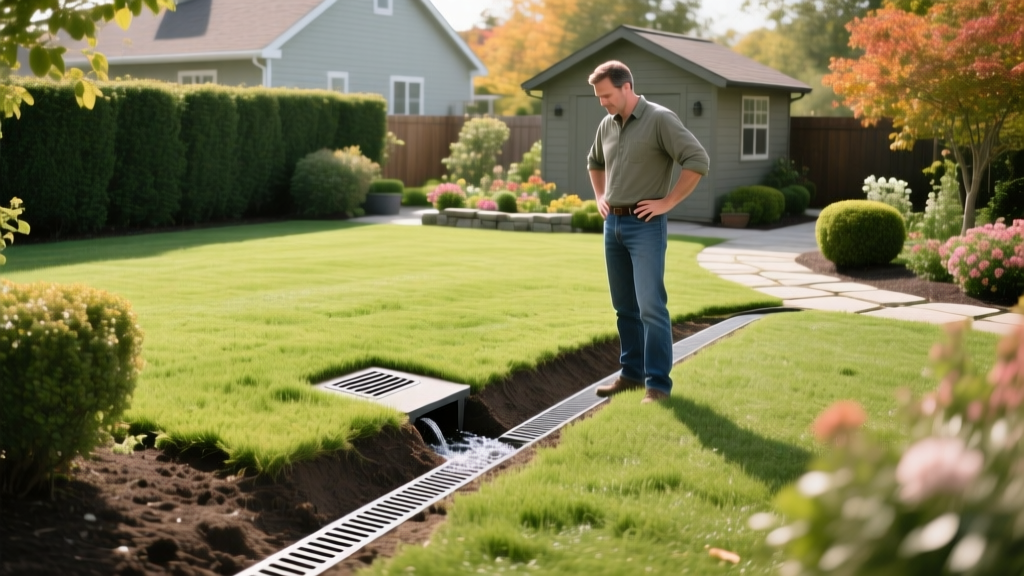
Step-by-Step Lawn Drainage Solutions for Waterlogged Yards
Diagnosing the Root Cause of Standing Water
Before purchasing pipes or gravel, you must determine whether your waterlogging issue is a surface grading problem or a subsurface soil compaction issue. Standing water for more than 24 hours after a heavy rain event creates anaerobic soil conditions, suffocating turfgrass roots and inviting aggressive fungal pathogens like Pythium blight and brown patch.
To isolate the problem, conduct a standardized soil percolation test. According to the University of Minnesota Extension, proper turf drainage requires soil to absorb water at a minimum rate of 1 inch per hour.
The 12-Inch Perk Test Procedure
- Dig a hole exactly 12 inches deep and 6 inches wide in the lowest, most waterlogged area of your lawn.
- Fill the hole with water and let it drain completely to saturate the surrounding soil matrix.
- Refill the hole to the top and insert a wooden yardstick.
- Wait 15 minutes and measure the water level drop.
- Multiply the drop distance by 4 to calculate the hourly percolation rate.
Diagnostic Rule of Thumb: If your water drops less than 0.25 inches in 15 minutes (under 1 inch/hour), you have severe subsurface clay compaction requiring mechanical or hardscape lawn drainage solutions. If water pools on the surface but the hole drains quickly once dug, your issue is negative surface grading, not subsurface drainage.
Decision Matrix: Matching the Problem to the Solution
Selecting the wrong lawn drainage solution is the most common cause of failed DIY landscaping projects. Use this matrix to match your specific hydrological problem to the correct intervention.
| Drainage Solution | Best Application | 2026 Avg. DIY Cost | Limitations |
|---|---|---|---|
| French Drain | Intercepting subsurface water across a wide slope | $15 - $30 per linear ft | Requires a valid daylight outlet or dry well |
| Dry Well | Capturing point-source water (downspouts, sump pumps) | $150 - $350 per unit | Ineffective in heavy clay with high water tables |
| Surface Swale | Redirecting surface runoff away from foundations | $2 - $5 per linear ft (topsoil) | Consumes usable lawn space; requires re-sodding |
| Deep-Tine Aeration + Gypsum | Alleviating minor soil compaction and clay flocculation | $80 - $120 per 1,000 sq ft | Will not fix severe grading or high water tables |
Step-by-Step Installation: The Subsurface French Drain
For lawns suffering from widespread subsurface saturation, a French drain is the most reliable lawn drainage solution. This system uses a perforated pipe surrounded by gravel to create a path of least resistance for water to exit the soil profile.
CRITICAL SAFETY WARNING: Before breaking ground, you must call 811 to have local utility companies mark buried gas, water, and fiber-optic lines. Striking a buried utility line can result in fatal injuries and tens of thousands of dollars in repair liabilities.
Step 1: Trenching and Slope Calculation
Dig a trench 12 inches deep and 6 inches wide along your planned route. The most critical variable in trenching is the slope. Water requires gravity to move; a flat trench will result in stagnant, mosquito-breeding water inside your pipe.
- Minimum Slope: 1/8 inch of drop per linear foot.
- Optimal Slope: 1/4 inch of drop per linear foot.
Use a string line with a line level, or a rotary laser level for runs exceeding 30 feet, to verify your grade before proceeding. If you cannot achieve a 1/4-inch per foot slope to a daylight outlet, you must route the pipe to a subterranean dry well or install a sump pump basin at the lowest point.
Step 2: Pipe and Fabric Selection
Do not use bare corrugated pipe. The NC State University Turfgrass Program frequently notes that fine soil particles will infiltrate bare perforated pipes, causing total system failure within three to five years.
For modern installations, use a pre-wrapped system like the NDS EZ-Drain or wrap a standard ADS 4-inch single-wall corrugated pipe in a non-woven geotextile fabric (such as Baughman Tile). As of 2026, a 10-foot section of NDS EZ-Drain retails for approximately $75 to $90. Non-woven fabric is mandatory; woven landscape fabric restricts lateral water flow and will bottleneck your drainage capacity.
Step 3: Gravel Bedding and Backfill
Place a 2-inch base layer of washed 3/4-inch river rock at the bottom of the trench. Never use crushed gravel or limestone. Crushed gravel contains 'fines' (stone dust) that wash into the pipe and clog the perforations. River rock is smooth and washed, ensuring high porosity.
Lay your fabric-wrapped pipe on the gravel bed with the perforations facing down. (Water enters from the bottom up as the trench bed saturates, keeping the top of the pipe clear of sediment). Cover the pipe with another 4 to 5 inches of washed river rock, leaving 3 inches of space to the surface. Fold the excess geotextile fabric over the top of the rock to create a 'burrito' wrap, preventing topsoil from migrating into the gravel void. Finally, cap the trench with 3 inches of native topsoil and lay sod or seed to match the surrounding lawn.
Biological and Soil-Level Drainage Interventions
If your perk test revealed slow drainage but you lack the slope required for a French drain, you must alter the soil chemistry and structure. A pervasive myth in amateur lawn care is that adding sand to heavy clay improves drainage. In reality, mixing sand into clay creates a concrete-like matrix that worsens waterlogging.
The Gypsum and Compost Protocol
To fracture compacted clay soils, apply pelletized gypsum (calcium sulfate) at a rate of 40 lbs per 1,000 square feet. The calcium ions replace sodium on the clay particles, causing them to bind together into larger aggregates (flocculation), which opens up microscopic pore spaces for water to infiltrate.
Follow the gypsum application with deep-tine core aeration (pulling 3-inch to 4-inch plugs). Immediately topdress the lawn with 1/4 inch of screened, aged compost or expanded shale products like Turface. The organic matter will bind with the clay, permanently improving the soil's hydraulic conductivity over a 2-to-3-year period.
Real-World Troubleshooting and Edge Cases
Even perfectly installed lawn drainage solutions can fail if environmental edge cases are ignored during the planning phase.
The Frozen Outlet Problem
In northern hardiness zones (Zones 3 through 6), French drains that daylight at the end of a driveway or curb often freeze solid in January. When the exposed pipe opening ices over, water backs up into the trench, freezes, and causes frost heave that destroys the surrounding hardscape. The Fix: Bury the final 10 feet of the drainage pipe and terminate it into a pop-up emitter valve situated in a sunny, south-facing lawn area, or route it into a deep, frost-protected dry well filled with crushed stone.
Silt Accumulation in Dry Wells
Dry wells connected directly to roof downspouts often fail because roof runoff carries microscopic asphalt shingle grit and leaf debris. Over a decade, this silt fills the dry well reservoir, rendering it useless. The Fix: Install a catch basin with a removable debris basket (like the NDS 12x12 Catch Basin) at the downspout transition point. Clean the basket bi-annually in late spring and late autumn to protect the subterranean infiltration gallery.
By accurately diagnosing your soil's percolation rate and selecting the correct mechanical or biological intervention, you can permanently eliminate standing water and restore a healthy, aerobic environment for your turfgrass root system.

