
Lawn Care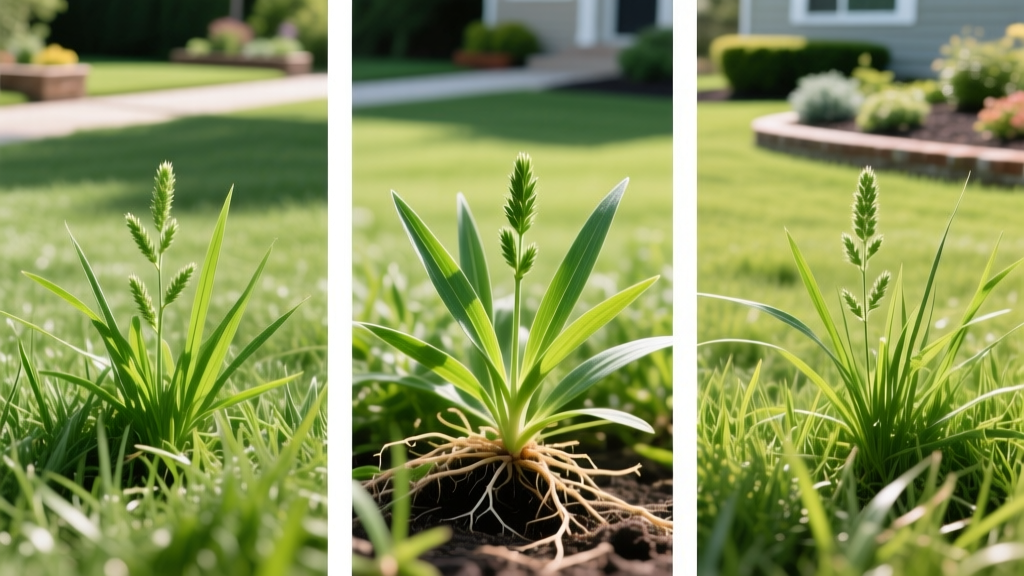
Invasive Grass Weeds Identification Pictures & Spot Treatment Guide
The Botanical Challenge of Grassy Weeds
Broadleaf weeds like dandelions and clover are easily eradicated with standard auxin-mimic herbicides (2,4-D, Dicamba, Triclopyr). Grassy weeds, however, share the same fundamental monocot biology as your desired turf. When homeowners rely on generic weed-and-feed products, the grassy weeds simply absorb the chemical and metabolize it, while the broadleaf plants die. Effective eradication requires exact species identification and targeted post-emergent graminicides or ALS-inhibitors. Because visual differences between turfgrass and invasive grassy weeds are often microscopic, utilizing high-resolution invasive grass weeds identification pictures to examine specific morphological markers is the only reliable way to prevent misapplication and turf injury.
Decoding Identification Pictures: What to Look For
When comparing your lawn to invasive grass weeds identification pictures, amateur gardeners often focus on leaf color or overall height. These are highly variable traits influenced by soil nitrogen, mowing frequency, and drought stress. Professional turfgrass managers focus on the collar region—the junction where the leaf blade meets the leaf sheath. According to the NC State University TurfFiles Weed Identification Guide, the collar region contains three definitive structures that remain consistent regardless of environmental stress.
| Structure | Location & Function | What to Look for in Pictures |
|---|---|---|
| Vernation | How the youngest leaf is folded inside the bud shoot. | Is it rolled (circular cross-section) or folded (V-shaped cross-section)? |
| Ligule | Membrane or fringe of hairs at the inner junction of sheath and blade. | Membranous (paper-like), hairy, or absent? Is the edge smooth or jagged? |
| Auricles | Claw-like appendages extending from the collar to grasp the stem. | Present (claw-like), short/blunt, or completely absent? |
Spot-Treatment Protocols for High-Threat Species
Once you have matched your specimen to verified invasive grass weeds identification pictures, you must select the correct active ingredient. Spot-treating requires a dedicated 1-to-2-gallon backpack or pump sprayer to minimize off-target drift and reduce chemical costs.
1. Smooth and Large Crabgrass (Digitaria spp.)
Visual Markers: Rolled vernation, a prominent membranous ligule that is toothed or jagged at the top, and absolutely no auricles. Large crabgrass will have distinct long hairs near the base of the leaf sheath, while smooth crabgrass is hairless.
Spot-Treatment Prescription:
Active Ingredient: Quinclorac (e.g., Drive XLR8).
Mixing Rate: 0.73 fl oz per 1,000 sq ft in 1 to 2 gallons of water.
Adjuvant: Methylated Seed Oil (MSO) at 1% v/v (approx. 2.5 tbsp per gallon).
Timing Note: Quinclorac is highly effective on both young (1-tiller) and mature crabgrass, but mature plants may require a second application 14 to 21 days later. Do not seed desirable turf for 21 days post-application, as quinclorac carries a residual pre-emergent effect on certain cool-season grasses.
2. Goosegrass (Eleusine indica)
Visual Markers: Folded vernation, a membranous ligule that is slightly fringed, and no auricles. The most distinct visual marker visible in identification pictures is the flattened, silver-to-white base of the stem and sheath, which gives it the nickname "silver crabgrass." Its seedhead resembles a zipper.
Spot-Treatment Prescription:
Cool-Season Turf (Fescue, Bluegrass): Fenoxaprop-p-ethyl (e.g., Acclaim Extra) at 0.2 to 0.4 fl oz per 1,000 sq ft. Requires a Non-Ionic Surfactant (NIS).
Warm-Season Turf (Bermuda, Zoysia): Foramsulfuron (e.g., Revolver) at 0.1 to 0.2 fl oz per 1,000 sq ft. Warning: Do not apply Revolver when ambient temperatures exceed 85°F, as it will cause severe phytotoxicity (yellowing and stunting) to Bermudagrass.
3. Dallisgrass (Paspalum dilatatum)
Visual Markers: Folded vernation, a membranous ligule with a distinct fringe of hairs at the top, and no auricles. Dallisgrass grows in aggressive, star-shaped clumps with thick, pale-green midribs. The seedhead features 3 to 5 distinct racemes (spikes) covered in dark, sticky anthers.
Spot-Treatment Prescription:
Active Ingredient: Foramsulfuron (Revolver) or MSMA (where state regulations permit for golf/industrial turf; MSMA is largely banned for residential use as of 2026).
Mixing Rate (Revolver): 0.15 fl oz per 1,000 sq ft.
Adjuvant: MSO is strictly required. Dallisgrass has a heavily waxed cuticle; without MSO, the water-based herbicide will bead up and roll off the leaf blade.
Application Strategy: Apply in late summer or early fall when the weed is actively translocating carbohydrates to its deep, bulbous root system. Spring applications often result in top-kill only, leading to rapid regrowth.
Surfactant Science: Penetrating the Waxy Cuticle
The most common reason spot-treatments fail against invasive grassy weeds is not the herbicide itself, but the failure to use the correct surfactant. According to data from the USDA PLANTS Database and university extension trials, grassy weeds have evolved thick, waxy epicuticular layers to retain water during drought.
- Non-Ionic Surfactants (NIS): Products like Induce or Surf-Ac 820 reduce water surface tension, allowing the spray droplet to spread flat across the leaf. NIS is sufficient for thin-cuticle weeds like annual bluegrass (Poa annua).
- Methylated Seed Oils (MSO): Products like DyneAmic or Prime Oil contain vegetable oil esters. MSO does not just spread the droplet; it actively dissolves and penetrates the waxy cuticle, pulling the active ingredient into the plant's phloem. Always use MSO for mature crabgrass, goosegrass, and dallisgrass.
- Crop Oil Concentrates (COC): Similar to MSO but derived from petroleum. COC is highly effective but carries a much higher risk of turf burn during summer heat. Stick to MSO for residential spot-treatments.
Post-Treatment Void Management
Killing an invasive grassy weed leaves a physical void in your turf canopy. If this void is not managed, wind-blown weed seeds will germinate in the exposed, sunlit soil within 14 days.
- Wait for Necrosis: Allow 7 to 10 days for the treated weed to completely brown and die. Do not pull living weeds, as this disrupts the translocation of the herbicide to the roots.
- Rake and Remove: Use a steel thatching rake to vigorously remove the dead organic matter down to the soil surface.
- Overseed or Sod: For cool-season lawns, apply a starter fertilizer (e.g., 18-24-6) and drop high-quality seed directly into the void. For warm-season lawns, cut a 2-inch plug from a healthy area of your lawn and press it into the void to encourage rapid stolon spread.
Frequently Asked Questions
Why did my crabgrass turn bright red after applying Quinclorac?
This is a sign of successful herbicide activity. Quinclorac mimics auxins, causing uncontrolled, rapid cellular growth that the weed cannot support. The red or purple coloration is a stress response indicating the vascular system is collapsing. The weed will desiccate and die within 10 to 14 days.
Can I use Glyphosate (Roundup) for spot treatment?
Glyphosate is a non-selective systemic herbicide. It will kill the invasive grassy weed, but it will also permanently kill any desirable turfgrass it touches, leaving a dead patch that requires reseeding. Reserve glyphosate only for treating weeds growing in driveway cracks or landscape beds, never for in-lawn spot treatments.
How often should I calibrate my spot-treatment sprayer?
Calibrate your 1-gallon pump sprayer every spring. Spray water over a 100 sq ft measured area (10x10 ft) and time how long it takes. If you walk too fast, you under-apply and the weeds survive; if you walk too slow, you overdose the soil and risk damaging the roots of your desirable turf.

