
Lawn Care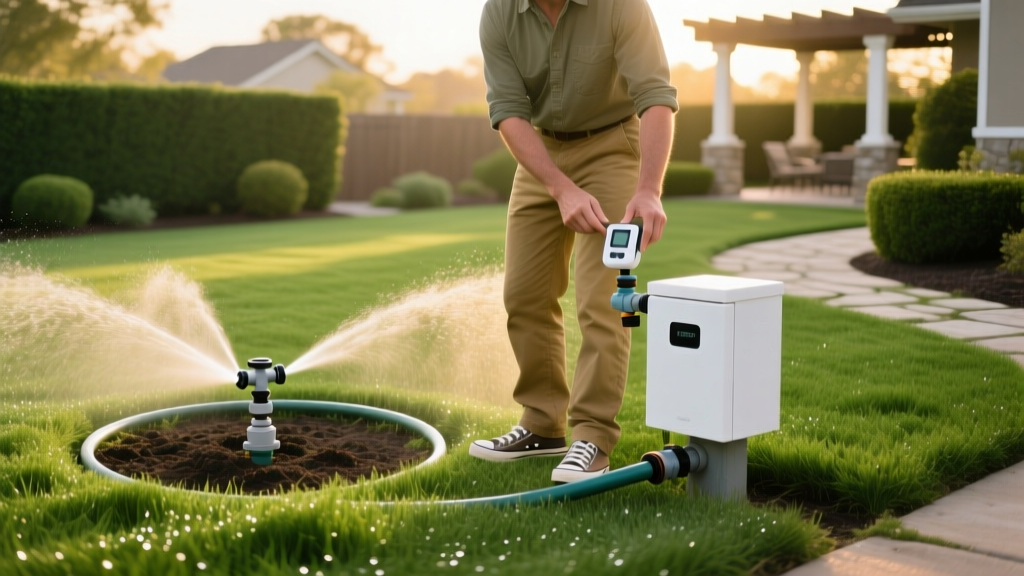
Irrigating a Lawn: Deep Soak Schedules and Smart Sprinkler Setup
The Science of Deep Soak Irrigation
Shallow, daily watering is the primary cause of shallow root systems, fungal outbreaks, and excessive municipal water bills. When irrigating a lawn, the objective is to moisten the entire root zone—typically 6 to 8 inches deep for cool-season grasses like Tall Fescue and Kentucky Bluegrass, and 4 to 6 inches for warm-season varieties like Bermuda and Zoysia. Applying light, frequent water only wets the top inch of soil, encouraging roots to grow upward toward the surface where they are highly susceptible to heat stress and drought.
Evapotranspiration (ET) Baseline: During peak summer temperatures (85°F–95°F), a healthy lawn loses approximately 0.25 to 0.30 inches of water per day to evaporation and plant transpiration. To maintain optimal turgor pressure without waterlogging the soil, you must replace roughly 1.0 to 1.5 inches of water per week for cool-season grasses, and 0.5 to 1.0 inches for warm-season grasses, distributed across 2 or 3 deep watering sessions.
Calibrating Your System: The Catch Can Test
Before programming any timer, you must determine your system's precipitation rate (PR). Sprinkler heads vary wildly in output. Standard spray heads apply water at 1.5 to 2.0 inches per hour, while rotary nozzles (like the Hunter MP Rotator) apply water at a much slower 0.4 to 0.6 inches per hour. Guessing your run times leads to massive inefficiencies. According to the University of California Agriculture and Natural Resources, performing a catch can test is the only accurate way to measure your specific zone output.
- Placement: Set out 5 to 6 flat-sided cans (tuna or cat food cans work perfectly) in a grid pattern across a single irrigation zone. Place them at varying distances from the sprinkler heads to account for overlapping coverage.
- Execution: Run that specific zone for exactly 15 minutes during low-wind conditions (early morning is ideal).
- Measurement: Use a ruler to measure the water depth in each can. Calculate the average depth across all cans.
- Calculation: Multiply the average depth by 4 to get your hourly precipitation rate. If your average after 15 minutes is 0.3 inches, your system applies 1.2 inches per hour.
Smart Controller Configuration and Hardware
Upgrading to a Weather-Based Irrigation Controller (WBIC) is the most impactful hardware change you can make when irrigating a lawn. These devices use local ET data, soil type, and slope gradients to automatically adjust run times. The EPA WaterSense program certifies controllers that meet strict efficiency criteria, ensuring they actually reduce water waste rather than just adding Wi-Fi convenience.
| Smart Controller Model | Approx. Cost (8-Zone) | Key Feature for Lawn Care | Best Soil/Application |
|---|---|---|---|
| Rachio 3e | $229 | Hyper-local weather intelligence and automatic cycle/soak generation. | Heavy clay soils; sloped yards. |
| Orbit B-hyve XR | $149 | Built-in WeatherSense and EPA WaterSense certification on a budget. | Standard loam soils; flat residential lawns. |
| Hunter Pro-HC (Hydrawise) | $285 | Professional-grade predictive analytics and flow-meter integration. | Large estates; mixed sun/shade microclimates. |
Critical Wiring Warning: When retrofitting an older timer with a smart controller, ensure your master valve or pump start relay is correctly mapped. Smart controllers utilize a 24V AC transformer; connecting a 24V DC solenoid (common in older commercial systems) will instantly fry the controller's internal triacs.
Soil-Specific Watering Adjustments: The Cycle and Soak Method
The infiltration rate of your soil dictates how long you can run a zone before water pools on the surface and runs off into the street. Sandy soils infiltrate water rapidly (up to 2.0 inches per hour), while heavy clay soils absorb water agonizingly slow (often less than 0.2 inches per hour). If you attempt to apply 0.5 inches of water to a clay lawn in a single 25-minute run, the last 15 minutes will result in pure surface runoff.
| Soil Type | Infiltration Rate | Recommended Strategy | Example Schedule (0.6" Total) |
|---|---|---|---|
| Sandy Loam | 1.0" - 2.0" / hr | Single continuous run. High frequency, lower duration. | 15 minutes straight, 3x a week. |
| Standard Loam | 0.5" - 1.0" / hr | Single run or 2-part cycle depending on slope. | 20 minutes straight, 2x a week. |
| Heavy Clay | 0.1" - 0.3" / hr | Mandatory Cycle and Soak. Short bursts with 45-60 min rests. | 3 cycles of 7 mins, 1 hr apart, 2x a week. |
Troubleshooting Common Irrigation Failure Modes
Even with a perfectly calculated schedule, physical system flaws will ruin your lawn. Diagnose these specific edge cases if you see localized stress:
- The Mixed-Nozzle Violation: Never mix standard spray heads and rotary nozzles (like MP Rotators) on the same zone. Spray heads apply water 3x faster. If they run together, the spray areas will flood and cause fungal rot before the rotary areas receive enough water to reach the root zone. Separate them into distinct zones or swap all heads to matched-precipitation rotors.
- Hydrophobic Soil Patches: If a specific dry spot refuses to absorb water and the water beads up, the soil has become hydrophobic (often due to thatch buildup or fungal mycelium). Core aerate the specific 4x4 foot area and apply a liquid soil surfactant (like Pelon or SimpleGrow) to break the water surface tension.
- Sunken Sprinkler Heads: Over years of topdressing and thatch accumulation, sprinkler bodies sink below the turf canopy. The spray pattern is blocked by the grass itself, creating a 'donut' of brown grass around the head. Use a shovel to pop the head up and install a 1-inch PVC slip-fit riser extension.
- Pressure Mismatch: If your spray heads are 'misting' or fogging into the wind, your static water pressure exceeds 45 PSI. This atomizes the water droplets, causing massive wind drift and evaporation. Install a 30 PSI pressure regulator (like the Hunter PSR-22) at the zone valve to force the water into heavy, wind-resistant streams.
Frequently Asked Questions
Should I water my lawn at night to prevent evaporation?
No. While night watering minimizes evaporation, it leaves the grass blades wet for 10 to 14 hours in the dark, creating the perfect microclimate for fungal pathogens like Dollar Spot and Brown Patch. The optimal window for irrigating a lawn is between 4:00 AM and 6:00 AM. This allows the water to soak deeply into the soil while the morning sun quickly dries the foliar canopy.
How do I adjust my smart controller for a sudden heatwave?
Do not manually override the schedule. If your controller is connected to a local weather station or uses ET data, it will automatically extend run times. If you must intervene, use the 'Seasonal Adjust' or 'Water Budget' feature on your controller to bump the global output by 15% to 20%. This scales all zones proportionally without ruining your carefully calibrated cycle-and-soak intervals.
Is it better to use a soil moisture sensor instead of a weather-based timer?
For highly irregular microclimates (e.g., a lawn half-shaded by massive oak trees and half in full baking sun), a wireless soil moisture sensor (like the Hunter Solar Sync or Toro Precision Soil Sensor) buried in the driest zone provides superior accuracy. It bypasses weather algorithms entirely and triggers the system only when the volumetric water content (VWC) in the root zone drops below 20%.

