
Lawn Care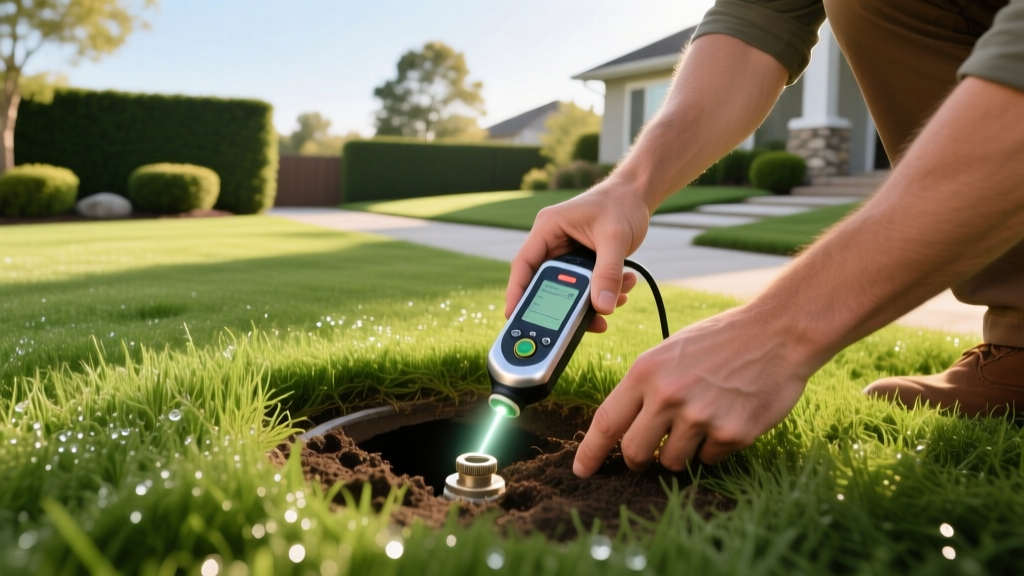
Use an Irrigation Valve Finder to Locate Buried Sprinkler Valves
Losing a sprinkler system map turns a simple $15 diaphragm replacement into a $400 excavation nightmare. When valves are buried under 12 inches of soil, shifting topography, and overgrown root systems, random digging destroys turf and wastes hours. Professional irrigation technicians rely on a dedicated irrigation valve finder to pinpoint solenoid boxes without guessing. This guide details the exact hardware, radio frequencies, and tracing methodologies required to locate buried irrigation valves with surgical precision.
The Physics of Electronic Valve Location
An electronic irrigation valve finder operates on the principle of inductive tracing. The system consists of a transmitter and a receiver. The transmitter injects an alternating current (AC) radio signal—typically at 33 kHz, 82 kHz, or 200 kHz—into the 18-gauge solid copper underground feeder (UF) wire that connects the controller to the valve solenoid. As the signal travels down the wire, it generates a localized electromagnetic field. The handheld receiver detects this field, allowing you to trace the wire's exact path and identify the valve location where the wire terminates at the solenoid coil.
According to the Irrigation Association, proper system mapping and electronic tracing are critical first steps in commercial and residential irrigation troubleshooting, preventing costly collateral damage to underground utilities and landscaping.
Tool Comparison Matrix: Which Finder Do You Need?
Not all locators are built for the specific challenges of low-voltage irrigation wiring. Below is a breakdown of the primary technologies used to find buried valves.
| Technology Type | Top Model Example | Price Range | Max Depth | Best Application |
|---|---|---|---|---|
| Dedicated Wire Tracer | Tempo Communications 521A | $250 - $320 | 3 to 5 feet | Standard residential valve & wire tracing |
| Multi-Frequency Locator | RIDGID SR-60 | $1,200 - $1,500 | 10+ feet | Commercial systems, deep utility conflicts |
| Ground Penetrating Radar | Bosch D-TEX 120 | $600 - $800 | 2 to 4 feet | Locating valve boxes when wires are severed |
| Acoustic / Magnetic | Fisher TW-6 Metal Detector | $300 - $450 | 8 inches | Shallow valves with brass/copper solenoids |
Step-by-Step: Tracing a Valve with a Wire Locator
Using a dedicated wire tracer like the Tempo 521A requires a specific setup to ensure the signal reaches the target valve without bleeding off into the soil.
Step 1: Isolate and Prep the Controller
Turn off the main power to the irrigation controller and unplug it. Remove the faceplate to expose the terminal strip. Identify the 'Common' wire (usually white or black) and the specific 'Zone' wire (colored) for the valve you are trying to find. Disconnect both wires from the terminal block.
Step 2: Establish a Proper Ground
Warning: Never connect a wire tracer transmitter to a live 110V/220V pump start relay circuit. Ensure the main power to the irrigation controller is completely disconnected before attaching the alligator clips to the terminal strip.
A common failure point when using an irrigation valve finder is improper transmitter grounding. If you simply clip the black ground wire to a nearby metal fence or the controller's ground screw, the signal will loop back on itself, creating a 'halo' effect that masks the actual wire path. Instead, drive a dedicated copper grounding stake into moist soil at least 15 feet away from the controller and the suspected valve path. Connect the black lead to this stake. This forces the electromagnetic field to travel the entire length of the wire out to the valve and back through the earth.
Step 3: Connect the Transmitter
Attach the red alligator clip directly to the disconnected Zone wire. Turn the transmitter on and select a frequency. For standard residential lawns with minimal underground interference, 82 kHz provides an excellent balance of signal propagation and distance. If you are in an area with heavy rebar or buried power lines, drop to 33 kHz to reduce signal jump.
Step 4: Sweep with the Receiver
Turn on the handheld receiver and set it to 'Peak' mode. Hold the receiver vertically and walk slowly from the controller outward along the suspected wire path. The receiver will emit a loud tone and display a bar graph indicating signal strength. The tone will peak when the receiver is directly over the buried wire. Follow the wire path until the signal abruptly stops or forms a tight, dense circle—this indicates the wire has coiled into the valve box and terminated at the solenoid.
Overcoming Signal Loss and Edge Cases
Even the best irrigation valve finder will struggle if the physical infrastructure is compromised. Here is how to troubleshoot common signal failures.
The Gel Splice Problem
If your signal travels 20 feet and abruptly dies, you have likely hit a wire splice. Previous repairs using waterproof silicone gel packs can absorb or scatter the RF signal. To bypass this, switch your receiver to 'Null' mode (indicated by a dip in the signal rather than a peak) which is more sensitive to faint, scattered fields, or use an inductive clamp directly over the wire downstream of the splice if it is accessible.
If your signal travels 20 feet and abruptly dies, you have likely hit a wire splice. Previous repairs using waterproof silicone gel packs can absorb or scatter the RF signal. To bypass this, switch your receiver to 'Null' mode (indicated by a dip in the signal rather than a peak) which is more sensitive to faint, scattered fields, or use an inductive clamp directly over the wire downstream of the splice if it is accessible.
Signal Jumping to Adjacent Utilities
If your receiver suddenly indicates a 10-foot depth or tracks perfectly parallel to the street, the signal has 'jumped' to a buried metal water line or coaxial cable. Lower the transmitter power output from 100% to 25% to contain the electromagnetic field strictly to the 18-gauge irrigation wire.
If your receiver suddenly indicates a 10-foot depth or tracks perfectly parallel to the street, the signal has 'jumped' to a buried metal water line or coaxial cable. Lower the transmitter power output from 100% to 25% to contain the electromagnetic field strictly to the 18-gauge irrigation wire.
Non-Electronic Fallback Methods
If the irrigation wire is completely severed and an electronic irrigation valve finder cannot complete the circuit, you must rely on mechanical and acoustic fallback methods.
- The Solenoid Chatter Method: Manually activate the suspected zone from the controller while standing in the yard. Listen for a faint humming or 'chatter' sound emanating from the soil. In quiet environments, a valve under 6 inches of soil can be heard vibrating.
- Soil Probing: Use a 36-inch fiberglass soil probe with a T-handle. Systematically probe the areas between the last known working sprinkler head and the zone's logical termination point. When the metal tip strikes the plastic lid of a valve box or the PVC manifold, the acoustic feedback and physical resistance will change noticeably.
- Thermal Imaging: In early morning, run the zone for 10 minutes. Use a high-resolution thermal camera (like the FLIR E8-XT) to scan the turf. The valve box and surrounding manifold will often retain heat or moisture differently than the surrounding soil, creating a visible thermal anomaly.
For comprehensive system maintenance and water efficiency standards, refer to the EPA WaterSense Irrigation Guidelines, which emphasize the importance of maintaining accessible, properly mapped valve manifolds to prevent water waste during leaks.
Frequently Asked Questions
Can I use a standard stud finder to locate sprinkler valves?
No. Standard magnetic or capacitive stud finders are designed for drywall and shallow wood/metal framing. They lack the sensitivity and depth penetration required to detect a 3-inch plastic valve box or an 18-gauge wire buried under soil and turf roots.
How deep are sprinkler valves typically buried?
Most residential valve boxes are installed so the lid is flush with the final grade. The actual valve manifold inside the box usually sits between 8 and 14 inches below the surface. In regions with deep frost lines, valves may be buried in vaults up to 24 inches deep to prevent winter freezing.
Will an irrigation valve finder work if the wire is cut?
A wire tracer will only trace the path up to the exact point where the copper wire is severed. Beyond the cut, the circuit is broken, and no electromagnetic field is generated. To find the valve past a cut, you must use Ground Penetrating Radar (GPR), metal detection (if the solenoid contains enough copper/steel mass), or physical soil probing.
Investing in a reliable wire tracer and taking the time to properly ground your transmitter will save thousands of dollars in landscape repair and professional leak detection fees. Map your system digitally once the valves are found to eliminate future guesswork.

