
Lawn Care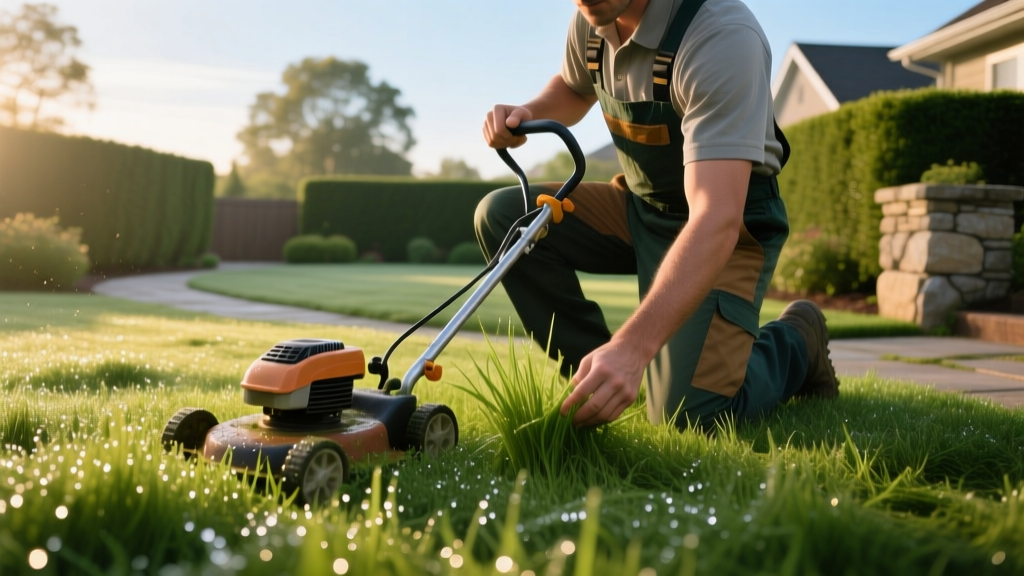
Is It Okay to Mow the Grass When Wet? A Turf Health Explainer
The Short Answer: Why Moisture and Mower Blades Don't Mix
Homeowners frequently ask, is it okay to mow the grass when wet after a heavy morning dew or a sudden afternoon thunderstorm? The short answer is no. Cutting saturated turf compromises both the biological health of your lawn and the mechanical integrity of your equipment. However, the severity of the damage depends entirely on the moisture source (dew vs. rain vs. irrigation) and the volume of water present on the leaf blade.
When a grass blade is saturated, its internal hydrostatic pressure changes, making the tissue highly pliable. Instead of being cleanly sliced by a spinning steel blade, the wet blade bends, folds, and ultimately tears. This ragged tear damages the plant's vascular tissue (xylem and phloem), leading to a frayed tip that loses 30% to 40% more moisture to evaporation and turns brown within 48 hours. According to turfgrass researchers at the University of Minnesota, consistently mowing wet lawns weakens the turf canopy, making it highly susceptible to environmental stress and weed invasion.
The 'Tear Test' Diagnostic
Wait 24 hours after your last mow and inspect the grass tips closely. If you see a clean, sharp cross-section, your blade is sharp and the grass was dry. If the tips look shredded, white, or frayed like a chewed piece of rope, you are either mowing with a dull blade or cutting the grass while it is too wet to stand upright against the blade's suction.
Fungal Vectors: How Your Mower Spreads Disease
The most severe consequence of mowing wet grass is the rapid acceleration of fungal pathogens. Fungi require three elements to thrive: a susceptible host, a virulent pathogen, and a favorable environment (the Disease Triangle). Wet mowing artificially creates the favorable environment while simultaneously acting as a mechanical vector for the pathogen.
When mower wheels roll over wet turf, they create micro-abrasions on the leaf surface. Simultaneously, the mower deck acts as a centrifuge, spraying macerated, wet clippings—which are now loaded with fungal spores and mycelium—across the entire yard. The UMass Center for Agriculture, Food and the Environment notes that diseases like Dollar Spot and Brown Patch can spread across an entire property in a single mowing session if the turf canopy is saturated.
| Turf Disease | Primary Pathogen | Wet-Mowing Risk Factor |
|---|---|---|
| Dollar Spot | Clarireedia jacksonii | High: Mycelium spreads via wet clippings clinging to mower wheels and deck. |
| Brown Patch | Rhizoctonia solani | Critical: Ragged wounds from torn wet blades provide direct entry points for spores. |
| Pythium Blight | Pythium aphanidermatum | Extreme: Spreads rapidly in water films left by heavy mower tracks in humid conditions. |
Mechanical Toll on Modern Mower Equipment
Beyond turf pathology, wet grass inflicts measurable mechanical damage on your mower. The issues differ significantly depending on whether you operate a gas-powered or battery-electric platform.
Gas-Powered Mowers (e.g., Honda HRX217, Toro Recycler)
Wet grass clippings are dense and heavy. When pulled into the deck, they stick to the baffles and the underside of the deck. This buildup disrupts the aerodynamic airflow required to stand the grass up before cutting and to expel the clippings. The result is 'deck lugging,' where the engine RPM drops significantly as it struggles to spin the blade through a dense mat of wet vegetation. Over time, this causes premature wear on the spindle bearings, stretches the drive belt, and can cause the engine to overheat or stall.
Battery-Electric Mowers (e.g., EGO Power+ 21', Ryobi 40V)
While modern 56V and 80V lithium-ion mowers feature IPX4 water-resistance ratings to protect against light splashing, they are not waterproof. Mowing soaking wet grass forces heavy, moisture-laden clippings into the deck's discharge chute and around the motor housing. If wet clippings accumulate near the battery compartment seals or the brushless motor vents, it can lead to moisture ingress, corrosion of the copper windings, and eventual electrical failure. Furthermore, the increased physical resistance of cutting wet grass causes the electric motor to draw higher amperage, which can reduce your battery runtime by up to 35% and generate excess heat in the battery cells.
⚠️ Equipment Warning: Never use a mulching plug when mowing damp grass. Wet clippings will mat against the deck baffles, completely blocking the recirculation path and causing the mower to leave thick, suffocating windrows of dead grass on your lawn.
The 'Squeeze Test' Framework: When is it Safe to Mow?
If you are on a tight schedule or facing an impending multi-day rainstorm, you need an objective way to measure turf moisture. Relying on visual inspection is flawed; grass can look dry on top while remaining saturated at the soil line. Use this standardized field test used by turf professionals:
- Walk the Lawn: Walk across the turf in normal shoes. If your footprints remain compressed and the grass blades do not spring back upright within 3 seconds, the soil is too saturated to support the weight of a 60-100 lb mower without causing severe soil compaction and rutting.
- The Squeeze Test: Kneel down and grab a handful of grass blades from the middle of the canopy (not just the tips). Squeeze them tightly in your fist for 3 seconds.
- Evaluate the Moisture:
- Water drips or runs down your hand: STOP. The turf is too wet. Wait at least 4-6 hours or until the next day.
- Hand feels damp, but no dripping: PROCEED WITH CAUTION. You can mow, but you must adjust your mower settings (see mitigation below).
- Hand remains completely dry: OPTIMAL. The turf is ready for a standard cut.
Damage Control: Mitigation Strategies for Damp Turf
Sometimes, mowing wet grass is unavoidable. If an incoming hurricane or a strict HOA mandate forces your hand, implement these specific adjustments to minimize the biological and mechanical damage:
- Raise the Deck Height: Increase your cutting height by 0.5 to 1.0 inches. If you normally cut at 3.0 inches, raise it to 3.75 inches. This reduces the total volume of wet tissue being removed and prevents the blade from engaging the thickest, most water-logged part of the lower canopy.
- Switch to Side-Discharge: Remove the mulching plug and the bagger attachment. Use the side-discharge chute to eject the heavy, wet clippings entirely out of the deck. This prevents clogging and keeps the clippings from matting on the turf surface, which would otherwise block sunlight and smother the grass below.
- Reduce Ground Speed: If using a self-propelled or riding mower, reduce your ground speed by 30%. This gives the mower blade more time to process the heavy, wet vegetation and allows the deck's airflow to effectively eject the clippings.
- Clean the Deck Immediately: Within 15 minutes of finishing, tip the mower (gas mowers: carburetor side UP; electric mowers: follow manufacturer tilt guidelines) and use a putty knife or stiff bristle brush to scrape all wet clippings from the deck interior. Leaving wet grass on the steel deck will initiate flash-rust within 24 hours.
Summary: The Wet Mowing Decision Matrix
Dew-heavy morning? Wait 2-3 hours for the sun to burn off the surface moisture.
Light drizzle? Delay mowing; the combination of water and torn leaf tissue guarantees fungal entry.
Impending 5-day storm? Perform the Squeeze Test. If damp but not dripping, raise the deck 0.5 inches, use side-discharge, and cut at a slower pace to secure the lawn before the deluge.

