
Lawn Care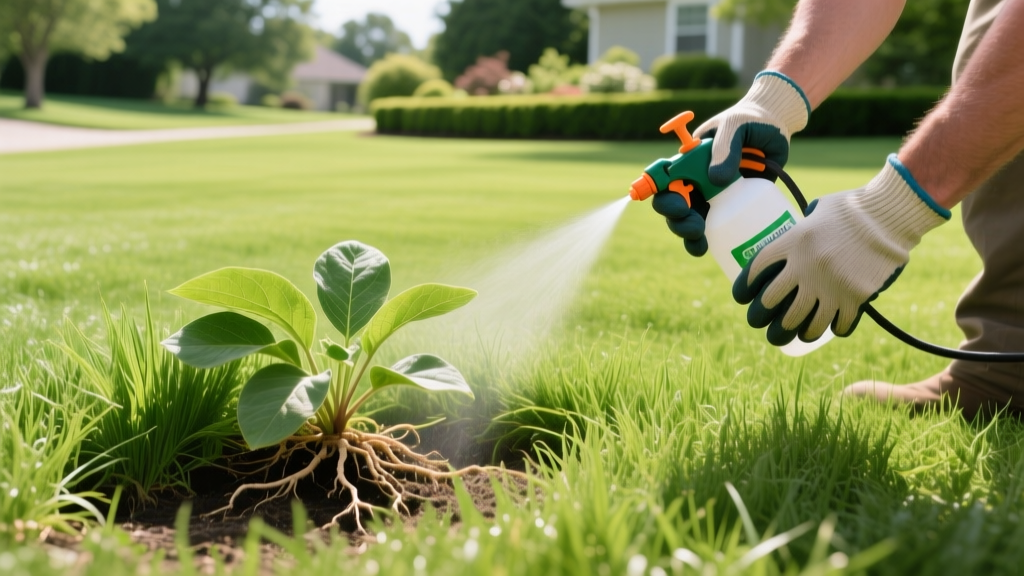
How to Get Rid of Johnson Grass: Spot-Treatment Guide for Lawns
The Rhizome Nightmare: Why Johnson Grass Resists Standard Lawn Care
Johnson grass (Sorghum halepense) is widely considered one of the most difficult perennial weeds to eradicate from residential lawns. Unlike annual grassy weeds like crabgrass that die off in winter, Johnson grass survives via an extensive, deep-rooted rhizome network. According to the USDA Plants Database, a single mature Johnson grass plant can produce over 200 feet of rhizomes in a single growing season, with nodes capable of generating new shoots even if the parent plant is destroyed.
Because Johnson grass is biologically a grass, standard broadleaf herbicides (like 2,4-D or dicamba) have zero effect on it. Furthermore, applying non-selective herbicides blindly will kill your desirable turf alongside the weed. Successfully learning how to get rid of johnson grass requires a strategic, multi-phase spot-treatment approach tailored to your specific turf type.
⚠️ CRITICAL TURF WARNING: Never apply fluazifop or sethoxydim to warm-season lawns (Bermuda, Zoysia, Centipede, St. Augustine). These selective herbicides will severely damage or kill warm-season turf. They are strictly for cool-season lawns (Tall Fescue, Kentucky Bluegrass, Ryegrass).
Chemical Spot-Treatment Protocols by Turf Type
Your chemical strategy depends entirely on whether you maintain a cool-season or warm-season lawn. Below are the exact chemical protocols, mixing ratios, and application techniques used by professional turf managers in 2026.
1. Cool-Season Lawns: Selective Herbicides (Fluazifop-p-butyl)
If you have Tall Fescue or Kentucky Bluegrass, you can use selective post-emergent herbicides that target Johnson grass without harming your lawn. The active ingredient fluazifop-p-butyl (found in products like Ornamec 170 or Fusilade II) is the gold standard.
- Product: Ornamec 170 (Fluazifop-p-butyl 17%)
- Cost: $85 - $110 per 8 oz bottle (covers approx. 10,000 sq ft)
- Mixing Rate: 0.5 to 0.75 oz per 1,000 sq ft, mixed in 1.5 gallons of water.
- Adjuvant: Must include a non-ionic surfactant (0.25% v/v) to penetrate the waxy leaf cuticle.
- Application: Broadcast spray over the affected area. Apply when Johnson grass is actively growing but before the seed head (boot stage) fully emerges.
2. Warm-Season Lawns: Non-Selective Spot Treatments (Glyphosate)
For Bermuda, Zoysia, or St. Augustine lawns, there are no safe selective herbicides for Johnson grass. You must use non-selective glyphosate (e.g., Roundup ProMax 50.2%) applied with extreme precision to avoid turf kill.
The 'Glove of Death' Technique
Spraying glyphosate in a warm-season lawn is highly risky due to wind drift. The most effective DIY spot-treatment method is the 'Glove of Death' wipe technique:
- Wear a thick cotton gardening glove on your dominant hand.
- Pull a disposable nitrile chemical-resistant glove over the cotton glove.
- Mix a 2.5% glyphosate solution (3.2 oz of 41% glyphosate per gallon of water) in a shallow, wide-mouthed bucket.
- Dip your gloved fingers into the solution until the cotton layer beneath the nitrile is saturated.
- Grasp the Johnson grass blades near the base and pull your hand upward to the tips, coating the weed in herbicide. This prevents dripping onto your desirable Bermuda or Zoysia grass.
Shielded Wick Applicators
For larger patches, use a commercial wick applicator or a sprayer equipped with a physical bell shield. Keep the spray nozzle within 2 inches of the soil surface to eliminate drift. Treat only when the Johnson grass is noticeably taller than your desired mowing height.
Herbicide Comparison Matrix for Johnson Grass
| Active Ingredient | Brand Examples | Turf Safety | Efficacy on Rhizomes | Est. Cost (2026) |
|---|---|---|---|---|
| Fluazifop-p-butyl | Ornamec 170, Fusilade II | Safe for Cool-Season | High (translocates to roots) | $90 / 8 oz |
| Sethoxydim | Vantage, Poast | Safe for Cool-Season | Moderate (requires 2 apps) | $75 / 16 oz |
| Glyphosate (41%+) | Roundup ProMax, Ranger Pro | Non-Selective (Kills all) | Very High | $65 / 1 gal |
| Clethodim | Envoy Plus, Arrow | Safe for Cool-Season | High | $110 / 16 oz |
Seasonal Eradication Timeline
Johnson grass cannot be eliminated in a single afternoon. Because the rhizomes store massive amounts of carbohydrates, you must time your applications to coincide with the plant's natural translocation cycles. NC State Extension emphasizes that fall treatments are often more lethal to the root system than spring treatments.
📅 The 3-Phase Attack Plan
Phase 1: Late Spring (Boot Stage)
Apply your first treatment when the Johnson grass is 12-18 inches tall and just before the seed head emerges from the sheath (the boot stage). At this stage, the plant is actively pulling nutrients upward, but preventing seed production is critical to stopping future infestations.
Phase 2: Mid-Summer (Stress Period)
Keep the lawn mowed at the lowest recommended height for your specific turf type. Johnson grass is highly intolerant of frequent, low mowing. This depletes its energy reserves while your desirable turf (if properly fertilized) outcompetes it.
Phase 3: Early Fall (Translocation Phase)
This is the most critical application. As temperatures drop, Johnson grass begins moving carbohydrates from its leaves down into the rhizomes for winter storage. Applying systemic herbicides (glyphosate or fluazifop) in early September ensures the chemical is pulled deep into the root network, killing the rhizomes and preventing spring regrowth.
Mechanical and Organic Fallbacks
For homeowners managing organic lawns or dealing with localized, severe infestations where chemical use is restricted, mechanical intervention is required. Pulling Johnson grass by hand is largely ineffective; if a single rhizome node snaps off in the soil, it will regenerate within 14 days.
Soil Solarization for Bed and Border Edges
If Johnson grass has invaded garden beds or lawn borders, solarization is a highly effective organic method. Mow the area to the soil line, wet the soil deeply, and cover it with clear 4-mil polyethylene plastic for 6 to 8 weeks during the peak heat of July and August. Soil temperatures under the plastic will exceed 120°F, effectively cooking the rhizomes and destroying seed viability.
The Horticultural Vinegar Myth
Many organic forums recommend 20% or 30% horticultural vinegar (acetic acid) for weed control. While this will burn the foliage of Johnson grass within hours, it is a contact-only burn-down. It possesses no systemic activity and will not penetrate the rhizome. The grass will reliably resprout within 10 days, making vinegar a waste of time and money for perennial grassy weeds.
Post-Eradication Turf Recovery and Prevention
Once the Johnson grass is dead, you will be left with bare spots in your lawn. Leaving these areas exposed invites new weed seeds. Immediately overseed cool-season lawns with a competitive Tall Fescue blend at a rate of 5-8 lbs per 1,000 sq ft. For warm-season lawns, plug the bare spots with Bermuda or Zoysia sod to rapidly close the canopy.
To prevent new Johnson grass seeds from germinating, apply a pre-emergent herbicide like Prodiamine 65 WDG (Barricade) in early spring when soil temperatures reach 55°F. Note that pre-emergents only stop seeds; they will not stop rhizomes from spreading from a neighboring property. If your neighbor has Johnson grass, you must maintain a physical trench barrier or apply a non-selective herbicide to the property line edge monthly during the growing season.

