
Lawn Care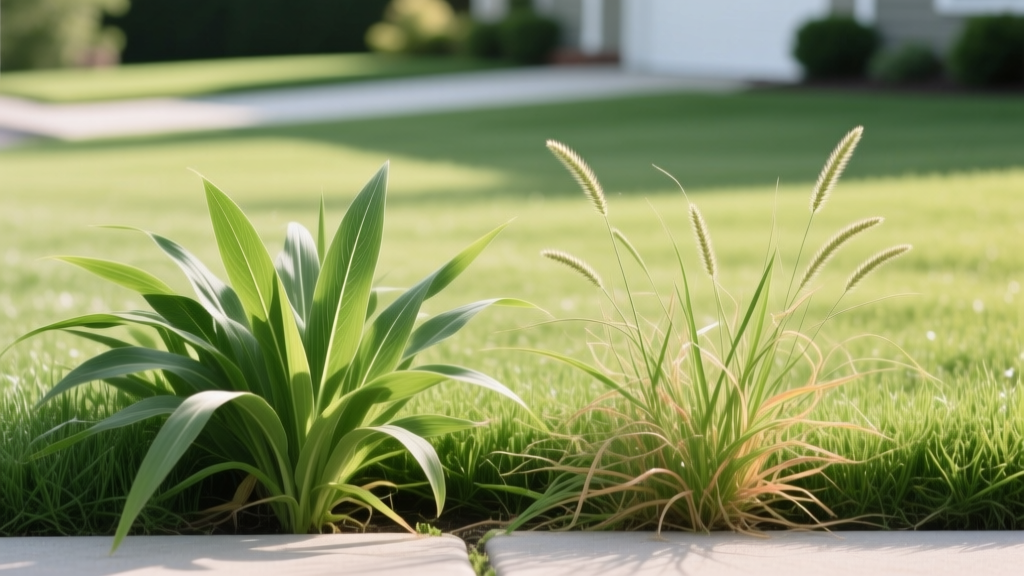
Johnson Grass vs Crabgrass: Identification and Spot-Treatment Guide
The Core Difference: Annual Invader vs. Perennial Nightmare
When homeowners spot aggressive, wide-bladed grassy weeds overtaking their turf in mid-summer, they often default to calling it 'crabgrass.' However, misidentifying johnson grass vs crabgrass is one of the most costly mistakes in lawn care. While both are warm-season grassy weeds that thrive in heat and humidity, their life cycles and root architectures demand entirely different chemical and cultural interventions.
Crabgrass (Digitaria spp.) is an annual weed that germinates from seed in spring, spreads via shallow stolons, and dies with the first hard frost. Johnson grass (Sorghum halepense) is a deeply entrenched perennial that spreads primarily through thick, scaly, subterranean rhizomes that can survive harsh winters and regenerate from fragments as small as one inch. Applying a standard crabgrass killer to johnson grass will merely burn the foliage, leaving the rhizome network intact to resprout within weeks.
Quick Diagnostic Rule: Grab the base of the weed and pull gently. If it snaps off at the surface with a shallow, fibrous root ball, you are likely dealing with crabgrass. If you feel deep resistance and pull up thick, white, segmented underground stems (rhizomes), you have johnson grass.
Botanical Identification: How to Tell Them Apart
Accurate identification requires looking past the general 'green and weedy' appearance and examining specific morphological features. According to the UC Statewide Integrated Pest Management Program, proper weed ID is the foundation of effective chemical control.
Leaf, Ligule, and Auricle Examination
- Crabgrass: Leaves are typically pale green to bluish-green, covered in fine hairs (especially large crabgrass), and lie flat against the ground. The ligule (the membrane where the leaf meets the stem) is tall, membranous, and jagged. Crabgrass lacks auricles (claw-like appendages at the leaf base).
- Johnson Grass: Leaves are broader (up to 1 inch wide), smooth, and feature a very prominent, thick white midrib running down the center. The ligule is membranous but features a fringe of hairs at the top. Like crabgrass, it lacks auricles, but the sheer size and white midrib are immediate giveaways.
Root and Stem Architecture (The Pull Test)
As noted by University of Minnesota Extension, understanding root structure dictates your herbicide choice. Crabgrass develops a shallow, fibrous root system and spreads laterally via above-ground stolons that root at the nodes. Johnson grass develops a massive subterranean rhizome system. These rhizomes are white to pale yellow, segmented with distinct nodes, and can penetrate up to 4 feet deep in uncompacted soils, though most reside in the top 12 inches.
Spot-Treatment Protocols for Crabgrass (Annual)
Because crabgrass is an annual, the goal of spot-treatment is to kill the existing plant before it drops seed, while relying on pre-emergents for long-term control.
Step 1: Post-Emergent Application (Quinclorac)
The gold standard for post-emergent crabgrass control in both cool- and warm-season lawns is Quinclorac (commonly sold as Drive XLR8 or Quinclorac 75 DF).
- Timing: Apply when the crabgrass is young (1- to 3-tiller stage). Mature, seeding crabgrass is highly resistant to quinclorac and will require multiple applications.
- Mixing Rate: Mix 0.367 fluid ounces of Quinclorac 75 DF per 1,000 square feet of lawn in 1 to 2 gallons of water.
- Surfactant Requirement: Quinclorac requires a high-quality Methylated Seed Oil (MSO) or Crop Oil Concentrate (COC) at a rate of 0.5% v/v (roughly 1.3 tablespoons per gallon of spray solution). Without oil, the herbicide will bead up and roll off the hairy crabgrass leaves.
- Application: Spot-spray only the affected areas. Avoid spraying when temperatures exceed 85°F to prevent vapor drift and turf burn.
Step 2: The Pre-Emergent Follow-Up
Killing visible crabgrass is only half the battle. To prevent the seeds dropped this year from germinating next spring, apply a pre-emergent like Prodiamine 65 WDG in early spring when soil temperatures consistently hit 55°F at a 2-inch depth. Apply at 0.415 oz per 1,000 sq ft and water in with 0.5 inches of irrigation.
Eradication Strategies for Johnson Grass (Perennial)
Pre-emergent herbicides are largely ineffective against established johnson grass rhizomes. You must use systemic post-emergent herbicides that translocate down into the root system, or employ mechanical wicking.
Warm-Season Turf (Bermuda, Zoysia, Centipede)
If you are managing a warm-season lawn, Fluazifop-p-butyl (sold as Fusilade II or Ornamec Over-The-Top) is highly effective. Fluazifop selectively targets grassy weeds without harming broadleaf plants or most warm-season turfgrasses.
- Rate: 0.25 to 0.5 fluid ounces per 1,000 square feet.
- Adjuvant: Must include a Non-Ionic Surfactant (NIS) at 0.25% v/v (approx. 1/2 teaspoon per gallon).
- Protocol: Apply to actively growing johnson grass (6 to 10 inches tall). Expect to see yellowing in 7-10 days and complete necrosis in 3 weeks. A second application 14 days later is often necessary to kill deep rhizome fragments.
WARNING: Cool-Season Turf Danger. Fluazifop will severely damage or completely kill Tall Fescue, Kentucky Bluegrass, and Ryegrass. Do NOT use Fusilade II on cool-season lawns.
Cool-Season Turf (Fescue, Bluegrass): The 'Glove of Death' Method
Because there are no selective post-emergent herbicides that will kill johnson grass without also destroying cool-season turf, you must use Glyphosate (Roundup Pro 41%) via targeted wicking. Spraying glyphosate will leave dead patches in your fescue lawn.
- Preparation: Mix a 2% to 3% glyphosate solution (approx. 2.5 to 3.5 fl oz per gallon of water). Do not mow the lawn for 5 days prior to treatment; let the johnson grass grow taller than the surrounding turf.
- The Wicking Technique: Put on a heavy-duty, chemical-resistant nitrile glove. Over it, wear a cheap, absorbent cotton work glove. Dip the fingers of the cotton glove into the glyphosate solution until damp, but not dripping.
- Application: Walk through the lawn and physically wipe your gloved hand over the top third of the johnson grass blades. Because the johnson grass is taller than your fescue, you will coat the weed while bypassing the desirable turf below.
- Translocation: The glyphosate will absorb through the leaves and travel down into the rhizomes over 7 to 14 days, killing the plant from the inside out.
Herbicide Selection Matrix & Turfgrass Safety
| Active Ingredient | Common Brand Name | Target Weed | Safe For Turf Types | Est. Cost (per 10k sq ft) |
|---|---|---|---|---|
| Quinclorac | Drive XLR8 | Crabgrass | Cool & Warm Season | $8 - $12 |
| Fluazifop-p-butyl | Fusilade II | Johnson Grass | Warm Season ONLY | $15 - $22 |
| Glyphosate (41%) | Roundup Pro | Johnson Grass (Wicking) | None (Non-selective) | $2 - $4 |
| Prodiamine 65 WDG | Barricade | Crabgrass (Pre-emergent) | Cool & Warm Season | $6 - $9 |
Common Spot-Treatment Failures and Edge Cases
Failure Mode 1: Spraying Mature Crabgrass. Applying quinclorac to crabgrass that has already developed seed heads (late July/August) is a waste of chemicals. The plant is in its reproductive phase and has thickened its cuticle. Pull these manually or let frost kill them, then focus heavily on spring pre-emergents.
Failure Mode 2: Tilling Johnson Grass. Never use a rototiller to break up soil infested with johnson grass. Every single rhizome node contains a dormant bud. Tilling chops one plant into fifty, effectively multiplying your infestation. Always rely on systemic chemical translocation or deep manual extraction.
Frequently Asked Questions
Can I use MSMA for johnson grass or crabgrass?
No. MSMA (Monosodium methanearsonate) was largely phased out for residential lawn use by the EPA due to arsenic toxicity and groundwater concerns. While it was historically a staple for golf courses and sod farms, homeowners must rely on Quinclorac, Fluazifop, or targeted Glyphosate applications.
How long should I wait to mow after a spot-treatment?
For both quinclorac and fluazifop, do not mow for 2 days before application (to ensure maximum leaf surface area for absorption) and wait at least 2 to 3 days after application before mowing. This allows the herbicide sufficient time to translocate out of the leaf tissue and into the stolons or rhizomes.
Will improving my soil health naturally choke out these weeds?
Crabgrass thrives in compacted, low-fertility soils where desirable turf is thin. Core aeration and maintaining soil pH between 6.2 and 6.8 will help your turf outcompete crabgrass. However, johnson grass is a vigorous agricultural pest that will easily outcompete even the healthiest, thickest lawn. Cultural practices alone will not eradicate an established johnson grass infestation; chemical intervention is mandatory.

