
Lawn Care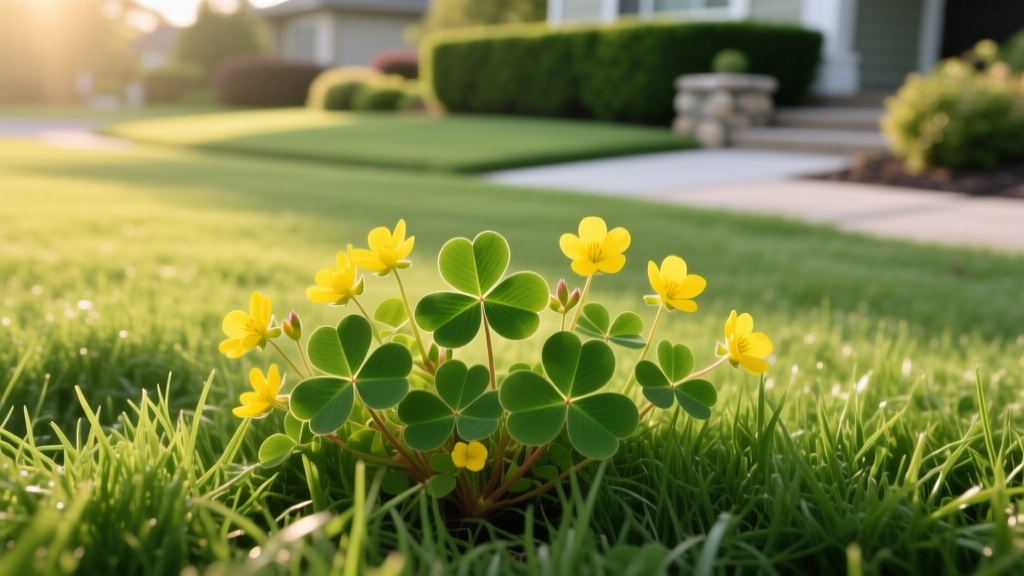
How to Kill Clover With Yellow Flowers: ID & Eradication
The 'Yellow Clover' Misidentification Problem
Homeowners frequently report an invasion of 'clover with yellow flowers' in their lawns. However, true white clover (Trifolium repens) exclusively produces white or pale pink blooms. If your turf is dotted with yellow-flowering plants featuring trifoliate (three-part) leaves, you are not dealing with standard clover. You are likely facing an aggressive imposter or a legume cousin that requires a completely different eradication strategy.
Misidentifying these weeds leads to failed herbicide applications, wasted money, and rapid spread. Standard broadleaf weed killers formulated for white clover often fail against yellow-flowering variants because their root structures, leaf cuticles, and growth cycles differ significantly. This diagnostic guide breaks down the exact species hiding in your turf and provides the precise chemical and cultural rescue protocols required to eliminate them.
Diagnostic Matrix: Identifying Your Yellow-Flowering Weed
Before purchasing any herbicide, you must confirm the exact species. Examine the leaf shape, root structure, and flower formation. Use the matrix below to cross-reference your lawn's symptoms.
| Feature | Oxalis (Yellow Woodsorrel) | Black Medic | Hop Clover (Lesser Trefoil) |
|---|---|---|---|
| Leaf Shape | Heart-shaped leaflets | Teardrop/oval with extended central vein | Oval/egg-shaped, smooth edges |
| Flower Structure | 5 distinct petals, solitary or small clusters | Tight, spherical black/yellow clusters | Small, dense cylindrical spikes |
| Root System | Deep taproot with brittle rhizomes | Shallow, branching taproot | Shallow fibrous roots, no rhizomes |
| Unique Trait | Leaves fold downward at night; explosive seed pods | Thrives in low-nitrogen, compacted soil | Resembles miniature black medic |
| Primary Herbicide | Triclopyr or Fluroxypyr | 2,4-D + Dicamba + MCPP | 2,4-D + Dicamba |
Deep Dive: The Usual Suspects
Oxalis (Yellow Woodsorrel): The Imposter
Oxalis (Oxalis stricta) is the most common weed mistaken for clover. While it mimics clover's three-leaf structure, its leaves are distinctly heart-shaped rather than rounded. According to the University of California Statewide Integrated Pest Management Program, Oxalis is particularly notorious for its explosive seed pods that can launch seeds up to 10 feet away when disturbed by mowing or string trimming. Furthermore, Oxalis possesses a deep, brittle taproot and horizontal rhizomes; pulling it by hand almost always leaves root fragments behind, guaranteeing rapid regrowth.
Black Medic & Hop Clover: The Legume Cousins
Black medic (Medicago lupulina) and hop clover (Trifolium dubium) are actual legumes, making them distant cousins to white clover. Black medic is easily identified by its teardrop-shaped leaves and a central vein that extends slightly past the leaf margin into a tiny bristle tip. As noted by Penn State Extension, black medic is a primary indicator weed for nitrogen-deficient and heavily compacted soils. If your lawn is overrun with black medic, the weed is merely a symptom of a failing turfgrass canopy that lacks the vigor to outcompete opportunistic legumes.
Chemical Rescue Protocol: Exact Herbicide Formulations
Do not buy a generic 'Weed and Feed' product from a big-box store and expect results. These products typically rely on low concentrations of 2,4-D, which will burn the top growth of Oxalis but leave the rhizomes entirely unharmed. You need targeted liquid concentrates applied via a pump sprayer.
⚠️ CRITICAL MIXING WARNING: Oxalis leaves are covered in a waxy cuticle that repels water-based herbicides. You must add a Non-Ionic Surfactant (NIS) to your tank mix. Without a surfactant, the herbicide will bead up and roll off the leaf, resulting in a 100% failure rate. Use 0.25% v/v (approximately 1/2 teaspoon of surfactant per quart of mixed solution).
Protocol A: Eradicating Oxalis (Yellow Woodsorrel)
- Active Ingredients Required: Triclopyr or Fluroxypyr.
- Recommended Product: Ortho WeedClear for Lawns (contains Triclopyr) or PBI/Gordon's Trimec Southern (if dealing with warm-season grasses like Bermuda or Zoysia).
- Application Rate: Mix 2 to 3 fluid ounces of Triclopyr concentrate per 1,000 square feet, diluted in 1.5 gallons of water.
- Cost Expectation: Expect to pay $35 to $55 for a 32-ounce concentrate bottle in 2026, which is sufficient to treat up to 10,000 square feet.
Protocol B: Eradicating Black Medic & Hop Clover
- Active Ingredients Required: A three-way blend of 2,4-D, MCPP, and Dicamba.
- Recommended Product: SpeedZone Broadleaf Herbicide for Turf or Bayer Advanced All-In-One Lawn Weed and Crabgrass Killer.
- Application Rate: Follow label rates, typically 1.5 to 2.5 fluid ounces per 1,000 square feet.
Edge Cases: Why Herbicide Applications Fail
Even with the correct active ingredients, homeowners frequently report failure. This is almost always due to environmental timing or physiological defense mechanisms of the weed.
- The Heat Stress Defense (Oxalis): When daytime temperatures exceed 85°F, Oxalis folds its leaves downward and closes its stomata to conserve moisture. If you spray during this window, the plant cannot absorb the systemic herbicide. Fix: Apply herbicides between 6:00 AM and 8:00 AM when the leaves are fully expanded and temperatures are below 80°F.
- The Drought Dormancy Trap: If your lawn is drought-stressed, weeds enter a semi-dormant state and halt internal fluid transport. Systemic herbicides like Triclopyr rely on the plant's vascular system to move the poison down to the roots. Fix: Irrigate the lawn deeply 48 hours before application to ensure the weeds are actively growing and translocating nutrients (and herbicide) to their roots.
- The Seed Bank Explosion: Spraying mature Oxalis that has already formed seed pods will kill the parent plant, but the dying process often triggers the pods to burst, planting the next generation. Fix: Never use a string trimmer near flowering Oxalis. Spot-spray the plants while they are still in the vegetative or early flowering stage, before seed pods develop.
Cultural Rescue Fixes: Correcting the Soil Environment
Chemical eradication only removes the current generation of weeds. If you do not alter the soil environment, the weed seed bank will germinate again the following season. Black medic and hop clover are specifically adapted to thrive where turfgrass struggles.
Correcting Nitrogen Deficiencies
Legumes like black medic possess root nodules containing Rhizobium bacteria, allowing them to fix their own nitrogen from the atmosphere. If your soil lacks nitrogen, your turfgrass will starve while the legumes thrive. Conduct a soil test and apply a high-nitrogen, slow-release fertilizer (such as a 32-0-10 NPK ratio) at a rate of 1.0 to 1.5 lbs of actual nitrogen per 1,000 square feet during the turf's peak growing season. This forces the grass to thicken and shade out weed seedlings.
Alleviating Soil Compaction
Black medic has a shallow, aggressive root system that easily penetrates compacted, hardpan soils where turfgrass roots cannot establish. If you cannot push a 6-inch screwdriver into your lawn with moderate hand pressure, your soil is compacted. Schedule core aeration in the early fall (for cool-season grasses) or late spring (for warm-season grasses) to physically extract soil plugs, allowing oxygen, water, and nutrients to reach the turf's root zone.
Summary Action Plan
Identify the leaf shape first. If it is heart-shaped, deploy a Triclopyr-based herbicide with a surfactant in the cool morning hours. If the leaves are teardrop-shaped with an extended central vein, utilize a 2,4-D/MCPP/Dicamba blend and immediately schedule a soil test to address underlying nitrogen deficiencies and compaction. Consistent execution of these targeted protocols will eliminate yellow-flowering clover imposters and restore a dense, competitive turf canopy.

