
Lawn Care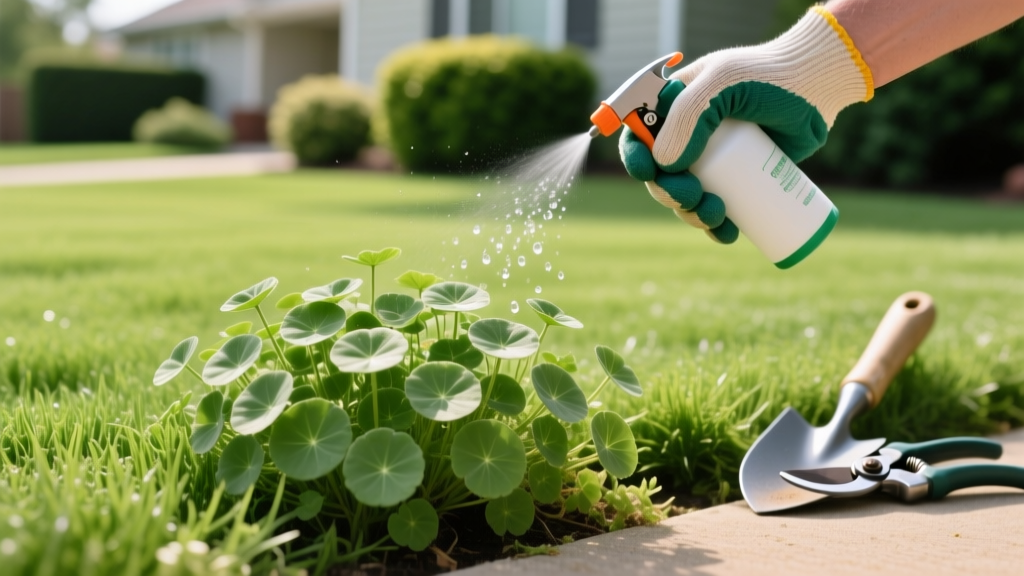
How to Kill Dollar Weeds: Spot-Treatment & Herbicide Guide
The Umbrella Test: Identifying Dollarweed vs. Lookalikes
Before you can effectively kill dollar weeds (Hydrocotyle spp.), you must confirm you are not treating a lookalike. Dollarweed, often called pennywort, is frequently confused with creeping charlie (ground ivy) and dichondra. Misidentification leads to incorrect herbicide selection and wasted chemical applications.
The Umbrella Rule: Look at where the stem attaches to the leaf. On dollarweed, the petiole (stem) connects to the exact center of the leaf's underside, resembling a tiny umbrella. On creeping charlie and dichondra, the stem attaches at the leaf's edge or margin.
Dollarweed leaves are perfectly round, bright green, and feature distinct scalloped edges. They typically measure 1 to 2 inches in diameter and form dense, low-lying mats that choke out desirable turfgrass. According to NC State TurfFiles, this weed thrives primarily in thin, weak lawns where soil moisture levels remain excessively high.
Why Dollarweed Invades: The Moisture Matrix
Dollarweed is an indicator plant. Its presence is a direct symptom of poor drainage, over-irrigation, or heavy clay soils that retain water. If you apply herbicides without addressing the underlying hydrology, the weed will return within a single growing season.
⚠️ Irrigation Warning: Lawns harboring dollarweed are almost always receiving more than 1.5 inches of water per week. Before initiating chemical spot-treatments, audit your sprinkler heads for leaks and reduce your irrigation schedule to force the soil profile to dry out between watering cycles.
Compacted soil exacerbates the issue by preventing water percolation. Core aeration is not just a cultural recommendation; it is a mandatory prerequisite for long-term dollarweed eradication in heavy soils.
Spot-Treatment Herbicide Selection by Grass Type
Selective post-emergent herbicides are the most efficient way to kill dollar weeds without damaging your surrounding turf. However, warm-season and cool-season grasses have drastically different chemical tolerances. Using a cool-season herbicide on St. Augustinegrass, for example, will cause severe phytotoxicity.
| Turfgrass Type | Active Ingredients Required | Recommended Product (2026) | Avg. Price Range |
|---|---|---|---|
| Warm-Season (Bermuda, Zoysia, Centipede) | Thiencarbazone, Iodosulfuron, Dicamba | Celsius WG | $135 - $155 (2 oz) |
| Warm-Season (St. Augustine, Centipede) | Atrazine | Hi-Yield Atrazine Weed Killer | $25 - $35 (1 gal) |
| Cool-Season (Fescue, Kentucky Bluegrass, Ryegrass) | 2,4-D, Dicamba, MCPP, Carfentrazone | SpeedZone Broadleaf Herbicide | $110 - $130 (1 gal) |
For warm-season lawns, Celsius WG is the industry gold standard for dollarweed control. It combines Group 2 (ALS inhibitors) and Group 4 (synthetic auxins) modes of action, which is critical in 2026 as many broadleaf weeds have developed resistance to standalone Group 4 herbicides like 2,4-D. For cool-season lawns, SpeedZone provides rapid visual burn-down within 24 to 48 hours due to the inclusion of carfentrazone-ethyl.
Step-by-Step Chemical Spot-Treatment Protocol
Broadcast spraying is unnecessary and wasteful for localized dollarweed patches. Use a 1-gallon or 2-gallon pump sprayer for precise spot-treatments. Follow this exact calibration and application protocol to ensure efficacy and turf safety.
- Calculate the Mix Rate: For Celsius WG, the standard spot-treatment rate is 0.057 ounces (1.6 grams) per gallon of water, which covers approximately 1,000 square feet. Use a digital gram scale for accuracy; estimating with the provided scoop often leads to under-dosing.
- Add a Non-Ionic Surfactant: Dollarweed leaves have a waxy cuticle that repels water. You must add a non-ionic surfactant (like DyneAmic or Methylated Seed Oil) at a rate of 0.33 fluid ounces per gallon. This breaks the surface tension, allowing the herbicide to spread and penetrate the leaf tissue.
- Check Environmental Thresholds: Apply only when soil temperatures are between 65°F and 85°F. Never apply when air temperatures exceed 90°F. High heat causes synthetic auxins to volatilize (turn into a gas), which can drift and severely damage nearby ornamental shrubs and trees.
- Execute the Spray Pattern: Use a fan nozzle (like a TeeJet 8002VS) to apply a fine mist. Spray the dollarweed until the leaves are visibly wet, but stop before the liquid begins to drip off the edges onto the soil. Soil contact is unnecessary and wastes chemical.
- Enforce the Waiting Period: Do not irrigate or allow rain to hit the treated area for at least 24 hours post-application. Mowing should be delayed for 48 hours to allow maximum systemic translocation of the herbicide down to the root system.
Organic and Non-Selective Spot Eradication
If you manage an organic lawn or have a severe infestation in a non-turf area (like driveway cracks or garden bed edges), non-selective and organic options are viable. Be aware that these methods will kill any desirable grass they contact.
- 20% Horticultural Vinegar (Acetic Acid):
- Pros: OMRI-listed, safe for pets immediately after drying, rapid contact burn.
- Cons: Only burns the foliage; does not translocate to the roots. Requires 3 to 4 repeated applications spaced 5 days apart to exhaust the dollarweed's root reserves. Highly corrosive to metal sprayer parts.
- Glyphosate (41% Concentrate):
- Pros: Complete systemic kill in a single application. Highly cost-effective for edging.
- Cons: Non-selective. Will leave dead, brown spots in your lawn that require raking and overseeding. Requires careful shielded application using a cardboard barrier to prevent drift.
- Boiling Water Extraction:
- Pros: Zero chemical residue, free.
- Cons: Extremely labor-intensive. Only practical for 5 to 10 isolated weeds. Must be poured directly on the crown to cook the taproot.
Cultural Remediation: Fixing the Root Cause
Chemical eradication is only 50% of the battle. As noted by Texas A&M Aggie Turf, modifying the microenvironment is the only way to prevent recolonization. Implement these cultural practices immediately after your herbicide application has taken effect.
1. Strategic Core Aeration and Top-Dressing
Rent a walk-behind core aerator and extract 3-inch deep soil plugs across the affected zones. Immediately follow this by top-dressing with 1/4 inch of coarse, washed masonry sand (for warm-season grasses) or a 70/30 compost-soil blend (for cool-season grasses). Drag the material into the aeration holes using a stiff-bristled push broom. This permanently increases the soil's percolation rate, eliminating the standing moisture dollarweed requires to germinate.
2. Adjusting Mowing Heights
Dollarweed struggles to compete with dense, tall turf canopies that block sunlight from reaching the soil surface. Raise your mower deck to the maximum recommended height for your specific grass species. For example, maintain St. Augustinegrass at 3.5 to 4.0 inches, and Tall Fescue at 3.5 to 4.5 inches. According to Penn State Extension, taller grass shades out broadleaf weed seedlings and forces them to expend energy on stem elongation rather than lateral spreading.
3. Deep and Infrequent Watering
Transition from daily 10-minute watering cycles to a schedule that delivers 1 inch of water per week in a single, deep session. Use a straight-sided tuna can placed in the sprinkler zone to measure exact output. Deep watering encourages turfgrass roots to grow downward, while the surface soil dries out sufficiently to deter dollarweed seed germination.

