
Lawn Care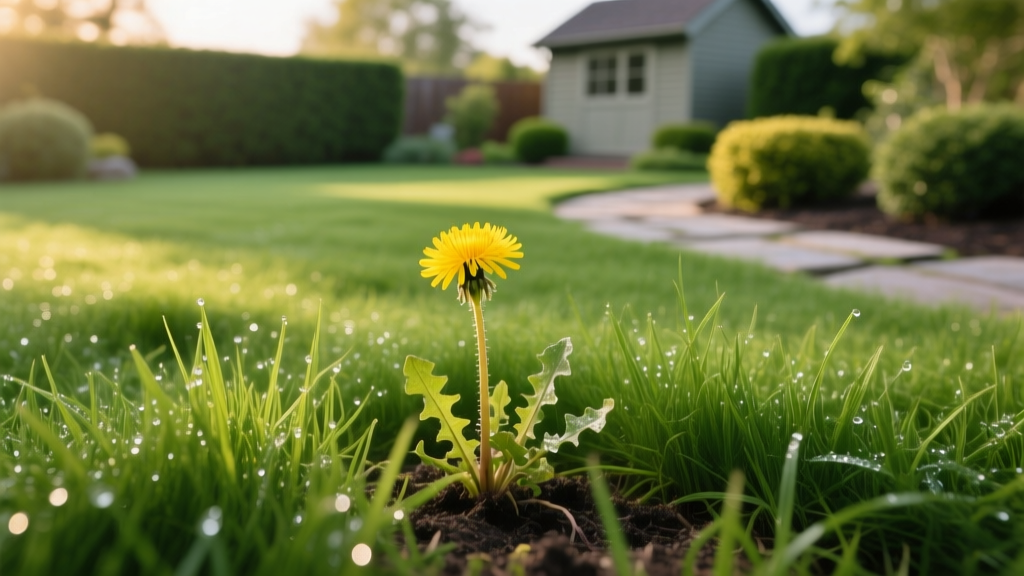
How to Kill Little Yellow Flowers in Lawn: Weed Rescue
The Diagnosis: What Are Those Little Yellow Flowers?
When you spot little yellow flowers in lawn areas, the immediate instinct is to reach for a generic weed killer. However, treating yellow blooms blindly is the primary reason homeowners fail to eradicate them. Yellow-flowering broadleaf weeds are not a monolith; they belong to entirely different botanical families, possess distinct root architectures, and react differently to chemical controls. Misidentifying the weed leads to wasted money, chemical burn on your turf, and a rapid resurgence of the infestation.
According to turfgrass pathology data from Penn State Extension, the vast majority of yellow-flowering lawn invaders fall into three categories: Yellow Woodsorrel (Oxalis), Dandelions, and Black Medic. Each indicates a specific underlying soil deficiency or compaction issue that must be addressed alongside chemical treatment.
Visual Diagnostic Matrix
| Weed Species | Leaf Structure | Flower Profile | Root System | Primary Soil Indicator |
|---|---|---|---|---|
| Yellow Woodsorrel (Oxalis) | Trifoliate, heart-shaped leaflets (resembles clover) | Small, bright yellow, 5 distinct petals | Shallow taproot with creeping stolons | Low nitrogen, acidic soil, thin turf canopy |
| Dandelion | Deeply lobed, jagged edges, basal rosette | Large, solitary yellow composite head | Deep, brittle taproot (up to 10 inches) | Compacted soil, low calcium, high potassium |
| Black Medic | Trifoliate, oval leaflets with a tiny central bristle | Tight clusters of tiny, pale yellow blooms | Shallow, fibrous root mass | Severe soil compaction, low nitrogen, drought stress |
| Birdsfoot Trefoil | Five leaflets per node, arranged like a bird's foot | Bright yellow, pea-like clustered blooms | Deep, branching taproot system | Poorly drained soils, low fertility |
The Root Cause: Why Are They Thriving?
Weeds are opportunistic symptoms of a failing turf ecosystem. Before applying post-emergent herbicides, you must understand why the weed outcompeted your grass. University of Minnesota Extension notes that broadleaf weeds establish rapidly when turfgrass density drops below 85% coverage.
- Soil Compaction: Dandelions and Black Medic thrive in soils with a bulk density exceeding 1.4 g/cm³. Grass roots suffocate in these conditions, while weed taproots penetrate easily.
- Nitrogen Starvation: Oxalis and Black Medic are legumes or legume-adjacent; they can fix atmospheric nitrogen or survive on trace amounts. If your lawn receives less than 2 lbs of nitrogen per 1,000 sq. ft. annually, these weeds will dominate.
- Acidic pH: Yellow Woodsorrel prefers a soil pH between 5.0 and 6.0. If your soil test reveals a pH below 6.2, cool-season grasses (like Tall Fescue and Kentucky Bluegrass) struggle to uptake phosphorus, giving Oxalis a massive competitive advantage.
Rescue Protocols: Targeted Chemical Eradication
Not all broadleaf herbicides are created equal. The active ingredient that kills a dandelion in 48 hours might barely stunt an Oxalis plant. To permanently remove little yellow flowers in lawn environments, you must match the active ingredient to the specific weed biology.
⚠️ CRITICAL GRASS-TYPE WARNING: The herbicide protocols below are formulated for cool-season grasses (Fescue, Bluegrass, Ryegrass) and Zoysiagrass. If you have St. Augustine, Centipede, or Bahia grass, you must use atrazine-based or specific Southern formulations (like SpeedZone Southern) to avoid severe phytotoxicity and permanent turf death.
Protocol A: The Dandelion & Black Medic Fix
Standard 3-way herbicides are highly effective here. Look for products containing 2,4-D, Dicamba, and MCPP (e.g., Ortho WeedClear or Gordon’s Trimec).
Mixing Rate: 1.5 fl. oz. per 1 gallon of water per 1,000 sq. ft.
Timeline: Visible wilting in 24 hours; complete necrosis in 10-14 days.
Protocol B: The Oxalis (Yellow Woodsorrel) Exception
This is where most DIY treatments fail. Oxalis possesses a waxy leaf cuticle and a resilient root system that readily shrugs off standard 2,4-D. According to NC State Turffiles, effective control of Oxalis requires the active ingredients Triclopyr or Fluroxypyr.
Recommended Products:
- Battleship III: Contains Triclopyr, Fluroxypyr, and 2,4-D. This is the professional gold standard for stubborn Oxalis.
- SpeedZone (Standard): Contains Carfentrazone, which provides rapid burn-down of the foliage, combined with 2,4-D and MCPP for root translocation.
Mixing Rate: 1.1 to 1.5 fl. oz. per gallon per 1,000 sq. ft. Always add a non-ionic surfactant (NIS) at a rate of 1 teaspoon per gallon to break the waxy leaf barrier of the Oxalis.
Step-by-Step Application Strategy for Maximum Kill
Herbicide efficacy is entirely dependent on environmental conditions and application technique. Follow this exact sequence to ensure the chemical reaches the root system without damaging your turf.
- Check the Thermometer: Apply only when daytime temperatures are between 65°F and 82°F. Never apply ester-based herbicides when temperatures exceed 85°F; the chemical will volatilize (turn into a gas), drift, and scorch your desirable grass.
- Mow 24 Hours Prior: Mow your lawn to its standard height one day before spraying. This removes older, less absorbent leaf tissue and forces the weed to produce fresh, highly permeable growth.
- Calibrate Your Sprayer: Use a 1- or 2-gallon pump sprayer. Fill halfway with water, add the precise herbicide dose, add 1 tsp of surfactant, then fill the rest with water. Agitate thoroughly.
- Spray to Dampness, Not Dripping: Apply a fine mist directly over the little yellow flowers until the leaves are visibly damp. Avoid pooling or runoff onto the soil, which wastes product and increases groundwater contamination risk.
- The 48-Hour Rain & Irrigation Rule: Do not water your lawn, and ensure no rain is forecasted for at least 48 hours post-application. The herbicide requires this window to fully translocate from the leaves down to the taproot.
Long-Term Cultural Prevention: Starving the Weeds
Chemical eradication is a temporary rescue fix. If you do not alter the soil environment, dormant weed seeds will germinate the following spring. Implement these cultural practices to build a turf canopy dense enough to naturally shade out yellow-flowering invaders.
Core Aeration and Overseeding
If Black Medic or Dandelions dominated your lawn, your soil is compacted. Schedule core aeration in early fall (for cool-season grasses) or late spring (for warm-season grasses). Extract 3-inch soil plugs at a density of 15-20 holes per square foot. Immediately follow with overseeding using a turf-type tall fescue or Kentucky bluegrass blend at a rate of 5-8 lbs per 1,000 sq. ft. to fill the voids.
Strategic Nitrogen Loading
Shift your fertilization schedule to heavily favor fall applications. Apply 1 lb of nitrogen per 1,000 sq. ft. in early September, and another 1 lb in late November. This builds deep root mass and thickens the grass blades, physically blocking sunlight from reaching Oxalis and Medic seeds sitting on the soil surface.
pH Correction via Liming
If your soil test confirms a pH below 6.0, apply pelletized calcitic lime at a rate of 50 lbs per 1,000 sq. ft. to gradually raise the pH toward the optimal 6.5 - 7.0 range. This unlocks bound phosphorus in the soil, giving your grass the energy required to outcompete acid-loving weeds.
Frequently Asked Questions
Will pulling little yellow flowers by hand work?
Hand-pulling works for Dandelions if you use a weeding fork to extract the entire 10-inch taproot. However, never hand-pull Oxalis (Yellow Woodsorrel). Pulling snaps the brittle stolons, leaving root fragments behind that will sprout three new plants from the broken nodes.
Can I use pre-emergent to stop yellow flowers?
Pre-emergents like Prodiamine are highly effective at stopping crabgrass, but they have limited efficacy on established broadleaf perennials like Oxalis and Dandelions. You must use a post-emergent liquid spray to kill existing plants, followed by a thick turf canopy to prevent new seeds from germinating.

