
Lawn Care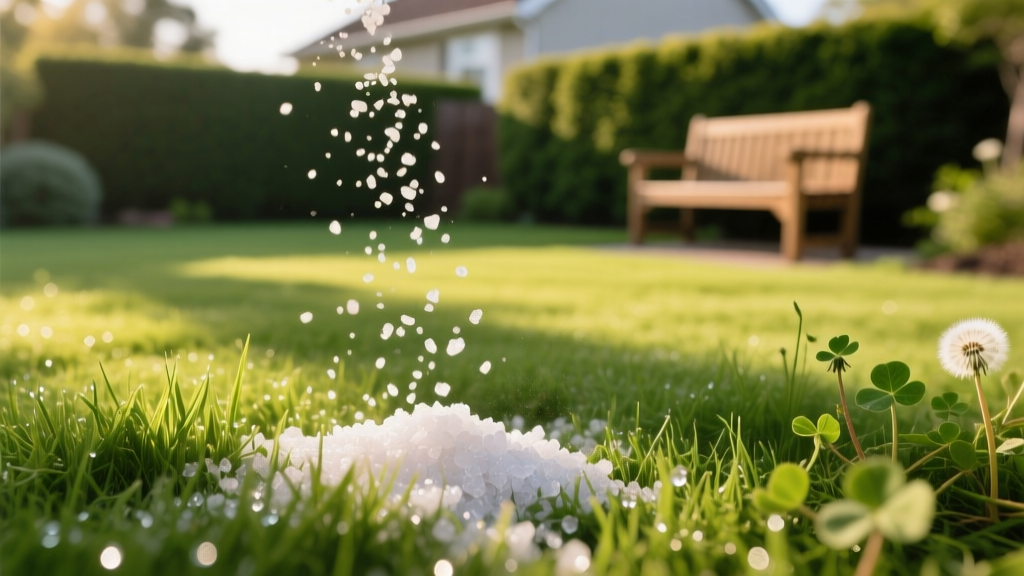
Can I Kill Weeds With Salt? The Science of Sodium Herbicides
The Short Answer: Yes, But At A Severe Cost
The direct answer to "can I kill weeds with salt" is yes. Sodium chloride (NaCl) is highly effective at desiccating plant tissue and killing unwanted vegetation. However, using household table salt, rock salt, or Epsom salt as a DIY weed killer in your lawn, garden beds, or near desirable trees is a catastrophic mistake for your soil health. While salt acts as a rapid non-selective herbicide, it simultaneously functions as a long-term soil sterilant. According to research from Penn State Extension, excessive sodium in soil destroys the structural integrity of the earth, rendering it incapable of supporting turfgrass or ornamental plants for years.
The Cellular Science: How Salt Kills Weeds
To understand why salt is so destructive, you must look at plant biology at the cellular level. When you apply a highly concentrated salt solution to weed foliage or the soil surface, you create a hypertonic environment.
- Osmotic Reversal: Normally, water moves from the soil (low solute concentration) into plant roots (high solute concentration). Salt reverses this gradient.
- Plasmolysis: Water is violently drawn out of the plant's cells to balance the external sodium concentration. The cell membrane shrinks away from the cell wall, causing immediate wilting, tissue necrosis, and plant death.
- Ion Toxicity: Sodium and chloride ions are absorbed by the roots in toxic amounts, disrupting enzyme function and blocking the uptake of essential nutrients like potassium and calcium.
⚠️ CRITICAL WARNING: The "Sterilized Soil" Danger Zone
Salt does not break down or evaporate. Unlike organic herbicides that degrade via microbial action, sodium remains in the soil matrix indefinitely until it is physically leached away by massive amounts of rainfall. A single heavy application of salt can sterilize a patch of soil, preventing any grass seed or plant from germinating for up to three years.
Salt does not break down or evaporate. Unlike organic herbicides that degrade via microbial action, sodium remains in the soil matrix indefinitely until it is physically leached away by massive amounts of rainfall. A single heavy application of salt can sterilize a patch of soil, preventing any grass seed or plant from germinating for up to three years.
The Hidden Danger: Soil Flocculation and Sodicity
The most severe consequence of using salt for weed control is the creation of sodic soil. Soil particles (particularly clay) possess a negative electrical charge, known as the Cation Exchange Capacity (CEC). Normally, positively charged calcium (Ca++) and magnesium (Mg++) ions bind to these particles, keeping soil aggregates loose, porous, and capable of draining water.
When you introduce massive amounts of sodium (Na+), the sodium ions displace the calcium and magnesium. Because sodium carries only a single positive charge, it causes the clay particles to repel one another and then tightly bind together in a process called dispersion. The result is a hard, crusty, impermeable surface that repels water, suffocates roots, and completely halts microbial life.
Where Salt is Acceptable (And Where It Is Destructive)
Because of its sterilizing properties, salt should only be used in specific, isolated hardscape scenarios where you never intend to grow anything again.
| Application Zone | Verdict | Reasoning & Risk Level |
|---|---|---|
| Driveway Cracks (Concrete/Asphalt) | Safe | No surrounding soil ecology to damage. Low runoff risk if applied directly into deep fissures. |
| Patio Paver Joints | Safe | Effective for killing moss and weeds in sand joints. Use rock salt directly. |
| Gravel Walkways | Caution | High risk of lateral leaching into adjacent lawn borders during heavy rain. |
| Lawn (Bermuda, Fescue, Zoysia) | NEVER | Will permanently kill turfgrass, destroy soil structure, and cause severe sodicity. |
| Garden Beds & Tree Root Zones | NEVER | Tree roots extend far beyond the canopy. Salt will cause systemic ion toxicity and tree death. |
Step-by-Step: Applying Salt to Hardscape Cracks Safely
If you are treating isolated weeds in a driveway crack or between patio pavers, follow this exact protocol to minimize environmental runoff.
- Timing: Apply only on a dry day with zero rain in the 48-hour forecast to prevent the salt solution from washing into adjacent lawn soil.
- The Mixture: Dissolve 1 cup of standard table salt into 2 cups of boiling water. The heat provides immediate thermal shock, while the salt ensures long-term desiccation.
- Targeted Application: Use a squeeze bottle or a specialized crack-weeding tool to pour the solution directly onto the weed's crown. Do not broadcast or spray.
- Alternative (Dry Application): For wider paver joints, pour coarse rock salt (NaCl) directly into the joint, filling it to just below the surface, and lightly mist with water to activate.
The Cost of Salt Damage Remediation
Homeowners often mistakenly believe that because table salt costs $1 per pound, it is a "cheap" weed killer. If salt leaches into your lawn, the remediation costs are staggering. Fixing sodic soil requires the application of Calcium Sulfate (Gypsum) to force the sodium off the soil's cation exchange sites.
💡 Remediation Math:
To remediate salt-damaged soil, you must apply gypsum at a rate of 50 lbs per 1,000 square feet. A 40 lb bag of pelletized gypsum costs approximately $15 to $20 in 2026. Following application, the area requires inches of deep, continuous irrigation to leach the displaced sodium below the root zone. If the soil structure has entirely collapsed, complete excavation and topsoil replacement ($0.50 - $1.50 per sq. ft.) is the only remaining option.
To remediate salt-damaged soil, you must apply gypsum at a rate of 50 lbs per 1,000 square feet. A 40 lb bag of pelletized gypsum costs approximately $15 to $20 in 2026. Following application, the area requires inches of deep, continuous irrigation to leach the displaced sodium below the root zone. If the soil structure has entirely collapsed, complete excavation and topsoil replacement ($0.50 - $1.50 per sq. ft.) is the only remaining option.
Lawn-Safe Alternatives to Salt
If you need to kill weeds in your lawn or garden beds without sterilizing the soil, rely on these proven, ecologically sound alternatives.
1. Horticultural Vinegar (20% - 30% Acetic Acid)
Standard kitchen vinegar (5% acetic acid) is too weak to kill mature weeds. Commercial horticultural vinegar (20% to 30%) rapidly burns down weed foliage on contact. As of 2026, a gallon of 20% acetic acid averages $25 to $35. Note: This is a non-selective contact burn-down. It will not kill the roots of perennial weeds like dandelions, and it requires strict PPE (goggles, gloves) as it is highly corrosive.
2. Pelargonic Acid (Fatty Acid Herbicides)
Products containing pelargonic acid (such as Scythe Herbicide) strip the waxy cuticle off weed leaves, causing rapid dehydration. It breaks down in the soil within days, leaving no toxic residue, making it vastly superior to salt for use near garden beds.
3. Selective Systemic Herbicides (For Lawns)
If you are trying to kill weeds inside a turfgrass lawn, contact burn-downs will leave you with ugly brown spots. Instead, use selective herbicides that target broadleaf weeds or specific grasses without harming your turf. For example, Mesotrione (Tenacity) is highly effective against crabgrass and broadleaf weeds in cool-season lawns, costing roughly $65 for an 8 oz bottle that treats multiple acres.
Frequently Asked Questions
Will Epsom salt kill weeds?
No. Epsom salt is magnesium sulfate, not sodium chloride. Magnesium and sulfur are essential secondary plant nutrients. Applying Epsom salt to weeds will actually act as a fertilizer, potentially making them grow greener and more vigorous. It has zero herbicidal properties.
Can I mix salt and vinegar together for a super-weedkiller?
While mixing 1 gallon of 20% vinegar, 1 cup of table salt, and a tablespoon of dish soap is a popular internet "hack," the salt component remains entirely unnecessary and dangerous for soil health. The 20% acetic acid is already doing 100% of the foliar burn-down work. Adding salt only guarantees that the soil beneath the weed will be sterilized against future planting.
Does boiling water alone work without salt?
Yes. Pouring boiling water directly onto the crown of a weed growing in a driveway crack causes immediate thermal destruction of the plant's cellular structure and root crown. It is highly effective for isolated hardscape weeds and leaves zero chemical or mineral residue behind, making it safer for adjacent soil ecology than salt.
For more information on managing soil health and avoiding chemical runoff, consult the Environmental Protection Agency (EPA) guidelines on minimum-risk pest control and soil preservation.

