
Lawn Care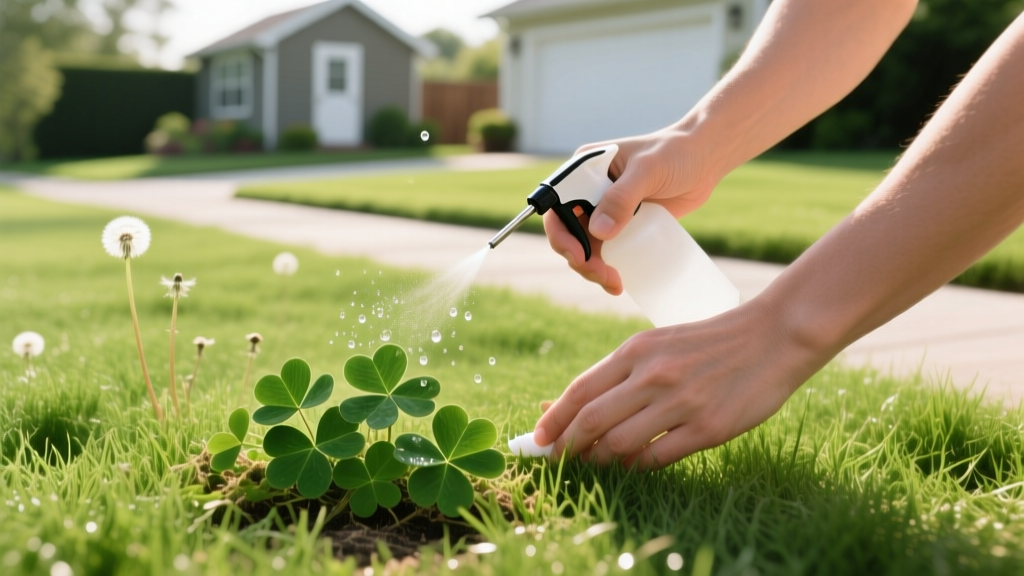
Killing Clover in Lawn: Spot-Treatment Guide for Turfgrass Recovery
The Biology of a Clover Invasion
White clover (Trifolium repens) is a perennial broadleaf weed that thrives in nitrogen-deficient, compacted soils. Unlike grassy weeds that compete directly for the same soil nutrients, clover possesses a symbiotic relationship with Rhizobium leguminosarum bacteria in its root nodules, allowing it to fix atmospheric nitrogen and sustain itself even when your turfgrass is starving. When tackling the challenge of killing clover in lawn environments, surface-level treatments often fail because clover spreads via resilient above-ground stolons that root at the nodes, creating a dense mat that chokes out desirable turf.
Diagnostic Check: Identify Your Clover
- White Clover: Features three-leaflet leaves with distinct white, V-shaped chevron markings. Produces white or pinkish globe-shaped flower heads. Spreads aggressively via stolons.
- Hop Clover (Trifolium campestre): Smaller leaves without the white chevron. Produces bright yellow, hop-like flower clusters. Prefers slightly more acidic soils than white clover.
- Microclover: A cultivated dwarf variety of white clover. Often intentionally seeded into eco-lawns, but can invade traditional turf if mowing heights are kept below 2 inches.
Why Clover Survives Your Mowing Routine
Many homeowners attempt to eradicate clover simply by lowering their mower deck. This is a critical mistake. Clover stolons naturally creep at a height of 1 to 2 inches. Mowing your lawn at 2.5 inches or lower removes the turfgrass canopy that shades the soil, allowing clover seedlings to establish. According to the University of Minnesota Extension, maintaining a mowing height of 3.5 to 4 inches for cool-season grasses shades the soil surface, drastically reducing clover germination rates and stolon expansion.
Chemical Spot-Treatment Matrix
When killing clover in lawn settings, single-active-ingredient herbicides like 2,4-D alone are largely ineffective against mature white clover. You need a multi-active ingredient approach or specific synthetic auxins. Below is a professional-grade comparison of the most effective selective herbicides for spot-treatment.
| Active Ingredient(s) | Example Product | Mixing Rate (per 1,000 sq ft) | Grass Safety Profile | Cost Estimate |
|---|---|---|---|---|
| Triclopyr + 2,4-D + Dicamba | Trimec Southern / Ortho WeedClear | 1.5 fl oz in 1 gal water | Safe for most cool-season, Bermudagrass, Zoysia. Caution on St. Augustine. | $15 - $25 / 32oz |
| Quinclorac | Drive XLR8 | 0.36 fl oz in 1 gal water | Excellent for Bermudagrass and Zoysia. Avoid on certain fine fescues. | $80 - $110 / 2.5gal |
| FeHEDTA (Chelated Iron) | Fiesta Turf Weed Killer | 3.0 to 5.0 fl oz in 1 gal water | Safe for ALL turfgrass species. Organic compliant. | $40 - $55 / 2.5gal |
The 4-Step Spot-Spraying Protocol
To maximize herbicide efficacy and minimize turf stress, follow this exact calibration and application sequence. Do not broadcast spray if clover patches cover less than 30% of your lawn; spot-treating saves money and protects soil biology.
- Calibrate Your Sprayer: Use a 1-gallon or 2-gallon pump sprayer. Mark a 20x50 foot area (1,000 sq ft) in your driveway. Spray the area with plain water at your normal walking pace to determine how much liquid it takes to cover 1,000 sq ft evenly. Adjust your mix based on this volume (usually 1 to 1.5 gallons).
- Add a Penetrant Surfactant: Mature clover leaves have a thick, waxy cuticle that repels water-based herbicides. Add a Non-Ionic Surfactant (NIS) or Methylated Seed Oil (MSO) at a rate of 0.25% to 0.5% v/v. This equates to roughly 1 to 1.5 teaspoons of surfactant per gallon of mixed solution.
- Execute the Spot Spray: Apply the mixture directly to the clover patches. Spray until the leaves are visibly wet and glossy, but stop before the liquid begins to drip off the leaf edges. Dripping wastes chemical and increases soil residual buildup.
- Enforce the 48-Hour Rule: Do not mow, irrigate, or allow foot traffic on the treated areas for at least 48 hours. Triclopyr and 2,4-D require 24 to 48 hours to translocate from the leaves down into the stolon nodes and root system. Mowing too soon removes the herbicide before it can kill the root crown.
Organic Alternatives: Iron-Based Herbicides
For homeowners managing pets, children, or organic-certified landscapes, FeHEDTA (iron chelate) is the premier choice for killing clover in lawn areas without synthetic auxins. FeHEDTA works by inducing massive oxidative stress in broadleaf plants. Because clover absorbs and transports iron much faster than turfgrass, the clover experiences fatal iron toxicity, resulting in severe tissue necrosis within 24 to 48 hours, while the grass remains unharmed.
Expert Insight: Iron-based herbicides like Fiesta require a two-pass system for complete eradication. Apply the first treatment when temperatures are between 60°F and 80°F. Wait exactly 21 days, then apply a second treatment to catch any regrowth from the stolon nodes. Research from the UC Statewide IPM Program confirms that a single application of FeHEDTA only provides 50-60% control of mature white clover, whereas two spaced applications push control rates above 85%.
Post-Treatment Turf Recovery
Eradicating the weed is only half the battle. If you do not alter the soil environment that allowed the clover to thrive in the first place, seeds dormant in the soil bank will germinate the following spring. Implement these cultural practices immediately after the clover shows signs of necrosis.
1. Correct the Nitrogen Deficit
Clover invades lawns receiving less than 1.5 lbs of Nitrogen per 1,000 sq ft annually. Two weeks after your final herbicide application, apply a high-nitrogen, slow-release fertilizer. A product like Milorganite (5-2-0) at a rate of 32 lbs per 5,000 sq ft, or a synthetic 24-0-0 at 4 lbs per 1,000 sq ft, will aggressively push turfgrass lateral growth to fill in the voids left by the dying clover.
2. Core Aeration and Overseeding
If the clover mat covered more than 20% of your lawn, you will have bare spots once the weeds decompose. Clover thrives in compacted soil where turfgrass roots cannot penetrate. Rent a walk-behind core aerator and pull 3-inch plugs across the affected zones. Immediately overseed with a shade-tolerant, aggressive cultivar like Titan Ultra Tall Fescue or a rhizomatous Kentucky Bluegrass blend. The aeration holes provide direct seed-to-soil contact, bypassing the thatch layer that often prevents grass seed from germinating.
3. Adjust Mowing and Irrigation
Raise your mower deck to a minimum of 3.5 inches. Taller grass blades produce deeper root systems and cast dense shadows that prevent clover seeds from receiving the UV light required for germination. Furthermore, transition from frequent, shallow watering to deep, infrequent irrigation (providing 1 to 1.5 inches of water per week in a single or split session). Clover favors consistently moist topsoil, while established turfgrass prefers deep soil moisture that encourages roots to grow 6 to 8 inches deep.
By combining precise chemical or organic spot-treatments with aggressive cultural recovery, you permanently alter the turf ecosystem, ensuring that killing clover in lawn spaces is a one-time project rather than an annual chore.

