
Lawn Care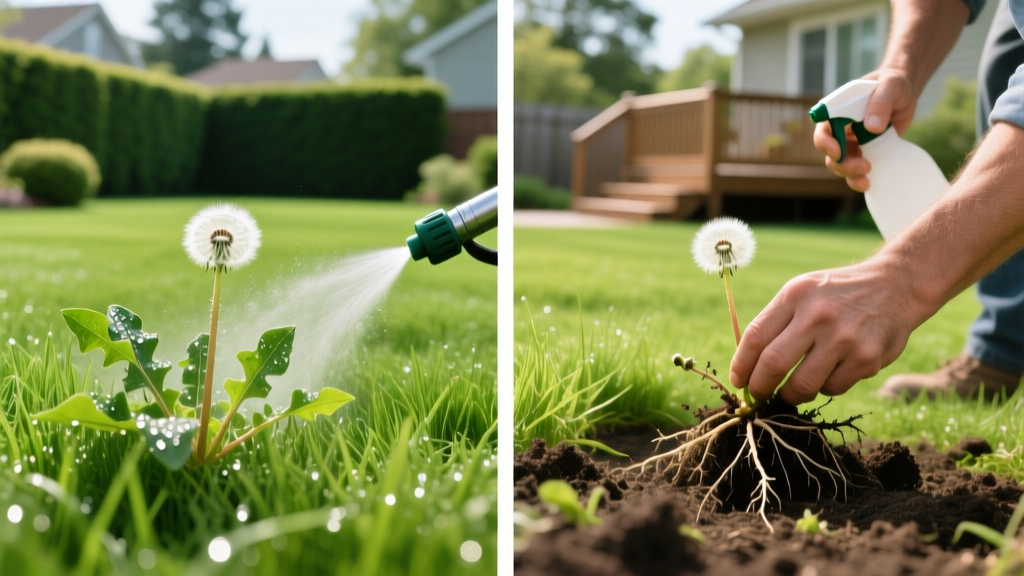
Killing Dandelions in Lawn: Selective Sprays vs Manual Digging
The Biology of the Taproot: Why 90% of Removal Attempts Fail
The common dandelion (Taraxacum officinale) is a perennial broadleaf weed engineered for survival. Its primary defense mechanism is a brittle, fleshy taproot that routinely extends 10 to 15 inches deep into compacted soil. The crown of the plant sits exactly at the soil line, and the root is highly segmented. According to turfgrass researchers at Penn State Extension, if you sever the taproot and leave even one inch of the upper crown attached to the root system, the weed will regenerate multiple new rosettes from the exposed tissue.
⚠️ Critical Failure Mode: Pulling dandelions by hand from dry, compacted soil almost guarantees the root will snap 2 to 3 inches below the surface. This triggers a hormonal response in the remaining root tissue, causing it to sprout two or three new crowns the following spring, effectively multiplying your weed problem.
Manual Extraction: Tools, Pricing, and the 45-Degree Technique
For lawns with fewer than 20 dandelions per 1,000 square feet, manual extraction is the most environmentally sound approach. However, you must use a tool designed to grip the taproot deep below the frost line, not a standard hand trowel.
Recommended Extraction Tools
- Fiskars Stand-Up Weeder (Model 9113): Retails for approximately $38. Features a 39-inch shaft and a serrated stainless-steel claw that grips the root at a 45-degree angle. Best for flat, established lawns.
- Grampa’s Weeder: Retails for roughly $45. Uses a 4-claw fulcrum design that requires less downward foot pressure, making it ideal for homeowners with mobility issues or highly compacted clay soils.
Step-by-Step Extraction Protocol
- Hydrate the Soil: Water the target area heavily the evening before. You need moisture to penetrate at least 6 inches deep to soften the clay around the taproot.
- Position the Claw: Center the weeder’s claws directly over the crown of the dandelion. Tilt the tool to a 45-degree angle rather than pushing straight down; this aligns the claws with the natural growth angle of the taproot.
- Engage and Lever: Step firmly on the foot platform to drive the claws 4 inches deep. Pull the handle back toward you to lever the root out.
- Inspect the Root: Check the extracted root. If the top is blunt and jagged rather than tapered, you left the crown behind. Re-insert the tool slightly deeper and extract again.
Chemical Spot-Treatment: Selective Herbicides that Actually Work
When dandelion populations exceed 20 weeds per 1,000 square feet, manual extraction becomes impractical. Selective post-emergent herbicides target broadleaf weeds while leaving monocot grass species (like Kentucky Bluegrass, Tall Fescue, and Bermuda) unharmed.
The Active Ingredient Matrix
Single-ingredient herbicides often fail to kill mature dandelions. You need a three-way mixture to overcome the plant's metabolic defenses. Look for products containing 2,4-D, Dicamba, and MCPP (Mecoprop).
- Trimec 992 Broadleaf Herbicide: Professional-grade concentrate. Costs around $45 for a 2.5-gallon jug, but treats up to 8 acres. Mix rate is 1.5 oz per gallon of water.
- Ortho WeedClear Lawn Weed Killer: Consumer-grade ready-to-spray. Costs about $15 for a 32 oz hose-end sprayer. Convenient but significantly more expensive per square foot of coverage.
Mixing and Application Protocol
If using a concentrate like Southern Ag Amine 2,4-D ($22 per pint), precise mixing is non-negotiable.
- Mix Rate: Add 2 ounces of herbicide to 1 gallon of water in a pump sprayer.
- Add a Surfactant: Dandelion leaves have a waxy cuticle that repels water. Add a Non-Ionic Surfactant (NISS) at a 0.25% rate (roughly 1/4 teaspoon per gallon). This breaks the surface tension, allowing the chemical to penetrate the leaf tissue. Products like Southern Ag Surfactant cost about $12 for a pint.
- Timing: Apply when soil temperatures are between 55°F and 75°F. University of Minnesota Turfgrass Science notes that fall applications (September to October) are vastly superior to spring applications. In fall, the plant is actively pulling carbohydrates down into the taproot for winter storage, effectively dragging the herbicide straight into the root system.
🛑 Vapor Drift Warning: Never apply 2,4-D or Dicamba when air temperatures exceed 85°F. At high temperatures, these chemicals volatilize (turn into a gas) and drift into neighboring yards, causing severe cupping and twisting damage to sensitive ornamentals, tomato plants, and grapevines.
Method Comparison Matrix: Digging vs. Spraying vs. "Natural" Remedies
| Method | Cost Per Weed | Success Rate (Mature Weeds) | Lawn Safety | Best Use Case |
|---|---|---|---|---|
| Manual Digging (Stand-up Weeder) | $0.00 (after tool purchase) | 85% (if soil is pre-watered) | 100% Safe | Organic lawns; fewer than 20 weeds |
| Selective 3-Way Herbicide | $0.02 - $0.05 | 95% - 99% | Safe for turf (if mixed correctly) | Heavy infestations; fall applications |
| 20% Horticultural Vinegar | $0.15 - $0.25 | 15% (foliage burn only) | Non-selective (kills grass) | Driveway cracks; NOT for lawn use |
| Boiling Water | $0.01 | 30% (shallow roots only) | Non-selective (kills grass) | Patio pavers; isolated sidewalk weeds |
The Horticultural Vinegar Myth
Many homeowners attempt to use vinegar for killing dandelions in lawn settings. Standard 5% household kitchen vinegar has a near 0% kill rate on mature dandelions. It will wilt the leaves temporarily, but the taproot remains entirely unaffected.
Even 20% horticultural vinegar (which costs around $35 per gallon and requires severe PPE to handle safely) fails as a long-term dandelion solution in turf. It acts as a contact burn herbicide, destroying the foliage but leaving the deep taproot intact. Furthermore, repeated applications of high-acidity vinegar drastically lower your soil pH, locking up essential nutrients like phosphorus and calcium, which ultimately starves the surrounding turfgrass. Vinegar is strictly a hardscape weed killer, not a lawn care tool.
Post-Treatment Recovery: Closing the Canopy
A dandelion is a symptom of a thin turf canopy and compacted soil. Once the weed is killed or extracted, you are left with a 2-to-3-inch bare dirt crater. If left alone, crabgrass and spurge will colonize this bare spot within three weeks.
"The best pre-emergent herbicide for dandelions is a thick, aggressive canopy of turfgrass. Dandelion seeds require direct sunlight and bare soil to germinate. If your grass is mowed at 3.5 inches and properly fertilized, dandelion seedlings will be shaded out before they can establish."
Immediately after manual extraction, fill the hole with a 50/50 mix of topsoil and compost. Drop 4 to 5 seeds of your lawn's matching grass cultivar (e.g., Titan Ultra Tall Fescue or Midnight Kentucky Bluegrass) into the hole, lightly cover, and water daily for 14 days. If you used a selective herbicide, wait the exact period specified on the product label—usually 14 to 21 days—before overseeding, as residual herbicide in the soil will inhibit new grass seed germination.

